

Firm sells ads to offer free college texts
Textbook prices are soaring into the hundreds of dollars, but in some courses this fall, students won’t pay a dime. The catch: Their textbooks will have ads for companies including FedEx Kinko’s and Pura Vida coffee.
Selling ad space keeps magazines, Web sites and television either cheap or free. But so far, the model hasn’t spread to college textbooks.
Now, a small Minnesota startup is trying to shake up the status quo in the $6 billion college textbook industry.
Freeload Press is offering more than 100 titles this fall completely free. Students or anyone else who fills out a five-minute survey can download a PDF file of the book, which they can store on their hard drive and print.
The model faces big obstacles. Freeload doesn’t yet have a stable of well-known textbook authors across a range of subjects, and it lacks the editorial and marketing muscle of the “Big 3” textbook publishers (Thomson, Pearson, and McGraw-Hill). Its textbooks don’t come with bells and whistles such as online study guides that bigger publishers have spent millions of dollars developing in order to lure professors – who assign textbooks and are the industry’s real customers.
St. Paul, Minn.-based Freeload’s numbers are modest so far: 25,000 users have registered and 50,000 books have been downloaded, for courses at schools ranging from community colleges to the University of Michigan. But the company says it is rapidly adding titles and will have 250,000 textbooks and study aids in circulation by next year. It also has signed agreements with three small, specialty publishers to make their textbooks available the same way, and is in negotiations with others.
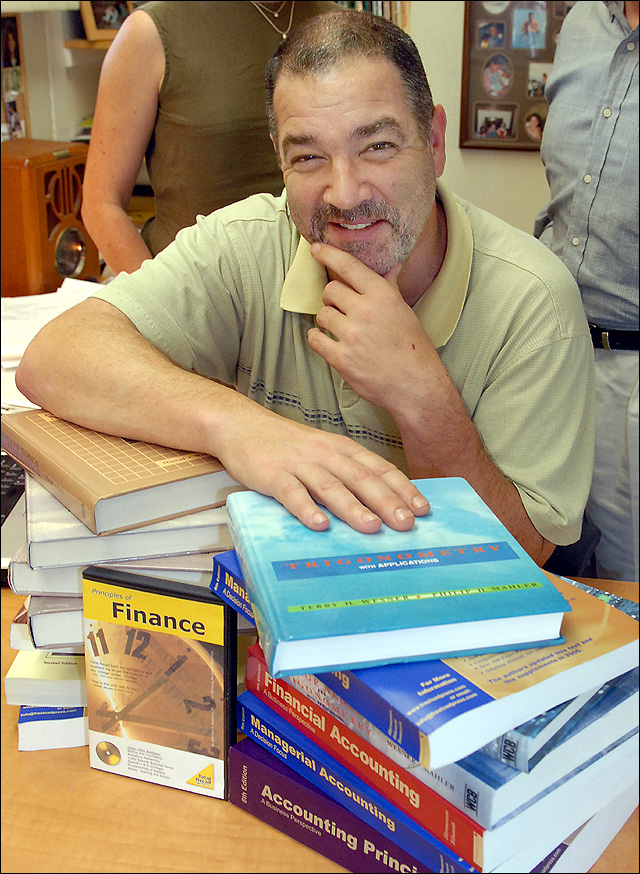
By putting advertising into textbooks, Freeload Press will offer more than 100 titles this fall to students completely free. Freeload Press CEO Tom Doran displays some of the books at his office in St. Paul, Minn.
What Freeload has going for it is its arrival on the scene at a time when textbook publishers are under immense pressure to moderate prices. A recent government study found prices have risen at twice the rate of inflation since 1986.
Publishers answer criticism by saying textbooks are expensive to produce, and note they are clobbered by the rapidly expanding secondary market for re-sales in bookstores and on the Internet.
The industry also is exploring ways to use technology to cut distribution costs and prices. Thomson, for instance, is making “ichapters” of textbooks available, similar to the iTunes model for music
But so far, publishers have resisted selling ads.
A Canadian subsidiary of McGraw-Hill briefly rolled out an ad-based model, but dropped the plan last year. Susan Badger, CEO of Thomson Higher Education, said her company tested the idea with focus groups, in biology, but professors were adamantly opposed.
Tom Doran, Freeload’s CEO, says McGraw-Hill’s experiment failed because it didn’t use the ad revenue to reduce prices enough to get students’ attention. As for faculty, Doran says he realizes not everyone will go for it.