

Review: ‘Da Vinci Code’ follow-ups lack thrill of best-selling mystery
A British judge may have exonerated Dan Brown of plagiarism, but that’s no reason to forgive the author of “The Da Vinci Code” for spawning the currently flourishing genre of theological conspiracy thrillers. As of last week, Steve Berry’s “The Templar Legacy” continued to hold its own at No. 6 on the New York Times best-seller list, Raymond Khoury’s “The Last Templar” had slipped a bit to No. 15, but Javier Sierra’s “The Secret Supper” had already ascended to No. 8.
Sierra’s novel was a mega-hit in Spain last year, as was Matilde Asensi’s “The Last Cato.” Publishers Atria and HarperCollins may have performed a public service by bringing these books to the United States, since both go a long way toward demonstrating that pop fiction in Europe is certainly no better than much that’s concocted here.
To be fair, Sierra’s book isn’t all that bad. Compared with “The Da Vinci Code’s” Dick-and-Jane prose, in fact, Sierra’s is downright Tolstoyan. His plot is better, too.
‘The Secret Supper’
Set in Milan in 1497, “The Secret Supper” is basically a murder mystery. The narrator is Agostino Leyre, a member of an elite corps of Dominicans known as the Order of Bethany, which has been receiving crank letters about goings-on in Milan signed by someone calling himself the Soothsayer. One letter relates the death during childbirth of Beatrice D’Este, duchess of Milan. What makes the letter noteworthy is that it’s dated three days before the duchess actually died. Father Agostino is dispatched to investigate, and all he has to go on is a seven-line riddle served up by the Soothsayer.
Corpses begin to mount – a friar here, a pilgrim there. And it all seems to have something to do with “The Last Supper,” which Leonardo da Vinci is taking an ungodly amount of time painting above a doorway in the refectory of the convent of Santa Maria delle Grazie. His mural apparently has nothing to do with the repast during which Jesus consecrated the first Eucharist and ordained the first priests. Instead, it’s an encoded message about the Cathars, a Gnostic sect thought to have been wiped out a couple of centuries earlier.
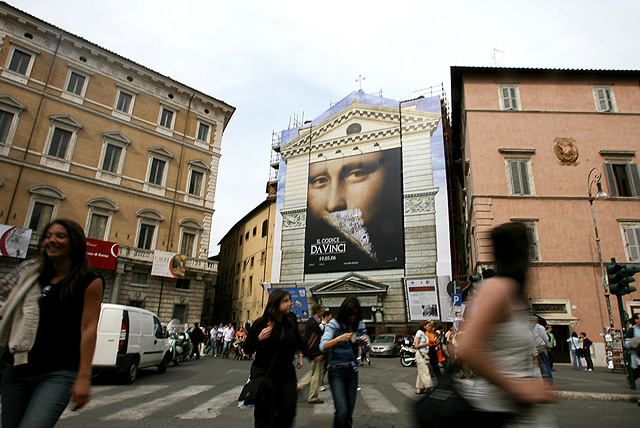
A poster promoting The
Sierra’s novel is more like Umberto Eco’s “The Name of the Rose” than Brown’s Grail quest. But that comparison does it no favors. “The Secret Supper” isn’t just Eco Lite. It’s Eco Nonalcoholic – some of the flavor, none of the kick. A principal problem is the character of Leonardo. As portrayed by Sierra, he seems better suited to a SoHo loft than a Renaissance studio. “Supper’s” an OK mystery, but in today’s highly competitive crime-fiction market, OK is just not good enough.
‘The Last Cato’
Asensi’s “The Last Cato,” set in 2000, aims at something loftier but belly-flops spectacularly. The narrator this time is Ottavia Salina, a 39-year-old nun and paleographer who works in a super-secret section of the Vatican’s “Classified Archives.” Top church authorities, including Vatican secretary of state Angelo Sodano, suddenly arrange for her to be transferred from the work she loves to help with an investigation. An Ethiopian man with strange scarifications all over his body has been killed in a plane crash. Sister Ottavia’s expertise is supposedly needed to determine the meaning of the scars.
Right there we have a problem. A paleographer is a specialist in ancient handwriting. It’s hard to see what expertise she would bring to a case like this – better to call in an anthropologist.
At any rate, Sister Ottavia is partnered with Kaspar Glauser-Roist, a captain of the Swiss Guards who seems to have trained with the SS, and with Professor Farag Boswell, an archaeologist and lapsed Copt. There’s got to be a code, of course, and this time it’s one devised by Dante and embedded in the cantos of his “Purgatorio.”
What’s the point of the investigation? Somebody is stealing relics of the true cross from churches around the world. Dante’s code will lead our intrepid trio to the people responsible for the thefts – the Staurofilikes, Brothers of the Cross, a secret order founded shortly after the cross was discovered by St. Helena in the fourth century. The title of the group’s leader is “the Cato.”
Asensi may hail from Spain, a country ostensibly Catholic, but she seems to have been miraculously protected from any sound knowledge of the church. Cardinal Sodano learns that Ottavia is a nun only when he meets her. (She’s not wearing a habit.) Sorry. The Vatican secretary of state would be fully briefed beforehand.
Offensive material
The book is studded with remarks that just about any Catholic would find offensive. Glauser-Roist is described as “the most dangerous man in the Vatican, the black hand who carries out every single one of the church’s disgraceful acts.” Reference is casually made to “the depraved lives of the cardinals of the Curia.” On the other hand, this is also a book that contains the following sentence: “Next to the patriarch was the Vatican nuncio, Monsignor John Lawrence Lewis, dressed as a clergyman.” How clever of him.
It’s not the faithful who ought to be offended by books like these. The doctrinal and historical claims made in them are too preposterous to warrant serious rebuttal.
No, the people who ought to be offended by these books are those who take art seriously. Turning “The Last Supper” and Dante’s “Commedia” into sudoku puzzles utterly trivializes them. Works of art are complex systems of symbols, not arrays of semaphores. These books are guilty of precisely what everybody is always denouncing fundamentalists for: delimiting meaning to the point of absurdity.
Not that some good hasn’t resulted. After all, thanks to his millions in royalties, Dan Brown is no longer teaching prep school students how to write. God does indeed work in mysterious ways.
Arts and Entertainment

Nominations, call for artists open for Lawrence’s 2026 Phoenix Awards

Go, See, Do: ‘Addams Family’, PRIDE parade and a host of library events among offerings

Lawrence library’s ‘How-To Festival’ allows residents to showcase their talents and expertise

AI helped a musician with Parkinson’s finish his new album when he could no longer play guitar
Go, See, Do: Final Friday Art Walk, City Band concert in the park, markets and more