

Value of AP classes doubted
Studies question use of rigorous courses; teachers defend practice
Laura Gauch and Jordan Noller have been reading heavy doses of Latin each night thanks to their Advanced Placement class at Bishop Seabury Academy.
“I thought you were crazy when you told us (to read) 30 lines a night. I thought there’s no way we can do that,” Gauch, a junior, said to her teacher, Amy Meyers.
But both students have plugged along with a goal of passing the AP test in the subject next month to give a boost to their transcript and perhaps earn some college credit.
Meyers said she had designed the AP section of her course for students wanting the challenge of a college-level class with lots of reading and additional writing.
“That’s what’s always behind my curriculum – to prepare them to know how to be successful students,” Meyers said.
Noller, a senior who plans to attend Knox College in Galesburg, Ill., in the fall, said the challenges she faced in AP courses gave her added confidence.
“They’ve made me feel better about college,” she said.
But three studies recently have offered somewhat conflicting results of AP’s value, including one study that suggested no academic difference among Hispanic college students from Texas whether they took an AP test in high school.
Also, the College Board has asked high school teachers to start completing a course audit on their curriculum, which has some wondering whether the board will exert too much control.
School performance
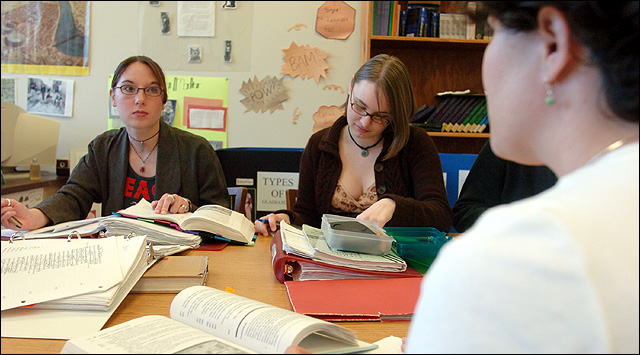
Bishop Seabury academy students Jordan Noller, left, and Laura Gauch listen to their instructor, Amy Meyers, talk about Latin. The girls are part of an Advanced Placement class at Bishop Seabury, 4120 Clinton Parkway.
From 2000 to 2005, between 130 and 140 Lawrence High School students have taken at least one AP exam. During that time, between 70 percent and 85 percent of LHS students scored either a 3 or higher on the exams. Some students took several tests, as many subjects are offered.
According to the Kansas University admissions office, KU typically grants some college credit to students who score a 3, 4 or the highest score of 5 on an AP exam.
At LHS about 165 students will take at least one AP test this year during the first two weeks of May, said counselor Linda Allen, the school’s AP coordinator. The tests cost $82.
“As expensive as college hours have become, that is a potentially a great savings for kids,” Allen said. “Whether they get the college credit or not, the exposure is great. It’s always a good eye-opener.”
LHS history teacher Michael Ortmann said the rigorous courses also boosted students’ confidence.
“There is something about that when you almost build yourself to the point where you say ‘I can tackle almost anything,'” he said. Ortmann is also the Midwest representative to the College Board’s National Academic Assembly.
At Free State, about 150 students will take at least one AP test, counselor Joel Frederick said. Although statistics on student scores were unavailable, Kelly Barker, a government and politics teacher, said the school’s students also generally had done well.
Forty-nine students are enrolled in the eight AP courses offered at Bishop Seabury. Some students may be enrolled in more than one course.
Specific scores also were unavailable, but the school has had numerous AP Scholars who have scored well on the tests, said Steve Kellogg, the academy’s AP coordinator.
High-end value
Related Content
Ortmann dismissed recent studies that questioned the value of AP courses, instead emphasizing their college preparation mission.
“I think the best way to do a study is to ask students who have done it. From my own experience, by being in AP, that has made the transition to college (for students) much more comfortable,” he said.
Ortmann and Barker, the Free State teacher, also stressed the importance of rigorous AP courses in the age of the No Child Left Behind requirements.
“We’re very well suited to focus attention on low-achieving students, but we also have to raise the kids at the very top, and that’s the only way we are going to keep the Adequate Yearly Progress happening,” Barker said.
Both agreed that the audit is more about helping colleges and universities determine how to value AP credits on transcripts if a student took the course but declined to take the test.
“The College Board’s desire for uniformity is valid,” LHS English teacher Michael Carriger said. “But LHS has long sought to align what we do with what the College Board values. Our performance on the AP exams has proven that.”
Barker said the same about Free State.
Bishop Seabury’s faculty during the summer will evaluate how many AP courses the academy should offer because the school has about 135 students. AP still will be part of the curriculum, Kellogg said. But the academy’s students also have done well, so he is generally less worried about the audit.
Back in the AP Latin course, Gauch said she tends to take AP courses because of their difficulty and ability to keep her interested.
That appears to be what her teacher is after.
“I feel as though I’m sending them prepared,” Meyers said.