

Capitol patina returns unevenly but eventually
Topeka ? In some places, the Statehouse’s copper dome is a pleasing green and in others a not-so-pleasing dark brown to black, but a chemical treatment applied five years ago is working, Statehouse architect Barry Greis said.
“Nature has its own schedule,” Greis said.
The copper dome was cleaned five years ago as part of a larger, nine-year, $135 million project to restore the Statehouse from top to bottom, inside and out. But the cleaning wiped away the patina – the thin layer of brown or green corrosion appearing on copper because of oxidation – that people were accustomed to.
The patina would have formed naturally, but applying a sulfur compound helped accelerate the process. First it turned the metal black, then green.
Greis said the color sought for all the dome can be seen just below the railing near the top.
“The sun, temperature and humidity affect the rate that it changes,” Greis said Monday.
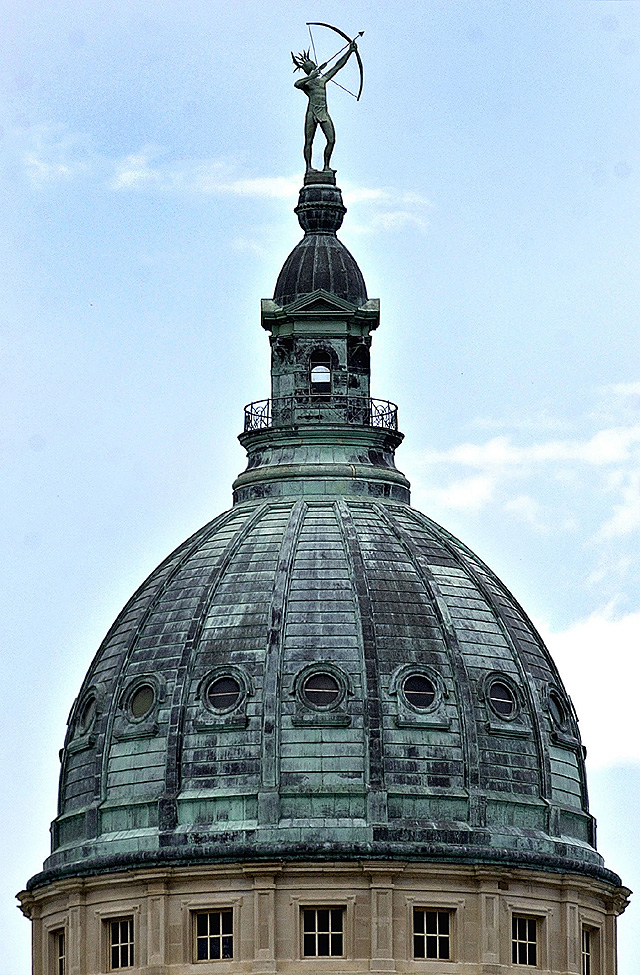
The cleaning and restoring of the copper patina on the Kansas Statehouse dome in 2000 was part of the larger 20 million Capitol restoration project in Topeka that is ongoing. Sunlight, temperature and humidity affect how the green patina returns.
When the dome was completed in 1903, there was a lot more coal and sulfur in the air from the coal burned for heat, which helped the patina to come out on the dome, Greis said.
He said nobody in 2000 could give state officials an estimated time for turning the copper to an all-green dome.
About four or five years from now, the Statehouse architect’s office will inspect the dome to determine the status of its color.
Greis said a subcontractor with expertise in restoration of copper might be hired to examine the dome. The lantern and cupola above the railing will be looked at, too, he said.
The Statehouse was piecemeal construction. The oldest part of the five-story building is the east wing, started in 1865 and completed in 1873. The Statehouse was finished in 1903.
State Government

Property tax protest bill would let a few dozen voters block tax increases in some parts of Douglas County

Lawmakers pass bill to create sports authority to oversee new Chiefs stadium in Kansas
Kansas Legislature passes a bill that would give 10% of voters the power to stop some property tax increases
Kansas Senate, House pass budget bill that pegs raises at 1% for most state employees
U.S. Supreme Court Justice Sonia Sotomayor to visit KU next month; will speak to students, select guests
