

Gamboa moving on in Arkansas
Coach's life less hectic as mania after attack fades
LITTLE ROCK, ARK. ? The questions are fewer now, the notoriety gone. Tom Gamboa is back on the baseball field, not in the majors, but managing in the minor leagues and finding peace and success away from the spotlight.
“Time has a way of healing all that,” he said.
Gamboa now manages the Los Angeles Angels’ Double-A affiliate, and his Arkansas Travelers have reached the Texas League championship series in his first season.
His life, once so hectic, has returned to normal.
In fact, when Arkansas outfielder David Gates found out Gamboa had been hired, a friend needed to remind him of the name.
“He was like, ‘You remember on TV a few years ago?”‘ Gates said. “I was like, ‘Oh, OK.”‘
Gamboa had been in baseball for almost 30 years, and was receiving little national attention as the first-base coach for the Kansas City Royals – until late in the 2002 season. That’s when William Ligue Jr. and his teenage son jumped over the railing at U.S. Cellular Field, home of the Chicago White Sox.
The ensuing scene was shown on television for days: Gamboa being thrown to the ground, kicked and punched, and players racing from the dugout to help.
“The unfortunate thing for me was just doing my job – in the right place but at the wrong time – I became a distraction for the own organization that I was working for, through no fault of my own,” Gamboa said.
Gamboa was Kansas City’s bullpen coach in 2003, then was fired after the season.
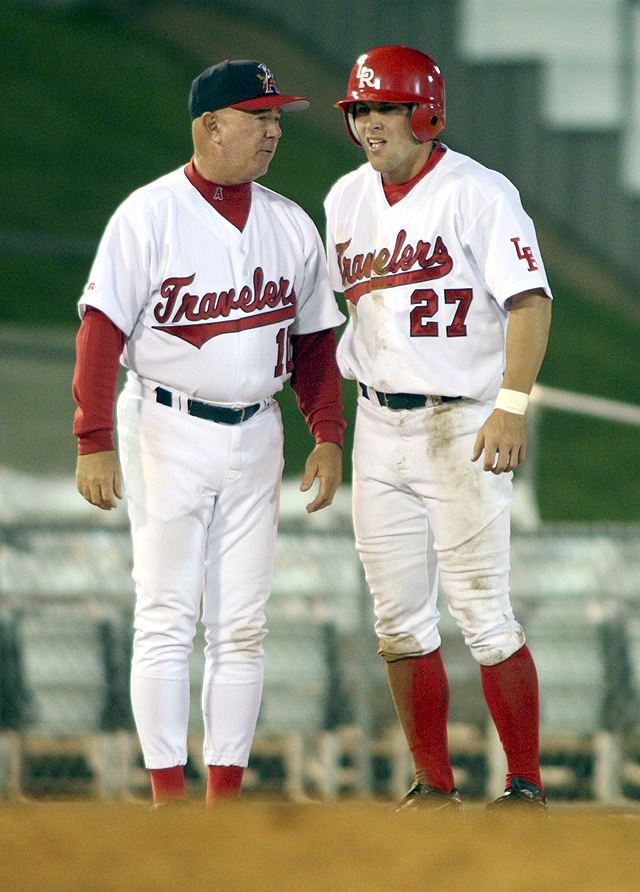
Arkansas Travelers manager Tom Gamboa, left, talks with player Reggie Willits during a game April 7 in Little Rock, Ark. Almost three years have passed since Gamboa was attacked by two fans in Chicago while coaching first base for the Kansas City Royals, and now his life is returning to normal.
He spent 2004 building his house on a California golf course, then managed in the Mexican winter league.
“Going down to Mexico made me realize how much I missed being on the field,” the 57-year-old Gamboa said.
Shortly before spring training, when the Angels needed a manager for the Travelers, Gamboa happily accepted the offer. Then he moved to Arkansas, one of few places in the United States he was unfamiliar with.
“Through baseball, I had been to eight countries and I had been to 47 states,” Gamboa said. “And only the Dakotas and Arkansas had I not been to. So, this checked another one off the list.”
At a level where so many players are worried about personal development, Gamboa had his own philosophy.
“Especially at the beginning of the year, he stressed it a lot – being team-oriented,” Gates said. “Playing for your team and not worrying about your own stuff. At the beginning of the year, that’s kind of more crucial, because you’re trying to start off on the right foot.”
Arkansas responded, going 9-1 to begin the season. The Travelers couldn’t continue that pace, and Tulsa won the first-half title in the East Division, but the tone was set.
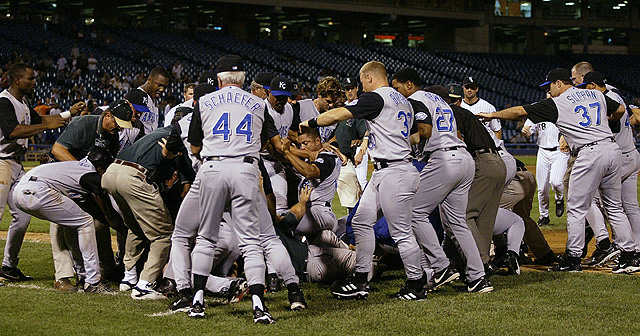
Kansas City Royals players and coaches move to aid first-base coach Tom Gamboa after two bare-chested fans ran onto the field and attacked him Sept. 19, 2002, at U.S. Cellular Field in Chicago. Three years after the attack, Gamboa is manager of the Double-A Arkansas Travelers.
Led by pitcher Jered Weaver and infielder Kendry Morales, two of the Angels’ top prospects, the Travelers won the second half, then beat Tulsa three straight games to advance to the championship series, where they’re now playing the Midland RockHounds.
“The second half, it just all came together,” Gamboa said. “The guys have really, really played well, and played great together as a team.”
Gamboa’s hearing is impaired because of the attack. His right ear feels plugged, like he just got off a plane, and that took some getting used to.
“The first six months, I was always tugging on it,” he said.
In 2003, Gamboa filed suit against Ligue, as well as the security firm and concessionaire at the ballpark at the time of the attack. The lawsuit still is pending.
Besides that, Gamboa has moved on, and others are finally doing the same. When he first arrived in each new Texas League town, the usual questions awaited. Now, they are asked less and less.
Gamboa said he would return to the majors “in a heartbeat” if given an opportunity, but he’s had fun working with the Travelers.
“The minor leagues, I’ve always enjoyed, because you’ve got tremendous enthusiasm from players that know that their careers are in front of them,” Gamboa said. “They’re climbing that staircase to get to the big leagues.”
Two years ago, Gamboa left the major leagues involuntarily. Now he’s back in baseball, and has led his team to the brink of a championship.
And that, not his past, is what people are paying attention to.
“Now, the focus is all on the players in that room,” Gamboa said. “Which is where it’s supposed to be in the first place.”