Review: ‘Divine Wind’ guides readers with science, art
Thus skill and science both must fall; And ruin is the lot of all,” Phillip Freneau wrote in his poem “The Hurricane.”
The 19th-century writer could just as well have been describing this year’s battered U.S. Gulf Coast as the ship he told of being lost at sea.
The works by Freneau and other poets, writers and artists woven among chapters on the science and history of hurricanes turn Kerry A. Emanuel’s book “Divine Wind: The History and Science of Hurricanes” (Oxford University Press, $45) into a fascinating tour of these tragic tempests.
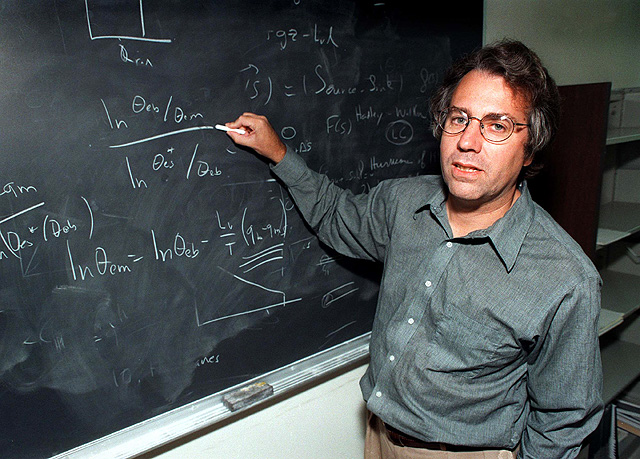
Emanuel, who teaches at the Massachusetts Institute of Technology, is one of the most respected authorities on these storms and brings that expertise to the discussions of science.
But he doesn’t let that knowledge obscure the message with jargon.
“Imagine a Roman coliseum 20 miles wide and 10 miles high, with a cascade of ice crystals falling along the coliseum’s blinding white walls,” he writes to describe the eye of a storm.
Detailed illustrations help readers easily understand the flow of air into the base of a storm, upward and out at the top.
Kerry A. Emanuel's Divine
For the title, “Divine Wind,” Emanuel reaches back to Mongol efforts to invade Japan in the 13th century, when typhoons wrecked the attacking fleets. These storms became known in Japan as “kamikaze” – “divine wind.”
Reflecting modern methods, satellite photos of recent hurricanes dot the volume’s pages.
But the author has widened the reach, adding such images as “The Coming Storm” and “Hurricane, Bahamas,” watercolors by American artist Winslow Homer; “Ships in Distress off a Rocky Coast,” an oil painting by Dutch artist Ludolf Backhuysen; “Inundacion en Guatemala,” an oil painting by Guatemalan artist Diego Isian Hernandez Mendez; and “Sudden Rain Shower on Ohashi Bridge,” a woodcut by Japanese artist Ando Hiroshige.
Don’t let the abundance of art, poetry and prose mislead – this is a serious volume, too, ranging even to calculus for those willing to tackle a solid discussion of storm forecasting.
The work can be understood without differential equations, but they are there for those who are interested, making this a well-balanced book for anyone with a desire to learn about hurricanes.
Emanuel is ready and able to balance the complex with the cool, including a John Fogerty lyric from “Change in the Weather”:
“Wind is ragin’ there’s a fire in the sky
“Ground shakin’ everything comin’ loose
“Run like a coward but it ain’t no use …
“There ain’t no survivin’, there ain’t no escape.”
Arts and Entertainment
Events: Ballet, cinema, walking tours and lots of Easter egg hunts

Theatre Lawrence’s upcoming season to feature ‘On Golden Pond,’ ‘Pirates!’ and more

Watkins Museum to host traveling exhibition featuring photographs, narratives of the Underground Railroad
Local vendors can apply now for KU’s new monthly on-campus market, Jayhawk Fridays

UPCOMING EVENTS: Easter egg hunts, fee-waived pet adoptions and more