

‘Living Scene’ turns 50
Valley Falls UMC to mark anniversary of artistic portrayal
Valley Falls ? Many churches have a tradition of presenting a “living Nativity” — a re-enactment of the birth of Jesus — in the days before Christmas.
But Valley Falls United Methodist Church, a 148-year-old congregation about 40 miles northwest of Lawrence in rural Jefferson County, has an unusual Easter tradition.
Each year during a Maundy Thursday worship service, 13 of the church’s men portray Jesus and the 12 disciples, just as they’re depicted in Leonardo da Vinci’s iconic painting, “The Last Supper.”
The painting, often viewed as a symbol of Western art, depicts the instant Jesus announces to the apostles that one of them will betray him.
The men who play roles in the 20-minute production — among them two bankers, a retired grocery store owner, a retired pharmacist, an accountant, a farmer, a seed dealer and an emergency dispatcher — don makeshift robes, fake beards and other theatrical garb and bring da Vinci’s “The Last Supper” to life.
When they mount the small stage at the front of the sanctuary Thursday evening in their biblical costumes, it’ll be the 50th straight year the church has presented its pre-Easter tableau, dubbed “The Living Scene.”
“Truly, something would really be missing if we didn’t do this. I can’t imagine not having it,” says Jacque Biester, one of four women organizing this year’s re-enactment.
“Everybody’s touched each time we do it. You can feel it. Some may have tears in their eyes,” says Tamie Ferrell, another organizer. “Easter wouldn’t be Easter without it.”
What’s striking about the 250-member church’s holiday tradition is that those who take on the roles of Jesus and his disciples typically return to participate again and again — for 10, 15, 20 years or more.
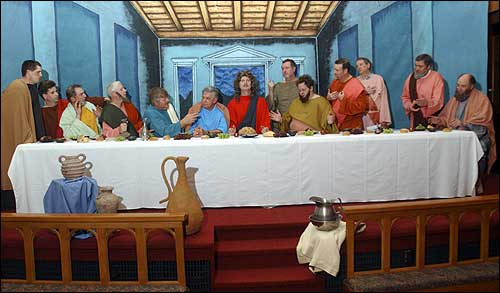
Valley Falls United Methodist Church parishioners recreate Jesus' Last Supper with his disciples as depicted in Leonardo da Vinci's painting.
Usually until they either age out of it or move away.
Like Frank Shrimplin, 77, who played a disciple in “The Living Scene” from 1964 to 1996. He stopped playing the apostle Philip because posing for minutes on end started to hurt his back and knees.
But Shrimplin’s still a booster of the event.
“I’ve seen it, and I’ve been in it. And it helps you spiritually,” the retired pharmacist says of the annual presentation.
“It’s as if you’re back there and can feel the camaraderie of Jesus and his disciples.”
Striking a pose
| Valley Falls United Methodist Church will present the 50th anniversary of “The Living Scene” — a live portrayal of Leonardo da Vinci’s painting “The Last Supper” (above) — during a7:30 p.m. Maundy Thursday worship service.The service and a spaghetti dinner from 5 p.m. to 7 p.m. are open to the public. A freewill offering will be taken at the dinner, which is also open to the public.To learn more about “The Living Scene” or to get directions to the church, call the church office at (785) 945-3344. |
Since its introduction in 1955, “The Living Scene” has developed and changed over the decades.
The presentation was created by the Rev. Henry Milliken and given guidance and direction by the Juanita Barnes, a church member who died in recent years.
The re-enactment commemorates the night of Jesus’ commandment for his disciples to love one another and when the Lord’s Supper was instituted.
For years, “The Living Scene” was simply a static recreation of da Vinci’s famous painting. The men would pose themselves just as Jesus and the disciples are shown in “The Last Supper.”
And they would hold their poses, without speaking or moving, for 20 to 25 minutes.
A difficult task for anyone, let alone the older participants.
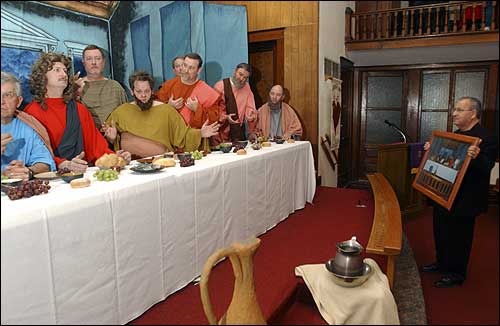
United Methodist Church parishioners recreate Jesus' Last Supper with his disciples as depicted in Leonardo da Vinci's painting with help from pastor L. Dean Thompson, right.
“When we had someone almost pass out, we knew we needed to change (the format),” Ferrell says.
So more movement, and some speaking roles, have gradually been added to the re-enactment, making it easier and more natural for the men on stage.
This year, participants in “The Living Scene” will have more to do than ever.
They will read lines of dialogue from “The Message — The New Testament in Contemporary Language” a 1993 translation by Eugene H. Peterson.
The men portraying Jesus and the disciples will enter from the rear of the sanctuary and proceed to the small stage, where Jesus will wash the feet of the other men.
Then they will all sit down at a long table, laden with plates of grapes and pieces of bread, where they’ll say their lines and then strike the familiar pose from “The Last Supper.”
“We’ve changed it a little bit every year, just to make it a little more interesting,” says the Rev. L. Dean Thompson, the church’s pastor.
Tight-knit bunch
Once men are recruited to play a role in “The Living Scene,” they usually stick with it.
“This will be my 23rd year,” says Chris Biester, 42, a farmer who always portrays Jesus.
Some of the men wear fake beards, while others grow real beards just for their annual roles in the re-enactment.
Biester, who has a mustache, wears a long, itchy wig that resembles the hair style of a heavy-metal rock singer.
Rick Ferrell, 46, has portrayed the disciple Peter 22 times.
“We all know each other. We all go to church together,” Ferrell says of the tight-knit bunch who participate in “The Living Scene.”
He is married to Tamie Ferrell, one of the event’s organizers. Tamie is the daughter of Frank Shrimplin, who played the disciple Philip for years.
Richard Ferrell, 19, the son of Rick and Tamie, stood in for his dad one year as Philip. He was 17 at the time, the youngest person ever to participate in the re-enactment.
“I was a little nervous, because I’d only sat in the pews before,” says Richard, who works as a welder in Holton.
“But I didn’t screw up anything. I just had to sit and point.”