Stair masters: Health-and-fitness craze reaching new heights
Chicago ? Taking a deep breath to quell the butterflies, Jon Blackburn warmed up before his race up the tallest skyscraper in the country. He lightly stretched his hamstrings. He jiggled his quads. And when he reached the starting doorway, Blackburn gazed up the stairwell and thought, “I can do this.”
It was November 2003, but just a year earlier walking up the 2,109 steps to the top of the Sears Tower in Chicago might have killed Blackburn. The Indianapolis engineer weighed 340 pounds and suffered from sleep apnea, high blood pressure and low back pain. He lost his breath carrying in the groceries.
But then Blackburn stumbled onto the obscure urban sport of stair climbing, which has been embraced by runners who love its cross-training benefits and weekend warriors looking for a winter diversion.
The unique activity is now attracting crowds: Blackburn is one of 3,700 people from 19 states and three countries who entered the recent OfficeMax Hustle Up the Hancock. In its eighth year, the grueling hike up 1,632 steps to the 94th floor of Chicago’s John Hancock Center is so popular that it sold out in 36 hours and has a waiting list of 700. Beginners might want to start with the Hustle’s half-climb of 42 floors; that race is run on another stairwell.
The Hustle was expected to raise $700,000 for the American Lung Assn. Its success is just one reason why Chicago, a city with a worldwide reputation for architecture and skyscrapers, has become a prime destination for stair steppers.
Besides the Hancock, Chicago-area events also are at the Sears Tower; the Aon Center, the third-tallest building in the country; and the Oakbrook Terrace Tower, the tallest building in Illinois outside of Chicago.
Other cities around the world, from Dubai to Des Moines, have joined the vertical marathon movement, with some even offering prize money. The unofficial world championship is an 800-meter uphill sprint outdoors followed by a 2,058-step race up the Menara Tower in Kuala Lumpur. The Great Wall Marathon in China, meanwhile, held in May, has more than 3,700 steps for runners to conquer.
Avoiding death
Though lofty goals, they’re no longer out of the question for Blackburn, who says stair climbing not only gave him a new perspective, but also saved his life. And now, like many enthusiastic skyscraper racers, he can’t look at a building without envisioning its stairs.
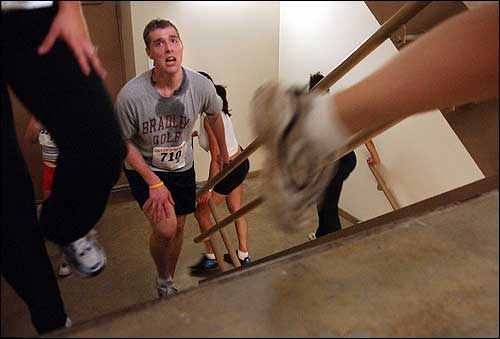
Brent Krambeck strains during the 1,643-step race up the Aon Center in Chicago.
“Stair climbing and changing your body are both about finding a pace you can sustain,” said Blackburn, 45, who trimmed down to 200 pounds.
The beauty of stair climbing, he and other climbers say, is that it’s a fast, intense cardiovascular workout that tones the quads and glutes like nobody’s business. It requires nothing but shoes and a flight of stairs.
Age also is a nonfactor. The Hancock has an impressive list of septuagenarians who plan to scale the building, including 71-year-old Cathi Watson, of Hoffman Estates, Ill., who calls herself an “exercise evangelist.”
| Here are some popular Midwest stair-climbing races:¢ Bop To The TopWhen: Jan. 29.Where: American United Life Building (37 floors, 806 steps), Indianapolis.Benefits: Riley Hospital for Children, Indianapolis2005 winners: Male, 3:55.02; female, 4:34.8; last finisher, 25:01.1.Contact: www.tuxbro.com¢ Kohl’s Step Up For KidsWhen: Jan. 30.Where: Aon Center (81 floors, 1,643 steps), Chicago.Benefits: Children’s Memorial Hospital.2005 winners: Male: 9:49; female, 12:06; last finisher, 1:11:13.Contact: www.childrensmemorial.org/stepup.¢ Tackle The Tower Stair Climb ChallengeWhen: Feb. 13.Where: Oakbrook Terrace Tower (31 floors, 680 steps).Benefits: The American Lung Assn.2005 winners: Male: 3:29; female, 4:40; last finisher, 14:02.Contact: www.lungil.org.¢ Officemax Hustle Up the HancockWhen: March 6.Where: John Hancock Center (94 floors; 1,632 steps).Benefits: American Lung Assn.2004 winners: Male, 9:49; female, 11:10; last finisher, 1:17:45.Of note: World’s fastest elevator takes 39 seconds to reach the top.Contact: www.lungchicago.org/get/hustle.asp.¢ Climbing For a CureWhen: Nov. 17.Where: US Bank Building (900 steps, 45 floors), Milwaukee.Benefits: Cystic fibrosis research.2004 winners: Male, 6:07; female, 7:22; last finisher, 18:28.Contact: www.cff.org/Chapters/wisconsin. |
“I power climb. The rush and thrill of finishing is awesome,” said Watson, who lost several family members to lung disease and has been the event’s top fund-raiser.
When the climbing begins
In most races, the athletes wear timing chips and wait their turn in a single-file line. Starts are staggered between 5 and 30 seconds apart, much like a time trial in cycling. At designated floors, volunteers, poking their heads out of doorways, cheer and hand out water.
The 71-year-old Watson, who runs 5- and 10-kilometer races, plans to beat her time of 33 minutes, 10 seconds. Elite athletes can scoot up the 94 floors of the Hancock in less than 10 minutes. Six-time defending women’s champ Cindy Harris, 36, of Indianapolis, one of the best female racers in the world, bounded up the steps in 11:15 last year.
This sort of pace, however, is not for the faint of heart. It can result in a dry cough, commonly known as the climber’s hack. It also causes a burning chest and shaky legs.
“My lungs literally hurt. I thought, “Wow. This is an event.'” said Kathy Froehlich, the fastest woman up the Aon Center this year. The 42-year-old Northbrook, Ill., resident coughed for two days after the race last month, thinking she had a cold.
The average racer will take it a bit easier and finish in about 25 minutes, said Randy Stancik, who helped launch the event and is the general manager of the John Hancock Observatory.
During the race, some participants walk briskly, one step at a time, without stopping. Handrails can be used for upward propulsion. Others, fueled by excitement and adrenaline, start off running–a colossal mistake–and are doubled over in agony by the 60th floor.
For everyone, moving the body vertically, rather than horizontally, can be a strenuous workout that conditions the heart and lungs but is less stressful on the joints than running. Stair climbing raises the heart rate faster than any other cardiovascular activity, said Sergio Rojas, head personal trainer for Lakeshore Athletic Club Illinois Center who ran five training classes for the Hancock race.
Health
Nonprofit plans a full slate of events for Sexual Assault Awareness Month, including trivia, art auction, vigil for survivors

Public invited to free event focusing on birth outcomes in Douglas County

IT’S NOT JUST VACCINES: Parents are refusing other routine preventive care for newborns

Ion robotic bronchoscopy transforms lung cancer detection

Just how important is a water filter?