Discouraged farmers predict below-average wheat harvest
Mother Nature dims crop prospects
Leonard Heffner’s hands are thick and so sullied that he declines a handshake. In denim coveralls, he bustles around one of his barns, not ceasing his work as he talks about the struggles of farming.
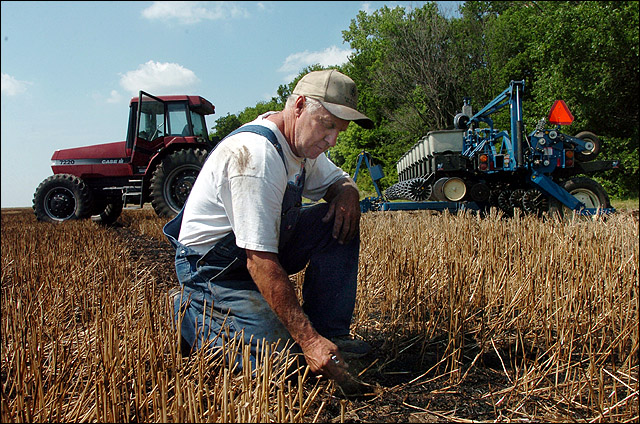
Leonard Heffner looks over the ground where he was planting soy beans Tuesday afternoon, just west of Worden.
“This country needs to go hungry one time,” he said, pointing a finger for emphasis. Then, maybe “they’d appreciate where the food came from.”
It’s wheat harvest time, and the outlook doesn’t look good, said Heffner, a Baldwin-area farmer. The fields of honey-colored wheat glowing in the sun are visible through a barn door on his property. A late frost and untimely rains have Heffner and others predicting lackluster returns.
“We were so close to having a great yield,” Jim Shroyer, a K-State Extension wheat specialist, said of the statewide outlook. “Our yields are going to be below average this year. Definitely it’s going to sting because we had so much potential.”
Such is farming. Growers depend on the weather. And the weather doesn’t always behave. Then there are wheat prices that don’t keep pace with the rising costs of land, equipment and other necessities, Heffner said. And farming can be physically demanding. These are just a few reasons why there are fewer people like Heffner these days.
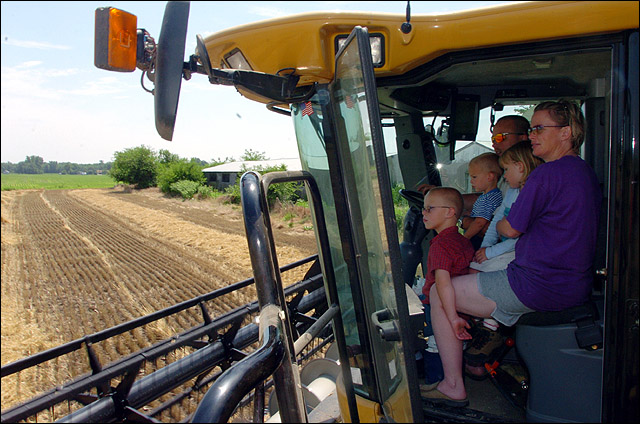
With the family aboard, Brian Pine, 36, and his children Carson 2, Hayden 6, and Jordan, 4, along with their mother, Kathy, 37, take a spin on the combine in northeast Lawrence. Brian Pine was cutting some of the family's 200-plus acres of wheat Tuesday.
Heffner is a third-generation farmer. He said he didn’t expect his children to follow in his footsteps. His son wears slacks – not coveralls – to his job.
“He’s not going to have to work as hard,” Heffner said.
It’s still early in the wheat harvest. But several farmers and extension agents are predicting below average yields. A rainy fall prevented some farmers from planting more wheat. A late frost didn’t help. And May rains, and high humidity increased the instances of fungal diseases, said Bill Wood, a Douglas County extension agent.
From 1999 to 2003, the average wheat yield in Douglas County was 44.2 bushels per acre. In 2003, yields peaked to 64 bushels per acre. The number fell to 46 bushels in 2004. But this year, in Douglas County and the rest of northeast Kansas yields will likely be in the low 40s, Wood said.
Shroyer said statewide yields this year were expected to be a bit disappointing.
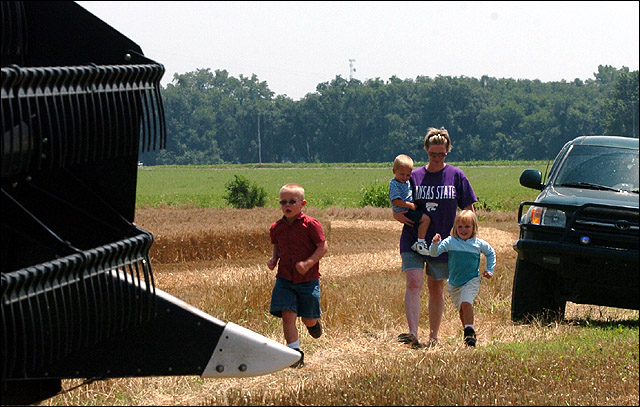
Members of Brian Pine's family run toward his combine for a ride Tuesday afternoon.
Wheat is more prevalent in western Kansas where it is drier. In the late-1990s, Douglas County farmers gradually cut back on wheat. In 1996, 17,000 acres were planted, but that number had declined to 5,800 acres by 2002, Wood said. Dry conditions then boosted plantings in recent years. The figure rose to 12,000 acres in 2004, Wood said.
Brian Pine of Pine Family Farms stood in a wheat field north of Lawrence on Tuesday. Cutting on the farm started Monday night.
“We’re just getting warmed up,” Pine said. “I think we’re going to be at best average, if not below average.”
There are inconsistencies in the fields. In some spots, the wheat is ripe for harvest. In others, it’s not.
“The weather has really thrown things off,” he said. “It’s certainly not going to be a bumper crop like last year. That’s just the way it is.”
Pine is a partner in the farm that has operated for six generations. He has three children. They could grow up to be farmers.
But “I’m not going to encourage it,” Pine said. “There’s a lot easier ways to make a living.”
City Government

Rising Rates: A three-part investigative series examines why Lawrence water and sewer bills have been soaring
Some leaders are now stating a new reason for why Lawrence’s utility rates are soaring: The city didn’t grow enough

Lawrence City Commission could start the process of finding a construction manager for new fire station

Lawrence is charging water, sewer customers a special tax not required by state or city law

Lawrence housing market strains residents as development fails to keep up, city’s affordable housing study finds