

Bolivia’s Supreme Court chief named president amid unrest
La Paz, Bolivia ? Bolivia’s Supreme Court chief, Eduardo Rodriguez, became president of the beleaguered country late Thursday after Congress accepted outgoing President Carlos Mesa’s resignation and the first two officials in the line of succession stepped aside.
Rodriguez, originally third in line to be president, rose to the top post after Senate President Hormando Vaca Diez declined to accept the job, and House Speaker Mario Cossio also agreed to step aside.
The development could defuse the political crisis that had caused Mesa to warn that the country could plunge into civil war.
Vaca Diez, first in line to succeed Mesa, spent Thursday trying to line up the votes at a special congressional session in the city of Sucre to succeed Mesa but decided in the evening that he faced too much public opposition to succeed Mesa.
When the House speaker also stepped aside, that cleared the way for Rodriguez, the Supreme Court president and a respected constitutional lawyer.
“The marchers will take a break to give the new president time to show what he can do,” said Santos Ramirez, a congressman and leader of the opposition Movement Toward Socialism party.
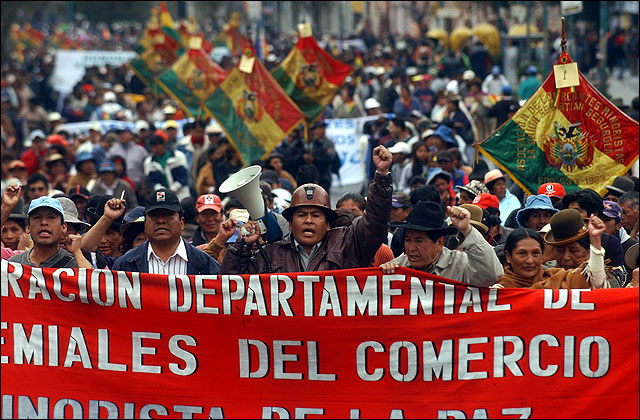
Thousands of demonstrators march during a rally in La Paz, Bolivia. Bolivia's high court chief was sworn in as Bolivia's president late Thursday, after lawmakers gathered in an emergency session following a day of violent protests and under a warning by the military of possible intervention.
Rodriguez will be a caretaker president who serves long enough to oversee new elections for president and perhaps Congress before the end of the year. The current calendar calls for elections in 2007.
The late-night developments came on a day when Bolivia’s military called for calm and groups of miners, farmers and indigenous advocates trying to block Congress from meeting battled police in full riot gear in Sucre, about 450 miles southeast of La Paz. The weekslong uprising claimed its first death Thursday.
Vaca Diez had faced strong opposition from the broad array of antiglobalization groups that have paralyzed La Paz as well as commerce among the country’s major cities with marches and highway blockades.
Before Thursday night’s developments, the protests were expected to gain strength from the death of a miner, Carlos Coro, 52, in a clash with soldiers while protesting the congressional session in Sucre. Internal Security Minister Saul Lara said the soldiers opened fire after the miners threw lit sticks of dynamite at them.
Coro’s death was the first after weeks of protests, a notable change from the last outbreak of street violence in Bolivia, when soldiers and police killed 56 demonstrators in 2003.