

Tonganoxie sites nominated by state for national register
Artifacts found on farms date back 1,000 years
Parcels of land near Tonganoxie that might have been home to prehistoric societies have been nominated for the National Register of Historic Places.
“These two sites are in a locality where there are a number of other prehistoric sites,” Kansas State Historic Preservation Office archeologist Will Banks said. “It’s just kind of interesting to see and try to understand how these groups were related to one another, if at all. That’s one of the big research questions out there and these sites are adding to the discussion.”
The locations – known as Caenen and Paul – are near Stranger Creek and Little Stranger Creek, but the exact locations of the sites have not been publicly disclosed for fear they would be disturbed. They are among 11 Kansas properties the Kansas Historic Sites Board of Review approved to be nominated for the National Register of Historic Places.
The sites are of historical significance because they provide information on a time period in Kansas history of which little is known, Banks said.
Tenant farmers of the land, which is owned by John and David Evans of Lebo, helped locate the sites, said Brad Logan, a research associate professor in the department of sociology, anthropology and social work at Kansas State University.
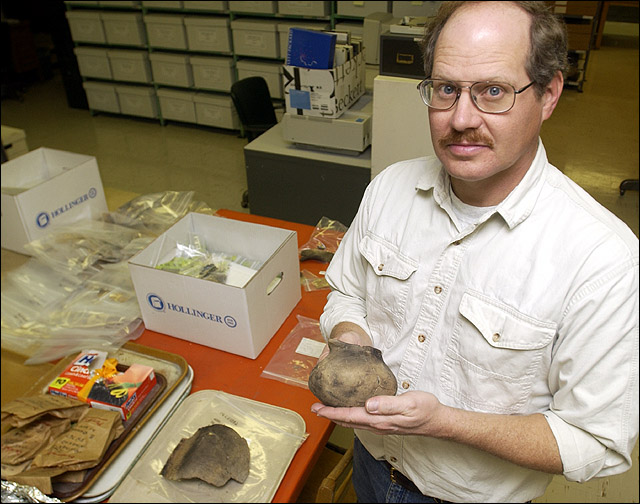
Brad Logan, research associate professor in the department of sociology, anthropology and social work at Kansas State University, shows a partially complete piece of pottery found during a major anthropological dig near Tonganoxie in this 2001 file photo. The site was the remains of a structure, home to American Indians sometime between 1000 A.D. and 1400 A.D.
Logan has been researching the land off and on since he was working on a doctoral project in 1982 and 1983 at Kansas University.
He was lured back to the area in 2001 when a storm flooded the area, exposing pottery and arrowheads. He also discovered a portion of what was once a house. The area was named the Scott Site and is near the Paul and Caenen sites.
But different people lived on the different sites and there’s about a 140-year gap between them.
“They had different housing and pottery,” he said. “But the sites are less than 300 meters apart. We have evidence of two entirely different people.”

Artifacts found at a farm site near Tonganoxie, shown in this 2001 file photo, include shaped points such as the small arrow point at left and the larger point, which is perhaps 1,000 years older than the items on the site. Logan suggests that the Indians who occupied the site found the older point and used it as a knife, as it had been resharpened.
Logan said he planned to continue research in the area. He has a grant and hopes to get a field school on site next summer.
“I expect there are more sites out there,” Logan said.
The Paul and Caenen sites are expected to be put on the National Register in three to four months.