Students oriented to Asian culture
Free State, Lawrence high schools respond to growing influence of Eastern countries
The Lawrence High School students heard about the Red Eyebrows and the Yellow Turbans. They discussed the silk routes, oppression of women and peasant revolts from thousands of years ago in China.
It was a scene still fairly uncommon in most American high schools.
But responding to China’s booming economy and its implications for the United States, more American high schools are offering classes on Chinese and Japanese culture, history and government.
Partly because of China’s growth, Lawrence and Free State high schools this semester are offering an East Asian studies class for the first time.
China’s economy grew at its fastest pace in eight years in 2004. And the world in 15 years is likely to be one in which Asia is the main engine of the global economy, with India and China as major powers, a new U.S. intelligence report said earlier this month.
The United States will wield less authority than now because of the greater influence of India, China and possibly other nations, the report predicted.
It’s unclear how many high schools nationwide offer East Asian studies, but the number is increasing, said Randi Hacker, outreach coordinator at Kansas University’s Center for East Asian Studies.
As China becomes more powerful economically, more U.S. high schools are trying to give their students “a leg up on the future,” Hacker said.
“The people who understand Chinese and speak Chinese are going to have (a) much rosier employment future,” she said.
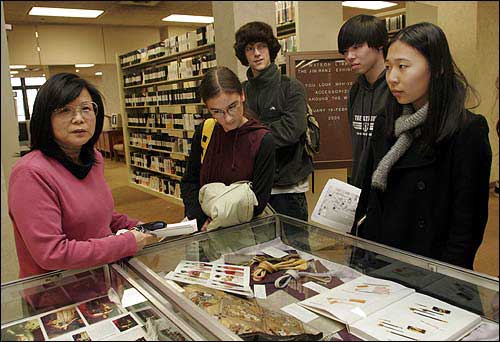
Vickie Fu Doll, left, Chinese studies librarian at Kansas University, gives a walking tour of Watson Library to Free State High School students, from left, Myriam Bloom, Adam Lauridsen, Michael Peng and Yuan Liu. More American high schools are responding to booming Asian economies by offering classes on Chinese and Japanese culture, history and government. The FSHS students, who are taking an East Asian studies class at their school, toured the library, where they'll be conducting research, on Thursday.
School districts across Kansas are responding to these trends.
Teachers in Garden City, Medicine Lodge and Topeka are campaigning to have an East Asian studies course offered at their high schools, Hacker said.
The Shawnee Mission and Olathe school districts offer courses in Eastern civilization, Chinese language and Japanese language, Hacker said. And the Blue Valley School District offers a course on East Asian studies.
“We do have to kind of look to our neighbors and find out what they’re doing,” said Debra Denson, who teaches the East Asian studies class at Free State. “Knowing that those other school districts are doing it makes it all the more real.”
LHS and Free State each offer one East Asian studies class. About 20 students are enrolled at LHS and 10 at Free State.
They are learning the histories of China and Japan from about 3000 B.C. to the present.
The classes started this semester after nearly two years of planning by Denson and LHS teacher Mike Ortmann, and a review by district administrators and teachers. School board members must also approve any new classes.
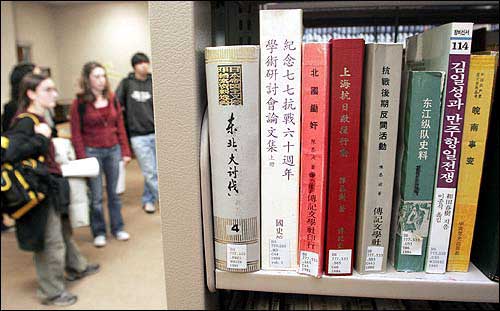
Books in the East Asian Collection line the shelves at Watson Library as a group of Free State High School students tours the facility at Kansas University. Knowledge of Asian culture and languages will become more important in the future as countries like China become increasingly more powerful in the global economy.
In class Tuesday at LHS, Ortmann and about 20 juniors and seniors discussed the Han dynasty, which from 202 B.C. to 220 A.D. ruled much of what is now present-day China.
Paper was invented and the silk trade routes became important under this dynasty, Ortmann said. He showed students maps of the silk routes linking China and the Roman empire.
“If we look in here, this is Afghanistan, this is Tajikistan, this is Kazakhstan,” he said, pointing to a map. “One of the hottest items in ancient Rome was Chinese silk.”
He finished the class talking about peasant groups that revolted against the Han dynasty — the Yellow Turbans, the Red Eyebrows and the Five Bushels of Rice.
“In order to join, you had to give five bushels of rice,” he said of the last group.
Lawrence High senior Rahul Gogineni said after class that he might someday become a diplomat or work for the United Nations.
He said he needed to know about China and Japan to build good relationships with people from those countries.
“They can see you’re not fluff,” said the 18-year-old, who is of East Indian descent and was born in the United Kingdom. “They can see you’ve actually gone into their history.”
City Government

Rising Rates: A three-part investigative series examines why Lawrence water and sewer bills have been soaring

Some leaders are now stating a new reason for why Lawrence’s utility rates are soaring: The city didn’t grow enough

Lawrence City Commission could start the process of finding a construction manager for new fire station

Lawrence is charging water, sewer customers a special tax not required by state or city law

Lawrence housing market strains residents as development fails to keep up, city’s affordable housing study finds