War-weary soldier seeking new start
As he hangs up his uniform, reservist is eager to help others with disorder
It has been two months since Jared Myers awoke in his Lawrence apartment and realized he was a mental wreck.
“I was having trouble functioning as a normal human being,” the 24-year-old Army Reserve sergeant said. “Basically, I crashed.”
Myers’ mother, Judy Smith, said she won’t forget the disturbing phone call she got from her son that day.
“He had an emotional breakdown,” Smith said. “When he contacted me he wasn’t even able to articulate.”
Smith immediately drove her son to the Dwight D. Eisenhower Veterans Administration Medical Center in Leavenworth. By the end of the day, Myers, a decorated veteran of the Iraq War, had been admitted to the hospital. He spent the next three weeks being diagnosed and treated for post traumatic stress disorder.
Many cases expected
During his stay at the hospital and while participating in veteran support groups, Myers met others who were suffering from or had experienced post traumatic stress. He was the only veteran from the current Iraq war. Most others were veterans of Vietnam and Korea, he said.
But as American military involvement in Iraq and Afghanistan continues, more veterans with emotional problems like Myers’ are expected.
A study by the Army published last year in the New England Journal of Medicine found one in six soldiers surveyed in Iraq had experienced depression, anxiety or post traumatic stress disorder. The study, however, was done early in the war. That ratio could become one in three, the same rate found for Vietnam veterans, medical experts said.
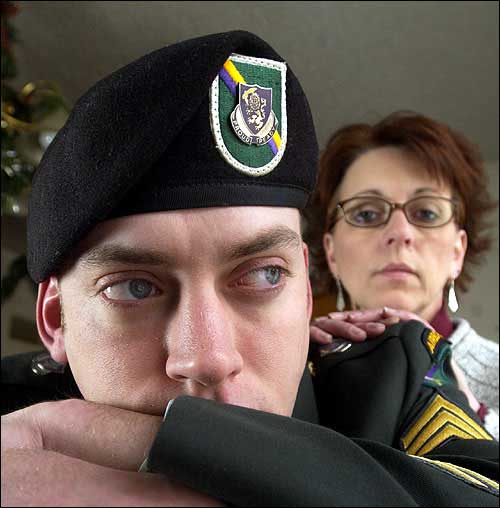
Army Reserve Sgt. Jared Myers suffers from post traumatic stress disorder after serving in Iraq. He's pictured on Friday with his mother, Judy Smith, who took him to the Dwight D. Eisenhower Veterans Administration Medical Center in Leavenworth after he suffered a breakdown related to his war experiences.
Post traumatic stress can occur following the experience or witnessing of life-threatening events such as combat, natural disasters, terrorist incidents or serious accidents.
Sufferers experience depression, nightmares, flashbacks and have trouble sleeping. They might drink heavily. For Myers, his experience involved all the above, especially depression and nightmares.
“I don’t know if it was me not being able to sleep because my mind was thinking about what happened or if I was afraid to go to sleep because even in my dreams I think about it,” Myers said.
Horrors of war
Myers entered the hospital a little more than a year after he was wounded in Iraq. In October 2003, he was in Iraq with the 418th Civil Affairs Battalion, which is normally based in Belton, Mo. He was driving an unarmored Humvee to his base in Baquba when it was struck by an improvised explosive device, or roadside bomb.
The blast killed one of his commanders, Capt. John Teal, who was sitting in the passenger seat next to him. It also severely wounded Sgt. Chuck Bartles, a Kansas University student who was riding in the back. Bartles’ arm was injured so badly it had to be amputated.

 Bronze Star honors bravery after horrific roadside attack (8-23-04)
 6News video: Lawrence soldier returns home (12-06-03)
Myers said he thinks he would have been killed if Teal’s body had not received the brunt of the blast. Myers’ right arm later required four pins to hold it together. Despite his wounds and the shock of what happened, Myers was able to drive the battered Humvee several miles through an area considered an insurgent “kill zone” to a medical aid station.
In August 2004, during a ceremony at his reserve unit’s headquarters back in the United States, Myers was awarded the Bronze Star for Valor for his actions that day in Iraq. Though it was not evident during the medal award ceremony, Myers’ emotional state had deteriorated after his return to the states to recover from his physical wounds. His mother knew something was wrong long before her son’s breakdown.
“Jared wasn’t the same person he was before he went to Iraq,” Smith said. “I saw him withdrawing socially. I saw him withdrawing from me. There were a couple of nights when we sat up talking and I knew then there was something wrong and that he just didn’t realize it yet. I urged him to get some help but I couldn’t force him to see a doctor until he realized he needed help.”
Smith noted that her son was cross-trained as a medic, and therefore carried other bad memories with him in addition to those from the Humvee explosion.
“There are still things he’s unable to talk about,” she said.
Road to recovery
Myers became inactive from the reserves last spring. But after spending seven years in the Army, he wasn’t ready to give it up. In October he became active again after signing up to take an intensive Arabic language course at the reserve center in Belton. Learning the language would better prepare him for an eventual return to Iraq, he said.
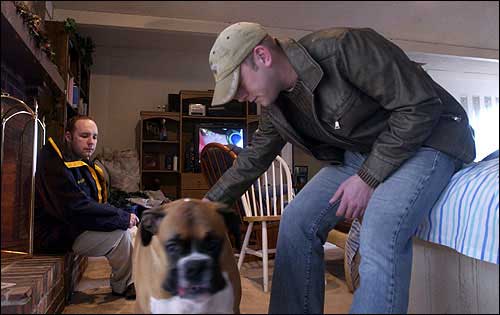
Army Reserve Sgt. Jared Myers, right, is suffering from post traumatic stress disorder after serving in Iraq. His brother Josh Myers and his dog joined him last week at his mother's Lawrence home.
The course demanded class work all day and about four hours of study at home at night. Also, because he was a sergeant, he was responsible for a team of 11 reservists and seeing that they each passed the course.
Smith said she thought the pressure of the class on top of the emotional baggage her son was already carrying from the war combined to push him over the edge mentally.
Since her son was released from the hospital in mid-December, she said, she has seen a remarkable improvement.
“They gave him excellent care,” Smith said. “He has come 180 degrees from where he was.”
Myers also said the hospital stay helped him tremendously. Meeting other veterans in support groups helped. He struck up a friendship with a Vietnam veteran who stays in touch with him.
“After hearing what they’ve gone through and how it affected their lives, I have kind of a pattern of guidance so I don’t make the same mistakes they did,” Myers said.
Yet Myers said he knew he could be dealing with the after-effects of the disorder for a long time. Though he is still on active duty and drives to Belton daily for in-house duties, he now is seeking a discharge from the reserves because of post traumatic stress. He expects the Army to decide about his discharge sometime in the next couple of months.
Even if a decision isn’t made that soon, Myers’ current hitch in the reserves ends in April and he doesn’t intend to sign on for more.
“I think it is time for me to do something else,” Myers said. “I can’t lead people anymore. Going back to Iraq doesn’t scare me; watching another soldier die would. That’s the biggest reason why I don’t want to go back.”
Myers is unsure what he wants to do now, but says he is leaning toward getting a degree in psychology and working with the Veterans Administration as a counselor.
“I think veterans will be more willing to talk to me because they will know I’ve been through it,” he said.
Smith is glad her son is leaving the Army, but she said she was very proud of him.
“He did his country a wonderful service,” she said. “Now it is time for him to put the uniform in the closet and get his life back together.”
City Government

Lawrence City Commission could start the process of finding a construction manager for new fire station

Lawrence is charging water, sewer customers a special tax not required by state or city law

Lawrence housing market strains residents as development fails to keep up, city’s affordable housing study finds
Property tax protest bill would let a few dozen voters block tax increases in some parts of Douglas County
Portion of 19th Street to close during much of April for stormwater structure replacement