

Robot learns to walk like toddler
Researchers unveil 'human-like' machine
Washington ? The difference between man and machine is shrinking. Scientists have developed a robot that “learns” to walk like a toddler, improving its step and balance with every stride.
The walking robot looks more like a moving Erector set than a human being, but the machine has the unmistakable gait of a person strolling along. The robot uses its curved feet and motorized ankles to spring its legs forward, its arms swinging at every step to help with balance.
Researchers on Thursday showed off the learning, walking robot, along with two less-advanced models, at the national meeting of the American Association for the Advancement of Science. A report on the research appears this week in the journal Science.
The machines use what the researchers called a “passive-dynamic design” that closely mimics the way humans walk. Earlier robots required powerful machines to stroll, with each leg, knee and ankle requiring motorized assistance. The effort requires a lot of energy.
The big advantage of the passive-dynamic robots is that they require about the same energy that humans use to walk, said Andy Ruina, a Cornell University researcher. By comparison, Asimo — an earlier robot developed by Honda Motor Co. — uses 10 times as much energy.
Power numbers are key to making a robot useful. The less energy used, the longer that the robots can operate without needing new batteries.
“For a robot to ever be practical, it will have to be able to run for a long time,” Ruina said.
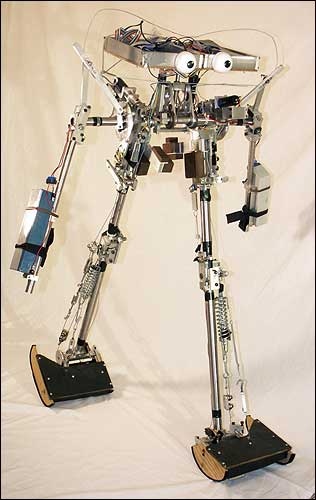
This robot uses what researchers call a passive-dynamic
The passive dynamic design uses gravity, along with muscle-like springs and motors. The energy required is just a fraction of that needed by other walking robots, Ruina said.
Ruina said the walking robots move like humans, falling and catching themselves as they move forward. This essentially is the same movement people use, a motion toddlers must master to walk.
“We let the machines take care of a lot of the motion,” he said. In contrast, most walking robots, such as Asimo, require a motor to power every motion.
A robot designed by Russ Tedrake, of Massachusetts Institute of Technology, is equipped with sensors that help the machine learn to walk in a way similar to humans’ gait. Appropriately, the machine is called “Toddler.”
The robot’s sensors measure the machine’s motion, tilt and rate of movement and then direct small motors to adjust and compensate for changes.
“It can learn to walk in 20 minutes,” Tedrake said. “Once it learns to walk, then it adapts its gait to new terrain.”
He said the sensors take measurements at the rate of 200 times a second and constantly send new instructions to the motors that control the tilt and motion.