International students adapt to new eating environment
What do international students at Kansas University have to say about getting used to cooking and eating in America?
“I had to make a major adjustment with food,” says Janaina Correa, 21, a KU volleyball player from Macapa, Brazil.
“I’m from a warm country, and usually we eat more salad and fruit. Here you have pizza, McDonald’s. In Brazil, we’ll eat that type of food about once a month; it’s expensive.”
Correa, who came to the United States in 2003, prefers to stick to preparing the staple food she’s accustomed to: rice and beans.
But it’s not always easy to eat like a Brazilian.
“Last year, during the (volleyball) season, I didn’t have any time to cook, so I was just eating out all the time. I gained like 5 or 7 pounds. This semester I lost all the weight. I started cooking at home, making my own food,” Correa says.
Michael Boyd, 22, a film student from England, also encountered some changes while adapting to life at an American college.
“Last semester, I had a meal plan at Mrs. E’s (Ekdahl Dining Commons). I ate a lot more, because I had paid for the plan. I think I put on a little bit of weight. I also got less exercise; I walk a lot more at home,” Boyd says.
These days, he does his own cooking, preparing meals like Kraft Easy Mac, ramen noodles or eggs.
On occasion, he’ll show his three roommates, who are also international students, how to cook a typical British meal.
“We’ll make a meal for all of us — bangers and mash (sausages and mashed potatoes), maybe some gravy and peas. They generally enjoy it,” Boyd says.
Surprised by portions
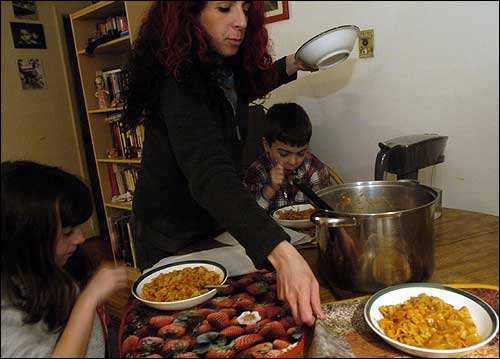
Francesca Vance, center, serves her children, Sienna, 8, left, and Dorian, 5, a pasta dish. Vance is among 1,600 international students at Kansas University.
Being introduced to the typical diet in the United States was an unpleasant experience for Rudy Kassindi, 20, a civil engineering student from the Republic of Congo.
“The first two months, my stomach was doing some weird sounds all the time from American food. It had some reaction to my stomach. The diet is totally different; I think that’s why,” Kassindi says.
He gained about 5 pounds, thanks to eating the kind of rich food that Americans are used to.
These days, Kassindi does his own cooking, shopping for tropical spices, fish and bags of rice at the Oriental Supermarket, 711 W. 23rd St., and the Mediterranean Market and Cafe, 3300 Bob Billings Parkway.
Yi Yang, 21, a Chinese student earning a degree in electrical engineering, was surprised by American portion sizes.
“When I first came to the States, I felt like every dish is huge — ‘Wow, that’s a lot of food for one person.’ I just got used to it, after you eat a couple of times at a restaurant,” Yang says.
“The Chinese restaurants here, the food is different than at home. They have buffets, and it’s just not normal to have those in China.”
Avoids fried foods
Nadine Billgen, 23, a graduate student from Bonn, Germany, tries to cook healthful, balanced meals for herself every day.
“If I do have time, I cook from scratch. I always think that most of the American food I can buy around here is very greasy, so I try to cook more lean. I also eat a lot of fish — salmon and shrimp,” Billgen says.
Occasionally, she treats herself to familiar foods from home, buying sauerkraut, chocolate and German bread from Au Marche — the European Market, 931 Mass.
Billgen stays away from food that is breaded and fried, such as fish sticks and chicken nuggets, as well as sugary sodas.
That’s hard to do in America.
“Few people (here) try to prepare their food from scratch,” she says. “There’s so much more instant and already processed food than in other countries.”
Food
Instant Pot Jewish brisket adds sweet and savory flavor to Passover and many holidays
The seafood industry is betting on fish that looks more like meat
This minty pea soup with ham is a creamy, chive-packed upgrade for puréed soups

Rural winery in Leavenworth County that won $22,000 state grant for tourism hopes to grow to be bigger part of community