

Steps to improve finances
Planners offer advice for new year
What’s the most important step you can take in 2006 to improve your personal finances? If you’re not sure, here are some suggestions from financial planning experts around the nation:
¢ Ted Beck, president and chief executive of the National Endowment for Financial Education, a nonprofit organization based in Englewood, Colo., that specializes in personal finance education.
“We believe there is no time like today to prepare for tomorrow. This means making the commitment to allocate as much money as possible each month for retirement, and then following through on that commitment – by participating in a 401(k) or other retirement plan, or increasing your contribution to such a plan. Whether you think of it as ‘paying yourself first,’ ‘investing in your future,’ or ‘another type of spending,’ the day will come when you appreciate having made this commitment. And, no matter your age, it’s never too early or too late to start.”
¢ Susan C. Keating, president and chief executive of the National Foundation for Credit Counseling in Washington, D.C.
“Commit to managing your money and expanding your financial literacy. Start by setting goals based on what is important to you. Create a budget to ensure that you are not spending more than the amount that you earn. Dedicate time each week to learning more about your finances, how to improve your financial health, savings priorities, and developing an efficient way to maintain your records.”
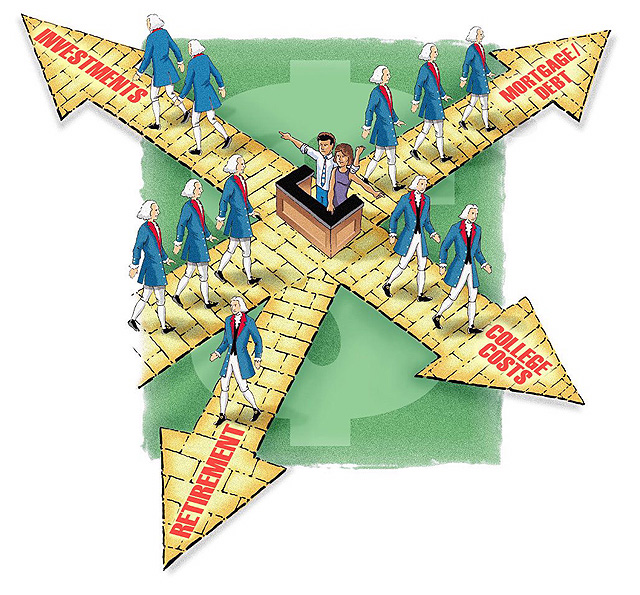
Size as needed (160 dpi, 38p x 35p) Hiram Henriquez color illustration of couple directing George Washington figures (representing dollars) down paths toward Investments, Mortgage Debt, College Costs, Retirement. Can be used with stories about financial planning. Miami Herald 1997 CATEGORY: ILLUSTRATION SUBJECT: Finances illus ARTIST: Hiram Henriquez ORIGIN: Miami Herald TYPE: EPS JPEG SIZE: As needed ENTERED: 1/21/97 STORY SLUG: Stand-alone illustration, business, finance, finances, saving, debt, planning, financial, mortgage, college, cost, investment, retirement, dollar, MI, 1997, henriquez
¢ Gary Foreman, editor of The Dollar Stretcher newsletter in Bradenton, Fla.
“Even if you never buy online, making the most of your shopping dollar is much easier thanks to the Internet. Now everyone has the tools to make good buying decisions. The Web makes it possible to thoroughly research an item before you head for the store. You don’t have to make snap decisions about which features you’ll really use. You can check for reliability and ease of use from your home, with no sales personnel hovering over you while you compare prices for competing models and competing stores. The Web even makes it easy to find coupons and special offers for your choice.”
¢ Greg McBride, senior financial analyst at Bankrate.com in North Palm Beach, Fla.
“At lot of people have been dining at the home equity buffet because interest rates have been low and home price appreciation has been strong. The problem is, those home equity lines of credit are tied to the prime rate. As the Federal Reserve raises short term interest rates, those HELOC rates have been moving higher at the same pace. If you had taken a $30,000 HELOC 18 months ago, you got a rate of 4 percent. Now it’s 7.25 percent, and your minimum payment – just interest – has gone from $100 to $181 a month. And that’s not repaying any of the balance. If you’re looking to pay off your HELOC with the sale of property or a large year-end bonus, by all means do that. Otherwise, consider refinancing into a fixed-rate home equity loan.”
¢ Don Blandin, president and chief executive of the Investor Protection Trust, a consumer education group in Washington, D.C.
“Resolve to join the fewer than one in four American investors who currently do all four of the following important things: read prospectuses; regularly review brokerage and mutual fund account statements; check out the disciplinary backgrounds of brokers/financial planners; and have a financial plan in place. Knowledge is an important part of being a savvy investor, but you have to combine those ‘book smarts’ with the right behavior if you are going to be successful in growing your financial nest egg for all life stages including retirement.”
¢ Jeanne M. Salvatore, vice president for consumer affairs at the Insurance Information Institute in New York.
“The most important thing is to call your agent or company representative and make sure your policies are up to date – life, home and auto. Things change, so your needs change. And a good resolution would be to keep better financial records. You need a home inventory, and you also need a list of all your important financial documents in case of a disaster. Make a list of your insurance policies, names and numbers of agents, your attorney. If you do it on your computer, you can e-mail it to somebody for safekeeping and make a copy on a CD and put it in a safe place.”