Famous murder gets new life in Met opera
Herkimer, N.Y. ? When Chester Gillette killed his pregnant lover, Grace Brown, on an Adirondack lake in July 1906, it was destined to become an immortal murder.
The tragic story became the basis for Theodore Dreiser’s 1925 novel, “An American Tragedy,” a saga subsequently spun into movies, television programs, plays, songs, true crime books – and a new production at the Metropolitan Opera in New York City. “An American Tragedy,” with music by Tobias Picker, premiered Friday.
“It’s the murder that will never die,” said Susan Perkins, executive director of the Historical Society in Herkimer County, where Brown’s death occurred and Gillette was eventually tried and sent to the electric chair. “The fascination with it over the years has been unabated.”
For communities in three upstate New York counties that share the story’s history, the opera helps launch the murder’s 100th anniversary. A series of summertime events are planned, including a re-enactment of Gillette’s trial and a special wreath-laying ceremony on Big Moose Lake on July 11, the day Brown was killed.
Perkins and about 100 others will travel to New York City to see the opera on Dec. 16.
“I don’t even pretend to understand why people are still interested after 99 years,” said Charlie Adams, a tour boat operator on Big Moose Lake. “It just astounds me.”
Immediate interest
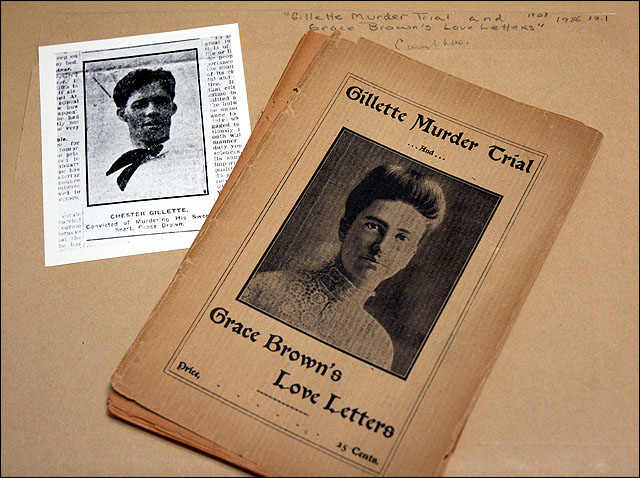
This photograph of Chester Gillette, left, and the love letters of Grace Brown, used in Gillette's 1906 murder trial, were provided by the Herkimer County Historical Society in Herkimer, N.Y. Gillette was convicted and put to death for the murder of Brown, his pregnant lover. An opera based on the Theodore Dreiser novel about the murder case premiered Friday at the Metropolitan Opera in New York City.
Chester and Grace’s story has kept the public spellbound since the beginning.
Brown, known as “Billie,” was a farm girl from South Otselic, in Chenango County, who worked at the Gillette Skirt Co. in Cortland, about 30 miles south of Syracuse. There, she met Chester Gillette, the nephew of the owner and the son of Salvation Army missionaries. Despite Gillette’s upbringing, history portrays him as a shiftless, would-be social climber.
After a brief courtship, Brown was pregnant. In a series of emotional letters, Brown implored the reluctant Gillette to marry her. He barely acknowledged her.
In July 1906, the pair headed for what was supposed to be a clandestine trip to the Adirondack Mountains – Brown still hoping for a proposal of marriage. After several stops, they ended up at Big Moose Lake, a large, shallow wilderness lake in the central Adirondacks.
There, the couple took an afternoon rowboat ride, during which Gillette allegedly struck Brown in the head with a tennis racket, she fell into the lake and drowned.
Brown’s body was found the next day in the lake along with the overturned rowboat. Gillette was spotted walking away with his luggage and arrested three days later in nearby Inlet, where he had gone to meet two women friends. Soon after, the sheriff found the tennis racket buried under a log.
The monthlong trial made headlines across the country. The jury needed just five hours to convict Gillette, who claimed Brown drowned accidentally and that he panicked and fled. In March 1908, he was executed in the electric chair at Auburn State Prison.
Almost immediately, the story began imbedding itself in America’s psyche, Perkins said. In November 1906, a company started selling booklets containing reprints of Grace’s letters, which had been read into evidence at Gillette’s trial. In 1907, Maude Gould, a piano teacher from Ilion, wrote a song about the case, “Entreating.” A folk ballad appeared in the Adirondack lumber camps.
The secret affair, sense of mystery and wilderness backdrop were among the ingredients that made the case so enticing, said Perkins, who likened the frenzy to the O.J. Simpson or Scott Peterson trials of contemporary times.
Keeping story alive
The story might have faded from public interest if not for Dreiser’s novel, which revived interest and transformed it into an archetypal story, said Joseph Brownell, a retired State University of New York at Cortland geography professor who co-authored a 1986 factual account of the murder, “Adirondack Tragedy.”
Following Dreiser’s novel, “An American Tragedy” made it to the New York City stage in 1926. There was another play in 1931 and in the same year, a Paramount film, starring Sylvia Sidney. In the 1950s, Lux Video Theater did a television take, with actor John Derek.
The most famous adaptation is the 1951 film, “A Place in the Sun,” which starred Montgomery Clift, Elizabeth Taylor and Shelley Winters and won six Oscars.
Arts and Entertainment

Events: Ballet, cinema, walking tours and lots of Easter egg hunts

Theatre Lawrence’s upcoming season to feature ‘On Golden Pond,’ ‘Pirates!’ and more

Watkins Museum to host traveling exhibition featuring photographs, narratives of the Underground Railroad

Local vendors can apply now for KU’s new monthly on-campus market, Jayhawk Fridays

UPCOMING EVENTS: Easter egg hunts, fee-waived pet adoptions and more