

World’s oldest object goes on display
University shows off zircon crystal for one-day celebration, 'rock concert'
MADISON, WIS. ? Call it much ado about almost nothing.
To create buzz about an otherwise arcane subject, the University of Wisconsin-Madison showed off a tiny speck of zircon crystal believed to be the oldest known piece of Earth at about 4.4 billion years old.
Saturday’s daylong celebration was capped with “The Rock Concert” by jazz musicians who composed music to try to answer the question: What does 4.4 billion years old sound like?
“This is it — the oldest thing ever. One day only,” said Joe Skulan, director of the UW-Madison Geology Museum, where the object was displayed under police guard. “The idea of having a big celebration of something that’s so tiny — we’re playing with the obvious absurdity of it.”
Jazz Passengers, a six-piece group from New York, was hired to compose music for the event. Composer Roy Nathanson said he mixed humor, jazz music, computer-generated beats and the occasional rocks being banged together.
“It’s an amazing story. The whole thing is something that captures your imagination,” Nathanson said.
Though scientists acknowledged there wasn’t much to see, spectators used a microscope to check out the tiny grain, which measures less than two human hairs in diameter.
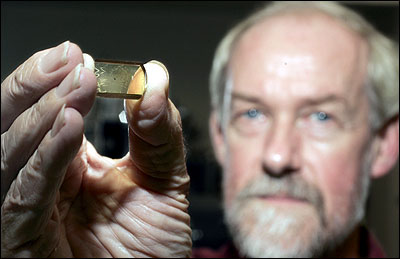
Simon Wilde, a professor, shows off a 4.4 billion-year-old zircon crystal he discovered in Australia, Friday in Madison, Wis.
Analysis of the object in 2001 by John Valley, a UW-Madison professor of geology and geophysics, startled researchers around the world by concluding that the early Earth, instead of being a roiling ocean of magma, was cool enough to have oceans and continents — key conditions for life.
The object will now return to its native Australia with Simon Wilde, professor at Curtin University of Technology in Perth, Western Australia, who made its discovery in 1984.