KU student feels towing company took her for a ride during flooding
Kansas University student Beth Krayenhagen thinks she got soaked twice in last week’s floods: once when her car got stuck in water at 19th and Maine streets and again when she got her towing bill.
The total for having her Oldsmobile pulled out of the floodwaters by a wrecker: $425, including a $225 initial fee, $100 for “special equipment” she disputes was actually used, $75 for storage she says wasn’t necessary, and mileage charges computed at $2.50 per mile.
The owner of the towing company, TransMasters, says it was a reasonable bill. But Krayenhagen is writing the Lawrence Police Department, which called the towing company, and Atty. Gen. Phill Kline’s consumer-protection office to complain about what she said was a case of consumer fraud and unfair business practices.
She also wants to raise consumers’ awareness about what they might be getting into when they call for a tow.
“There’s a lot of young people in this town, and they don’t know any better. They’ll just say, ‘OK, I’ll pay it,'” Krayenhagen said.
Government issues
The case raises questions about the system emergency workers have for arranging towing for people they encounter on the roads — a system the Douglas County Commission has said is ripe for price gouging.
As the system works now, if drivers don’t express a preference of towing company, emergency workers pick one of six companies from a rotating list designed to ensure each gets roughly equal business. That’s what happened in Krayenhagen’s case.
Under a plan considered this spring by commissioners, someone unsure about which company to call would get a printed list of companies, their locations and common fees for towing and vehicle storage.
“Some companies charge much higher fees and provide a lower level of service,” Commissioner Charles Jones said at the time. “How do we keep people from getting ripped off by companies that are charging exorbitant fees? … We just need to give them the power to make at least a somewhat informed decision.”
Marvin Schaal of Quality Towing said he thought $425 sounded exorbitant for someone in Krayenhagen’s situation.
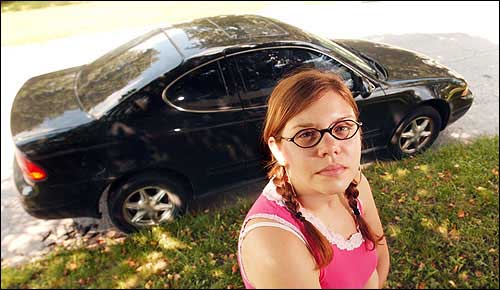
Beth Krayenhagen feels she got scammed during last week's floods when she got stuck with a bill for 25 from a towing company. Krayenhagen is pictured on Thursday next to her car parked outside her Lawrence home.
Dangers faced
“I’d have to pull a car out of a tree to make a tow bill that big,” he said. “That’s just crazy.”
But Kevin Raasch, owner of TransMasters, said he would expect other companies to say their prices would be lower. He said people forget that tow-truck operators often must venture into dangerous conditions and risk damaging their trucks to pull out vehicles. He said it was the driver’s fault the car got stuck in the first place, and he said Krayenhagen should have asked police, “Who’s the cheapest?”
“I hear about stuff every month. Everybody thinks that this should be this and this should be that and so on and so forth,” he said. “If I’m gonna go do something, I’m gonna get paid for it.”
Krayenhagen wasn’t at the scene — her boyfriend was driving her car at the time — but she said the water was about 18 inches deep.
She claims the company refused to show her an itemized bill until she insisted repeatedly. Raasch said that would not have happened.
More scrutiny?
Krayenhagen also said the company told her boyfriend the car had to be towed into storage even though he’d requested it to be dropped off at a nearby restaurant. Raasch said that would not have happened.
“We’ll take a car anywhere you want,” he said.
Krayenhagen said she paid the bill to get her car back but planned to take TransMasters to small-claims court.
Jerry Taylor, owner of Hillcrest Wrecker & Garage, also said the $425 bill was “probably high” and that a typical tow from flooded roads might cost anywhere from $250 to $350. Still, he said he’d had cases in which he believed every cost was justified but consumers insisted they’d been ripped off.
But he added that public-safety agencies should begin scrutinizing companies more closely before they’re put on the towing rotation list.
City Government

Lawrence City Commission could start the process of finding a construction manager for new fire station

Lawrence is charging water, sewer customers a special tax not required by state or city law

Lawrence housing market strains residents as development fails to keep up, city’s affordable housing study finds

Property tax protest bill would let a few dozen voters block tax increases in some parts of Douglas County
Portion of 19th Street to close during much of April for stormwater structure replacement