

Fame of artist, firm lure antique pottery collectors
It is hard to identify an unmarked piece of pottery or porcelain.
If a glaze color or type of design was popular, other factories often copied it. In the early 1900s, when the Arts & Crafts movement was gaining favor, Grueby Pottery Co. developed a matte-green glaze that was a best seller. Its success led to copies by at least 50 companies that used a similar glaze on pieces that were often cheaper.
Grueby art pottery was not made after 1910. But sometimes copies were made because a designer moved from factory to factory and kept making similar pieces. Frederick Rhead was an important man in the art-pottery business. He developed glazes, techniques and designs while working at many potteries, including Arequipa and Rhead in California; Avon Works in West Virginia; Weller, Roseville, American Encaustic and Homer Laughlin in Ohio; and University City in Missouri. His unusual designs, featuring squeeze-bag decorations and incised lines that created stylized trees with round leaves, were used at Weller, Avon and Roseville, so unmarked pieces confuse collectors.
Collectors today pay high prices for pottery by Rhead made at any of the factories. The fame of the artist is almost as important as the fame of the firm.
I have a Sprague & Carleton drop-leaf extension table with four side chairs and two leaves. Can you tell me something about the company?
Ira M. Sprague founded the Ira M. Sprague Furniture Works in Keene, N.H., about 1900. The company manufactured tables in Early American styles. The firm’s name became Sprague & Carleton sometime around 1930. Sprague & Carleton expanded through the 1940s and ’50s, making dining-room sets and other furniture. By the late 1960s, the company was owned by Triumph Industries of Houston.
I’m getting ready to give my old dollhouse and furniture to my granddaughter. But I was told that my set of cast-iron laundry-room pieces is too rare for play. I have a double set of laundry tubs, a mangle ironer (one with a roller), a washing machine, a chair and a heater. Each one has a sticker that reads “An Arcade Toy.” Can you tell me when these toys were made and if they’re valuable?
The Arcade Co. of Freeport, Ill., manufactured iron dollhouse furniture from 1925 to 1936. The company used the slogan “They Look Real” to market its toys. Because the toys are made of iron, many have survived years of play. But you might not want your granddaughter to play with them. The washing machine alone is valued at $300, and the laundry tub sells for $250 or more.
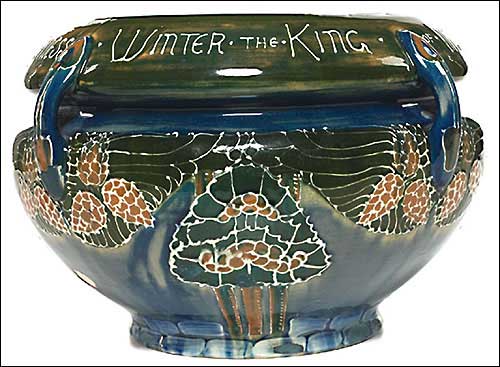
This Jardiniere is attributed to Frederick Rhead. It is marked with the Avon Pottery mark and sold for 80.
We paid $233 for a floor-standing coin-operated scale in 1977. The platform is inlaid with small ceramic tiles. A needle points to your weight on the round display at the top. Inside the numbers on the glass-covered display are the words “Honest Weight One Cent.” A large mirror etched with the word “Peerless” is mounted on the front. What is the history of this type of scale?
Coin-operated floor-standing scales were a huge business during the 1920s and ’30s. These scales were first made in the United States at the end of the 1880s. During the next 50 years, they were installed on city sidewalks and in railroad stations, barber shops, amusement parks and general stores. Peerless Weighing and Vending Co. was one of the largest U.S. manufacturers of coin-operated scales. The “lollipop” style of yours (a round top on a stem) dates it to 1920 or later. Large floor-standing scales were considered junk by the 1950s, when small bathroom scales were available for household use. But today a group of collectors is interested in the scales. If yours is in excellent, working condition, it could sell for several times what you paid for it.