Spanish translators bridge public communication gap
A growing Spanish-speaking population in the Lawrence area is causing a higher demand for interpreters in courts, on the police force and in other places where the ability to communicate is essential.
Often, the interpreters’ jobs go beyond merely knowing Spanish. They must be trustworthy both to the government and to the people for whom they’re speaking.
“I have to associate myself with them, to think about how I would feel,” said interpreter Maria Gonzalez, who helps injured people navigate the state’s workers’ compensation system. “I have to make them comfortable enough that they open up to me.”
Since the 2000 Census, the Hispanic population in Douglas County has climbed by 11 percent, from 3,281 to 3,654, according to estimates released this fall by the Policy Research Institute at Kansas University. Statistics indicate similar growth in the Hispanic population statewide.
Making changes
The growth is apparent at Lawrence Memorial Hospital, which in the past year began using a patient-doctor translating service, and at the Lawrence Police Department, which has started offering financial incentives for officers who take Spanish classes to help with traffic stops and investigations.
For the past several years, each of the Lawrence public schools has had an employee on site who can speak Spanish.
Gonzalez is one of only two full-time Spanish-language interpreters listed by the Kansas Hispanic and Latino American Affairs Commission for the Lawrence area. While others do translation work in the area, they typically have other jobs or perform other duties while translating.
Gonzalez, who lives in Lawrence and has been interpreting for two years, said she was working more as word of her services spread in growing Hispanic communities in Lawrence, Topeka and Eudora. She typically charges $30 per hour, but will do pro bono work if the situation warrants.
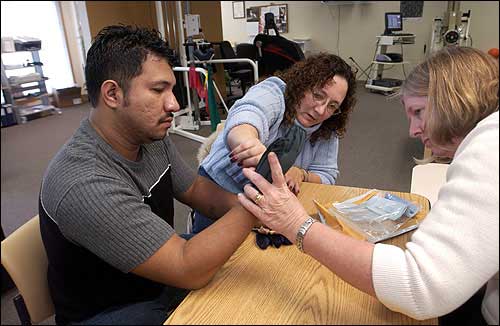
Jorge Galindo, left, and translator Maria Gonzalez discuss the fitting of a protective glove with physical therapist Jean Sublette in Kansas City, Mo. Gonzalez, a translator from Lawrence, helps members of the area's burgeoning Hispanic population such as Galindo communicate in public settings.
She said many Spanish-speaking people in the Douglas County and Kansas City areas moved here from California, and most are of Mexican descent.
Gaining trust
On a recent day she went to Kansas City to take a trip to the doctor with Jorge Galindo, a Guatemalan native who sends money back to his wife and children there. Two years ago, he caught his hand in a machine press at the factory where he works. It ripped flesh from the bone, then crushed what was left.
“It still bothers me,” she said for him. “I’m still having a hard time eating.”
At a rehabilitation center in Kansas City, Mo., Galindo sat quietly, his hand sheathed by a special tan glove. He needed a new glove that didn’t squeeze his wrist so much.
The difficulty people such as Galindo encounter isn’t always just their injuries, Gonzalez said. They sometimes feel frustrated and angered by the unfamiliar system.
Galindo also had bad experiences with past interpreters, so it took months for the two to settle into a professional relationship, Gonzalez said.”Some people don’t have any confidence in you, and you have to prove yourself,” she said.

 Attorneys cite lack of Hispanic jurors (05-19-04)
In the courtroom
Shelley Bock, one of the few Spanish-speaking defense attorneys in town, also must overcome clients’ mistrust after they’re swept into the legal system.
“No es para mi” — it’s not for me — he said recently to a Spanish-speaking client whom he’d just directed to go down the hallway and pay a $50 fee to apply for a diversion agreement.
In the first nine months of 2004, the district court in Douglas County spent more on Spanish-language interpreters than it had in all of 2003.
“Twenty years ago I would see one person per year who spoke Spanish,” Bock said. “Nowadays it’s every week.”
District court administrator Linda Koester-Vogelsang said there were plenty of qualified courtroom interpreters in Lawrence, in large part because of Kansas University. But occasionally, interpreters who are good at speaking the language don’t know much about the U.S. legal system, she said.
Judges sometimes must think on their feet to ensure Spanish speakers are treated equally.
Judge Paula Martin ran into a minor snag recently while filling in for the judge who usually handles criminal first-appearances. When a Spanish-speaking defendant appeared, Martin had to first find an interpreter, a process that took a few minutes. When the interpreter arrived, Martin didn’t have a copy of an official oath in front of her, so she smiled, held up her hand and took a stab at making up her own.
“Do you promise that you will truthfully and correctly translate everything that’s said today in court?” she asked.
City Government

Lawrence City Commission could start the process of finding a construction manager for new fire station

Lawrence is charging water, sewer customers a special tax not required by state or city law

Lawrence housing market strains residents as development fails to keep up, city’s affordable housing study finds
Property tax protest bill would let a few dozen voters block tax increases in some parts of Douglas County
Portion of 19th Street to close during much of April for stormwater structure replacement