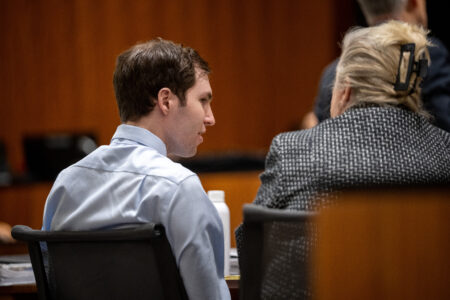
Soldier gets year in abuse of Iraqis
Tearful MP reservist describes brutal acts against prisoners
Baghdad, Iraq ? Spec. Jeremy C. Sivits, the first soldier to be tried in connection with the Abu Ghraib prison scandal, was sentenced Wednesday to one year in prison, a reduction in rank and a bad conduct discharge after an emotional trial in which he recounted in detail abuses of detainees and offered an apology.
Dressed in military fatigues, Sivits, 24, appeared remorseful, breaking into tears on occasion, as he described delivering a detainee under his control to a wing of the prison where soldiers were punching, stomping and stripping prisoners forced to wear sandbags on their heads.
“I apologize to the Iraqi people and to those detainees,” Sivits said, during a hearing open to the press but closed to media cameras. “I want to apologize to the Army, to my unit, to the country. I’ve let everybody down. That’s not me. I should have protected the detainees.”
About 150 angry Iraqis rallied near the makeshift military courtroom, denouncing as a whitewash the start of a judicial process that U.S. officials have said they hoped would demonstrate their resolve to punish all Americans who committed crimes in the prison and mollify widespread Arab anger.
Sivits, a military police reservist, was found guilty of two counts of maltreatment of prisoners, dereliction of duty for failing to protect the detainees and cruelty, the military said. His conviction will be automatically reviewed by the Army’s legal section.
Col. James Pohl, the military judge, sentenced Sivits to the maximum penalties allowed in a special court-martial convened as a result of a plea bargain Sivits struck in return for cooperating in the investigation of the other guards accused of taking part in the alleged abuses.
The only punishment available to the judge that Sivits did not receive was a fine of up to two-thirds of one year’s pay. Military law experts said the judge may have chosen not to impose that penalty because Sivits has a wife and two children.
Spreading the blame
Three of the six other guards were arraigned Wednesday in hearings that took place in the same makeshift courtroom in Baghdad in which Sivits was later tried. Staff Sgt. Ivan L. Frederick, Sgt. Javal Davis and Spec. Charles Graner face general courts-martial, which carry stiffer penalties.
Each of the three accused deferred his plea, but most of them are expected to plead not guilty June 21 and mount defenses that lay the blame for the abuses at the feet of higher-ranking guards, military intelligence officers and others operating at the prison, legal experts said.
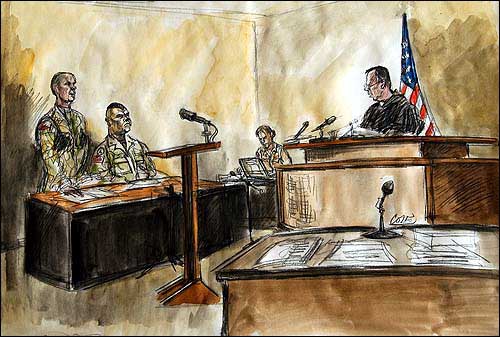
A sketch by British court artist Richard Cole shows U.S. Army Spc Jeremy Sivits, seated second from left, with defense attorney First Lt. Stanley Martin, standing, in the court presided over by Col. James Pohl. Sivits pleaded guilty to four counts of abuse Wednesday at the court-martial in Baghdad, Iraq.
“The other soldiers who are going into court, you’re going to see a systematic attempt to spread the blame,” said Jeffrey Walker, a former judge advocate for the U.S. Air Force. “It doesn’t get you innocent. But it can get you a lesser punishment. They’ve got a lot more to lose.”
‘I took the photo’
Sivits, a light-vehicle mechanic turned prison guard, told the court he participated in the alleged abuse of prisoners after he offered to help Frederick, one of the three arraigned Wednesday, escort one of seven detainees suspected of involvement in a riot to an isolation cell.
“I turned the corner and saw detainees lying on the floor,” Sivits told the court. “They were lying there with sandbags over their heads.” Other guards were “stomping on their hands and feet,” he said.
Sivits said he led the detainee in his charge toward the other detainees and “pushed him into the pile.”
“Someone grabbed him,” Sivits said. “I just kind of stood back at that point. I knew he was going to be assaulted.”
Graner asked Sivits to take a picture of Graner as he pinned detainees under the weight of his knees, cradled the head of a prisoner in one arm and drew back his fist as if he were going to throw a punch, Sivits testified.
“I took the photo,” Sivits said.
From there, Sivits described scenes of violence and humiliation that he said lasted more than 30 minutes in his presence. Prisoners were beaten and injured. They were forced to strip and kneel. They were made to simulate sexual acts.
Frederick hit the detainee Sivits had escorted to the isolation block so hard in the chest that the man “went down” and required a doctor’s attention and “a couple puffs off” an inhaler used by an inmate elsewhere to get his breath back, Sivits testified.
Frederick boasted he “might have put him in cardiac arrest,” Sivits said.
Graner punched a detainee in the temple and then quipped that he hurt himself, Sivits testified. “I guess he hit him so hard it hurt his wrist,” Sivits said.
The prisoners were piled into a “human pyramid,” and more photos were taken. One man was forced to masturbate while a second man was made to kneel at his waist to “look like he was giving the detainee oral sex,” Sivits said.
“I had enough and I left,” he said.
‘It was wrong’
Throughout the proceedings, Sivits, a high school baseball coach, appeared ashamed of his conduct. His lawyer, 1st Lt. Stanley L. Martin, described Sivits as a small-town mechanic who was “out of his element” in the Abu Ghraib prison.
On the stand, Sivits made no attempt to gloss over his role in abusing the prisoners.
“It was wrong. It shouldn’t have happened,” Sivits said, his voice cracking with emotion.
Sivits’ demeanor impressed Bakhtiar Amin, Iraq’s human-rights minister, who was one of four Iraqi ministers and Governing Council members who attended the court-martial.
“He showed remorse and regret, which I welcome,” Amin said. “It was a fair verdict. It’s sufficient for his case.”
National

Obama meets Mamdani in New York City before reading to preschoolers

Indiana primary will test Trump’s control over Republican Party after redistricting defiance

Powerful winds and reported tornadoes rip through the Midwest, leaving heavy damage but no deaths
Judge declines to dismiss case in 1979 disappearance of Etan Patz, setting up 3rd trial

Trump’s lawyers are in talks with the IRS to resolve president’s $10B lawsuit