St. Patrick’s Day feast
Private chef shares traditional Irish dishes
Paige Vandegrift’s love for Irish food was sparked when she was studying for six months in 1992 at Le Cordon Bleu London Culinary Institute.
Vandegrift — now a private chef living in Kansas City, Mo. — used to enjoy making weekly visits to Selfridges, a London department store famous for its enormous food halls with delicacies collected from around Europe.
“There was an entire room of bread. There was soda bread shipped in from Ireland, and it was just this little, tiny dense loaf that looked like a doorstop. It looked very, very humble. It was so good. I don’t even know how to describe it,” she recalled.
“I would take it home and have to refrain from having more than a couple of pieces of toast, slathered with butter.”
That served as Vandegrift’s introduction to authentic, Irish food while she lived in the United Kingdom.
Though London was as close as she ever got to Ireland, she did try to locate a British pub that would serve corned beef and cabbage on St. Patrick’s Day.
She couldn’t find one.
“I was sort of wondering how it (the Irish holiday) was celebrated, and they didn’t know what corned beef is. When I got back to the United States, I later found that it is more of an Irish-American dish,” Vandegrift said.
Since then, Vandegrift — who teaches a variety of cooking classes at the Community Mercantile Co-op, 901 Iowa — has explored Irish cuisine.
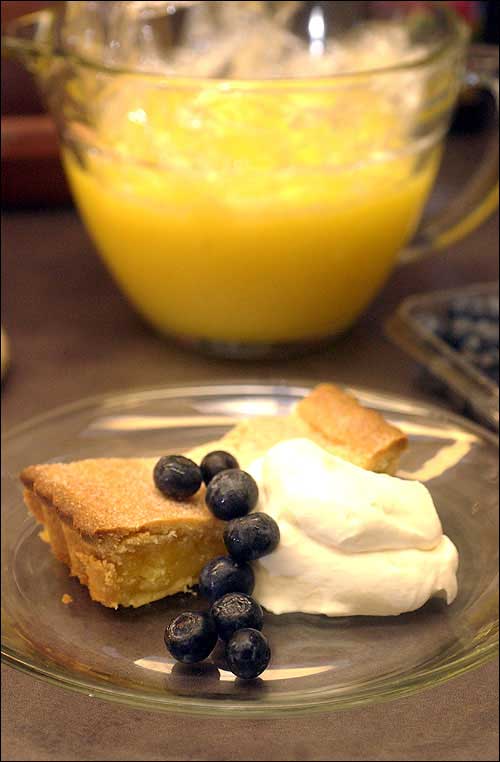
Private chef Paige Vandegrift's Lemon Curd Tart, served with whipped cream and fresh blueberries, is a classic Irish dessert. Vandegrift teaches cooking classes at the Community Mercantile Co-op in Lawrence.
“Irish food is really comfort food, in the sense that it uses very humble ingredients,” she said. “Ireland is one big farm. The green of the land and the farm-fresh produce is what people remember. To me, any cuisine with a large use of potatoes has got to mean comfort.”
Diet full of potatoes
Indeed, potatoes have always been an important part of Irish cooking.
“When the potato was introduced there, it flourished. I guess you can get a lot of yield (out of a field of potatoes), it’s a very healthy food and it’s filling. So it was something that Irish people could eat that grew well, it made up a large part of their diet and they could survive on it,” Vandegrift said.
| Paige Vandegrift, a private chef in Kansas City, Mo., is a graduate of Le Cordon Bleu London Culinary Institute.She teaches cooking classes at the Community Mercantile Co-op, 901 Iowa.To find out more about course offerings at the co-op, click on www.communitymercantile.com.To learn more about Vandegrift’s business, click on www.simple-food.com. |
Unfortunately, Ireland’s traditional dependence upon potatoes also is an example of what happens when a culture relies too heavily on one food staple.
A potato blight on the crops for several years running in the 1840s led to the Great Potato Famine and widespread starvation. That was the event that created huge waves of Irish immigration to the United States.
But there is much more to Irish food than just potatoes.
During a March 10 cooking class at the Lawrence co-op, Vandegrift educated participants about Irish cuisine by preparing a St. Patrick’s Day feast.
The menu featured some of the chef’s own favorites: Lamb Shanks Braised in Guinness with Root Vegetables; Colcannon, a traditional dish of rich, mashed potatoes with tender cabbage and green onions; Golden Raisin Irish Soda Bread; Irish Brown Soda Bread; and a double-crust Lemon Curd Tart with whipped cream and fresh blueberries.
The braised lamb shanks dish is a recipe she developed, and it’s classically Irish.
“I love braised dishes. Again, we’re back to comfort food. They are made with the humbler cuts of meat, the cuts that you can’t just throw on the grill. They take some skill on the part of the cook,” Vandegrift said.
“With braised dishes, you get this incredible sauce just from cooking those tough cuts of meat and on the bone. Any time you cook meat on the bone, it’s going to have more flavor.”
The technique of braising is used in order to brown and moisten meat through slow cooking. The use of Guinness stout in the braising liquid is a nice, Irish touch.
“It adds flavor. The French would probably use white or red wine and add some tomatoes. The Irish have always been cooking with what’s right there (readily available),” Vandegrift said.
Then there’s the Colcannon.
Speaking of comfort food, it’s the ultimate: creamy, warm and filling. The tender, sliced cabbage, green onions and rich potatoes go together splendidly.
“Most people, if you were to ask, ‘Would you like a dish of sauteed cabbage (and potatoes)?’ they would say, ‘No thanks.’ But the cabbage with the buttery, mashed potatoes adds a flavor. I like the surprise of it; it’s not just a simple plate of mashed potatoes,” Vandegrift said.
Dessert highlights menu
One food that’s often found on Irish dining tables is soda bread, a quick bread that uses baking soda as the leavening agent.
“It’s the bread that you find all over Ireland in many forms. It mixes up and goes straight into the oven, and it bakes in 30 to 35 minutes. Usually made with a mixture of grain, it’s healthful, it has kind of a nubbly texture and it keeps very well. It’s this sort of homey and humble food,” Vandegrift said.
At the recent, co-op cooking class, she prepared two examples: Golden Raisin Irish Soda Bread and Irish Brown Soda Bread.
One of Vandegrift’s favorite aspects of Irish cooking is dessert, typically incorporating fresh fruits. The star of her St. Patrick’s Day feast was Lemon Curd Tart, served with whipped cream and blueberries.
Her tart was light, beautiful to look at and — true to its name — tart indeed. The whipped cream and berries were the perfect accompaniment.
“It’s sort of an upscale lemon bar, with extra crust,” Vandegrift said. “What’s not to love?”
Food
Instant Pot Jewish brisket adds sweet and savory flavor to Passover and many holidays

The seafood industry is betting on fish that looks more like meat
This minty pea soup with ham is a creamy, chive-packed upgrade for puréed soups

Rural winery in Leavenworth County that won $22,000 state grant for tourism hopes to grow to be bigger part of community