

Rapala’s lures aim to hook anglers, fish
Largest tackle manufacturer focuses on looks, testing
MINNETONKA, MINN. ? The lure swam just over a foot below the surface, wiggling like a wounded minnow and making a rattling buzz.
Had this been one of Minnesota’s 10,000 lakes, the action of this blue and silver Jointed Shad Rap might have triggered a walleye to turn it into a quick snack. Instead, this was a testing tank for Rapala baits, a proving ground in the fishing industry’s continual mission to find new ways to hook fish — and anglers.
Many fishermen’s idea of the perfect lure has been shaped by the Finland-based Rapala VMC Corp., the world’s largest tackle manufacturer. Lauri Rapala, a Finn, carved the original cigar-shaped minnow lure that arrived in the United States in 1962.
Like other manufacturers, Rapala focuses on two questions in making and selling lures: Does it work, and does it look good?
“We just don’t want to make only pretty lures. … We want to make lures that swim naturally in the water and catch fish,” said Jarmo Rapala, grandson of the company’s founder and its chief lure designer.
It was Jarmo Rapala pulling that test lure though the tank at Minnetonka-based Normark Corp., Rapala’s North American headquarters.
Standing above the 15-foot-long testing tank, tucked in a room decorated in a North Woods theme, Rapala made a slight tweak that caused the two-piece crankbait to veer left. Rapala adjusted it again with a needle-nose pliers, making it run straight and true.
Rapala said developing a new lure could take two or three years and involved extensive field testing by tournament professionals, fishing guides and other experts.
Making lures is a competitive business, and the big manufacturers devote large amounts of resources to product development and testing, said Deb Johnson, editor of the trade magazine Fishing Tackle Retailer.
“The challenge is to come out with something that looks good to the consumer and also catches fish,” Johnson said.
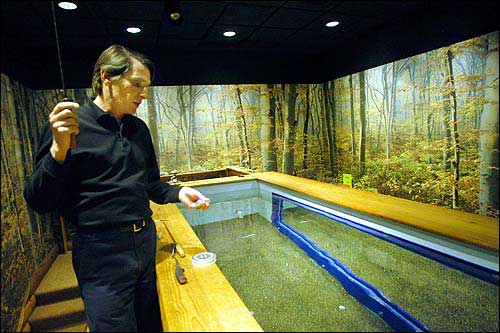
Rapala's chief fishing lure designer Jarmo Rapala, grandson of the Finnish lure developer Lauri Rapala, uses a tank to test lures. He tested the products May 5 at Rapala's North American headquarters in Minnetonka, Minn. The company's claim to fame is that every lure is tested at the factory.
America’s 44.3 million anglers generate about $41.5 billion in retail sales annually, including $4.4 billion in total spending on tackle and related equipment, and $597 million on lures, flies and artificial baits, according to the American Sportfishing Assn., an industry trade group based in Alexandria, Va.
Worldwide sales in 2003 for Rapala VMC were nearly $200 million, and the United States accounts for about 30 percent of the group’s annual sales, though the company doesn’t release a specific figure for U.S. sales.
This summer, Rapala plans to unveil what, for now, the company is calling “Project X.” It will be shown at a trade show in July and should hit the stores in August or September, said Mark Fisher, director of field promotions. Jarmo Rapala has spent the past nine months in the United States instead of his native Finland trying to perfect the product, which he called “a dream lure for the 21st century.”
A dream lure is one that meets those two big requirements, cosmetics and ability to hook a fish.
Lures such as Rapala’s deep diving Glass Shad Rap are so pretty that some customers at the Cabela’s store in East Grand Forks have bought full sets and taken the hooks off just for display, said Carl Smith, manager of the fishing department.
“You can’t hardly keep that in stock,” Smith said. “That is one that looks good and works good.”