

As ‘cyborg,’ professor tailors his own reality
Toronto ? When you first meet Steve Mann, it seems as if you’ve interrupted him appraising diamonds or doing some sort of specialized welding. Because the first thing you notice is the plastic frame that comes around his right ear and holds a lens over his right eye.
But quickly you see that there’s more to his contraption: A tiny video camera is affixed to the plastic eyepiece. Multicolored wires wrap around the back of Mann’s head. Lights blink under his sweater.
Mann greets you, warmly at first, though he soon gets distracted by something on the tiny computer monitor wedged over his eye.
In fact, being with Mann sometimes feels like the ultimate, in-your-face version of having a dinner companion who talks on a cell phone.
But don’t be put off by it.
Someday you, too, might be a cyborg.
Brave new world
Mann, a 41-year-old engineering professor at the University of Toronto, spends hours every day viewing the world through that little monitor in front of his eye — so much so that going without the apparatus often leaves him feeling nauseous, unsteady, naked.
While the small video camera gives him a recordable, real-time view of what’s in front of him, the tiny screen is filled with messages or programming code fed by a computer and wireless transmitters that Mann straps to his body.
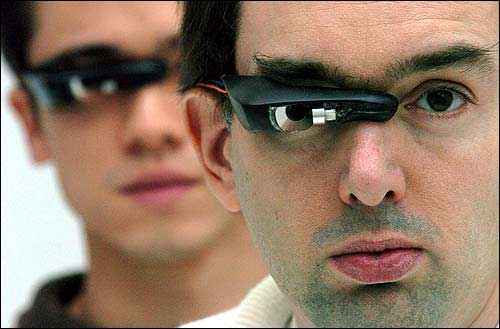
Professor Steve Mann, right, and graduate student Chris Aimone wear the EyeTap digital eye glass in Toronto. Mann spends hours every day viewing the world through a little computer monitor wedged in front of his eye. He believes that wearing computers and cameras will give people more power to protect their privacy and individuality.
Mann manipulates the computer through a handheld key device he invented, though he has experimented with putting electrodes on his skin and trying to control the cursor with brain waves.
If it sounds a bit creepy, consider this: Mann became a cyborg so he could be more human.
But Mann has sensitive and perceptive motives for his electronic immersion, which began 25 years ago. He believes that wearing computers and cameras will give people more power to maintain their privacy and individuality.
Power to the people
For one thing, Mann touts the power of wearable computers to filter out advertising and other elements of daily experience he finds objectionable.
And in a world of ever-increasing surveillance cameras for security, and strong database-mining software for government intelligence and corporate marketing, Mann believes regular people ought to have cameras and powerful computers on them, too. It’s all about leveling the power dynamic.
“People feel they’re masters of their own destiny when everything they need is right there with them,” he said.
A cyborg could, say, take pictures of hostile police officers during a political demonstration and instantly post them on the Web — to spur others to join in the protest, perhaps, or to simply provide alternative documentation of the scene. Mann calls such postings “glogs” — short for “cyborg blogs.”
A surreal beauty
Mann’s cyborg experience is much more than a political statement or geek showboating.
In his 2000 book “Cyborg: Digital Destiny and Human Possibility in the Age of the Wearable Computer,” Mann wrote about the surreal beauty he experienced in programming the computer in his vision to alter colors, or alert him to objects behind him.
“The wearable computer allows me to explore my humanity, alter my consciousness, shift my perspectives so that I can choose — any given time — to see the world in very different, often quite liberating ways,” he wrote in “Cyborg.”
For example, Mann and his graduate students have developed software that can transform billboards or other rectangular shapes in the physical world — when viewed through the lens of a wearable computer — into virtual boxes for reading e-mail and other messages.
It’s inevitable
Mann believes a cyborg future is inevitable. Eventually, he says, everyone will want to be more tightly linked with computers, to enhance our memory and connections to other people.
And in that case, Mann contends that wearing the machine will be optimal. “My computer’s twisted up like a pretzel around me, instead of me all hunched over a box,” he said.