

Inquest begins in Di’s death
London ? Britain’s royal coroner asked police to look into theories a conspiracy led to the car crash in Paris that killed Princess Diana and boyfriend Dodi Fayed, saying Tuesday he was obliged “to separate fact from fiction and speculation.”
Coroner Michael Burgess’ request — part of the opening of official inquests into the 1997 deaths — came as a tabloid newspaper reported Diana believed Prince Charles was plotting to kill her by staging a car accident. Fayed’s father said he suspects not only Charles, but also his father, Prince Philip.
A French investigation found the crash was an accident and that driver Henri Paul, who also died, had been drinking. But more sinister explanations for the crash abound, and Burgess said he asked police to investigate whether he should take them up in his inquests.
“I’m aware that there is speculation that these deaths were not the result of a sad but relatively straightforward road traffic accident in Paris,” Burgess said.
“I have asked the Metropolitan Police Commissioner (Sir John Stevens) to make inquiries. The results of these inquiries will help me to decide whether such matters will fall within the scope of the investigation carried out at the inquests,” he said.
Yearlong investigation planned
The coroner immediately adjourned his long-awaited inquiry — Britain’s first investigation of the crash — for at least a year to 15 months, saying he needs that time to review evidence gathered by French authorities and conduct his own investigations.
He acknowledged that “it would have been desirable for these inquests to have been heard and completed long ago.” That was impossible because he must rely heavily on French evidence that will not be available to him until all legal proceedings springing from the case there are finished, he said.
Burgess said he expected the French proceedings to wind down soon but warned that any unexpected delay could further slow his work. An appeal by French prosecutors is still pending against the November acquittal of three photographers whom Fayed’s father accused of invading his son’s privacy by taking pictures of the crash scene.
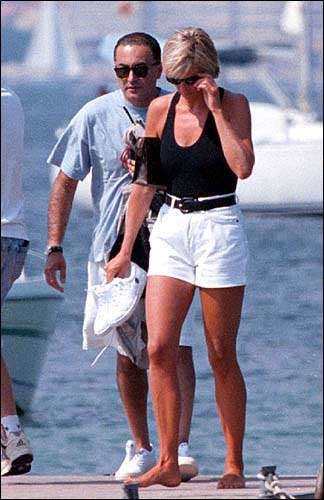
Diana, Princess of Wales, and her companion, Dodi Fayed, walk on a pontoon in the French Riviera resort of St. Tropez in this Aug. 22, 1997, file photo. Tuesday, Britain opened the first inquest into the deaths of Princess Diana and Dodi Fayed more than six years after they were killed in a car crash.
France’s highest court dropped manslaughter charges in 2002 against nine photographers who pursued the car before it crashed or who took photos at the site.
Report: Prince Charles named
On Tuesday, the Daily Mirror tabloid reported that Diana, in a letter to her butler Paul Burrell, claimed her ex-husband “is planning ‘an accident’ in my car, brake failure and serious head injury in order to make the path clear for him to marry” his longtime girlfriend Camilla Parker Bowles.
Charles’ office said it would not comment on the charge. Sarah Ferguson, the Duchess of York, told FOX News Channel’s “FOX & Friends” that the report was “disgraceful.”
The paper reported the letter in October but did not originally identify Charles as the person Diana suspected.
Egyptian-born billionaire Mohammed al Fayed, Dodi Fayed’s father, reiterated his belief that Diana, 36, and his 42-year-old son were victims of a plot and said he thought Charles and his father, Prince Philip, were involved.
“It’s absolute black and white, horrendous murder,” al Fayed told reporters at the formal opening of the separate inquest into his son’s death in Reigate, outside London, hours after Burgess opened the Diana inquiry.
“It’s the head of the royal family, and I suspect not only Prince Charles” but also Queen Elizabeth II’s husband, Philip, whom he described as “racist at the core.” Al Fayed has in the past said Philip plotted against Diana because the royal family objected to her relationship with a Muslim.
The palace dismisses such charges.
Burgess said he would focus his investigation on several key questions — “how, when and where the cause of death arose.”