

Retired police tackle cold cases
ROSEBURG, ORE. ? At age 16, Benny King was no cherub. Not even close. So when he vanished from a riverside beer party in 1975, some figured he had just skipped out on the bail his grandmother posted after King was charged with rape.
He had a string of juvenile offenses and was awaiting trial on the latest charge, which alleged he broke into a home in the small town of Lookingglass, Ore., and raped a woman at gunpoint, making her husband watch.
King remained missing for 23 years until mushroom hunters found his boots and bones in the woods west of Roseburg in 1998.
Volunteer squad
Four retired law enforcement veterans, who make up Douglas County’s volunteer Cold Case Squad, got the case in January 2003. It was the squad’s first.
Using gumshoe techniques, the four followed clues that led them to 46-year-old Johnny Carlos Tinker, a small-time hoodlum with some drug offenses who had been in and out of prison for years. He was arrested while serving time in Ontario, Ore., for taking photos of nude teenage girls.
In September, Tinker was questioned in prison by squad members Tom Hall and Thomas Schultz, and charged in King’s death. Tinker confessed in court and was sentenced to life.
“At that time we had enough on him. We probably knew as much about him as he knew about himself,” said Syd Boyle, one of the cold case detectives.
Tinker seemed almost relieved when confronted with the evidence. The killing was gnawing at his conscience, he told the investigators. He was relieved it was over.
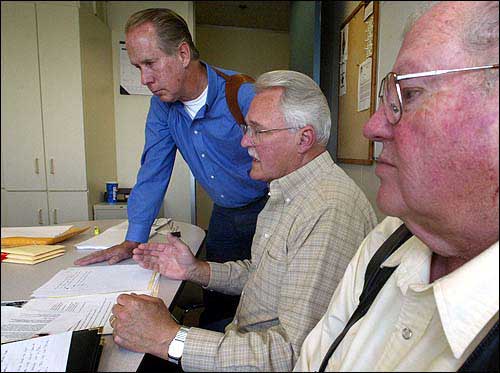
Retired law enforcement veterans Syd Boyle, left, Al Olson and Thomas Schultz examine papers involving a case at the Douglas County Sheriff's Office in Roseburg, Ore. The three volunteer about two days per week investigating long-unsolved cases.
Failed retirement
The Roseburg cold case squad — mostly 60-ish, with more than 100 years of police experience among them — could have put their feet up years ago, and they tried. There are golf courses in Douglas County, and the rivers are teeming with fish. But for two days a week, on their own time, they’re back at it: examining old files, tracking down witnesses, getting their hands dirty.
Cold case squads are forming across the country as new technology and DNA availability make it possible to delve into long-abandoned crimes, many of them homicides. A new CBS murder mystery series called “Cold Case” taps into the trend.
The Douglas County Sheriff’s Office advertised in the local newspaper, and Al Olson, Tom Hall, Thomas Schultz and Syd Boyle answered the call. They were selected from dozens of applicants.
Hall is a former postal inspector who handled bomb squad cases in Los Angeles and Phoenix. Boyle investigated a few homicides in Modesto and Turlock, Calif. Olson worked child abuse cases in Vancouver, Wash. Schultz was a former detective who served on police forces in Wisconsin, Las Vegas and Concord, Calif.
“All we knew is that they wanted to try the concept,” Olson said. “We had no idea which way it would go.”
He had tried to retire twice — the second time to a home on a golf course. It didn’t take. Detective work was like an itch he needed to scratch.
“Once it gets in your blood … it’s there forever,” said Olson, who also served as police chief in Pacifica, Calif.
A county detective, Lt. Curt Strickland, assigns the cases. The county provides a car, phone, badges, guns, a small office and expenses.
Persistent investigation
By taking just one case at a time the squad avoids distractions.
“We chose retired policemen because they have time, they have experience and because they offer their services as volunteers with no cost to the county,” said Pam Frank, a Sheriff’s Office spokeswoman.
King, squad members said, was a drug-user and drug thief who fell in with a bad crowd early. His parents could not be located at that time. He and Tinker hung out with a motorcycle group called “Brothers of the Wind.”
For years police believed a story by Tinker and others that King was last seen getting into an old Volkswagen at the 1975 party. “Everybody who worked the case, including us, chased that fictitious Volkswagen,” Schultz said. “It didn’t exist. Nobody in that group had one.”
The investigators questioned King’s buddies.
“For a long time they conspired to put out several tall tales,” Schultz said. “They said (King) had been spotted in Canada.”
Boyle said the squad kept after virtually everybody who knew King and, in effect, wore them down.
“We kept narrowing down the names then fixed on a couple of them,” Olson said.
They learned a co-defendant in the home-invasion rape wanted King killed to keep him quiet.
Suddenly, the cocoon that had protected Tinker began to fall away. The squad got their “Aha!” moment during two prison interviews: Tinker told the investigators he killed King in part because he was outraged over the circumstances of the rape.
Emerging story
Other details emerged in the courtroom.
Tinker and another man took King into the woods on the pretext of looking for a hidden marijuana stash. The first blast from Tinker’s sawed-off shotgun wounded King, who fled into the woods. Tinker lured King out of hiding, telling him the gun went off accidentally.
When King emerged, Tinker, then 17, fired twice into his head.
The other man in the woods that day was granted immunity for his testimony.
“It tied the details down,” Boyle said.
About 6,000 murders go unsolved each year in the United States. About 200,000 have gone cold since 1960.
“Typically, if no new leads are formed within 72 hours, a case has a 60 to 65 percent chance of going cold pretty quickly,” said forensic anthropologist Max Houck, who worked with the FBI crime lab and is a founder of the new Institute for Cold Case Evaluation at West Virginia University.
The institute specializes in getting forensic help to the nation’s 18,000 police departments, often at reduced costs.
Missing person
Their first case behind them, the squad is focusing on another missing person, Barbara Joy Gallagher, age 31 when she was last seen in 1988.
She lived in a heavily wooded area in rural Azalea with Robert Barr, a violent, consummate con man who was married to another woman. The body of Barr’s wife was found in 2001 in the Lake Tahoe region, near where he killed himself several weeks later.
“We’ll probably never find (Gallagher’s) body,” Olson said.
Yet, these men who might have been clearing a meadow, farming cattle, fishing — if not for the itch — press on, doing what feels right.
Boyle recently spent a day crawling under Barr’s old house; maybe there was something the investigators missed.
Public Safety
Defendant in double-homicide case from 2022 will not be immune from prosecution based on claim of self-defense
Teen who took and shared nude photo of special needs student at Free State High found guilty of misdemeanor in plea deal
Hundreds of residents urging Douglas County sheriff to oppose ICE bill; Armbrister says law would not boost ICE locally
Nonprofit plans a full slate of events for Sexual Assault Awareness Month, including trivia, art auction, vigil for survivors

Local law enforcement leaders to answer questions about ICE, traffic stops, other issues at NAACP event
