

Kantronics officials hope product signals turnaround
Lawrence bus system testing devices
When the Internet exploded into people’s everyday lives, officials at Lawrence-based Kantronics Inc. were hit with some of the shrapnel.
Business at the manufacturer of specialized radio modems began to decline in the 1980s as the Internet began to thrive. Before the Internet arrived, radio modems were one of the best ways to share information between computers.
The company’s work force dropped from about 65 employees in the early ’80s to its current eight.
“Our future looked very dark out here at one point,” said Cheryl Seiwald, the company’s president and chief executive. “What needed to happen was that Kantronics needed to look at what we do best and apply it in a different market.”
Seiwald is convinced the company’s future will be found in its new product, which helps companies track and manage their vehicle fleets.
The product, called the Kantronics Talon Universal Data Controller, can be installed on almost any vehicle. It captures data such as the speed of the vehicle, the direction it is moving, when a door is open, and when an engine begins to overheat. That data is then sent by radio waves to another device, which then puts the information on a computer.
Seiwald said she expected the product, which sells for $1,200 to $1,400, to double the company’s annual sales. She declined to discuss the company’s current sales but said they were significantly lower than the $10 million to $15 million the 32-year-old company did in the early 1980s.
“We expect this to produce several million dollars in sales for us,” Seiwald said.
She said it could boost the company’s work force to 15 people.
The product uses radio waves, making it a natural fit for Kantronics, Seiwald said, and unique among its competitors.
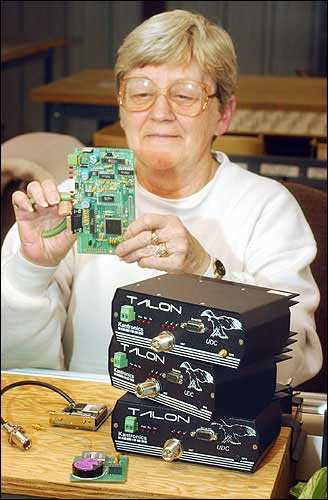
Sandra Edwards, an assembly worker at Kantronics Inc., works on the company's newest product, a tracking device than can be used by companies who have large vehicle fleets. Company officials are hoping the product doubles annual sales totals at Kantronics. Edwards worked Monday at Kantronics' facility at 1202 E. 23rd St.
Most fleet-tracking systems use cellular telephone technology, which means customers have to pay a monthly fee. The Kantronics product has no monthly fee because the radio waves can be used for free.
“One of the potential clients we’re talking to is the Detroit school system,” Seiwald said. “It has 700 buses, and it pays $14,000 per month in fees for its system.”
Seiwald said she anticipated school districts, public transportation systems, delivery companies and ambulance and fire departments to be some of its larger customers.
Lawrence transit officials are helping the company test the product. Last week, company officials installed devices on Lawrence’s 13 paratransit buses that operate in the city. Karin Rexroad, the city’s public transit administrator, said the devices should allow for greater driver oversight and better planning.
For example, Rexroad said the system would show officials whether drivers were following the most efficient routes. The Talon allows the city to have a record of every stop a driver makes, which Rexroad said could be useful in dealing with complaints.
If the test with the paratransit system goes well, Rexroad said it was possible the Talon could be installed on the city’s fixed-route system. She said the system would allow waiting customers to log onto a Web site and see how close a bus is to a particular stop.
She also thinks Kantronics is tapping into a growing national market.
“I think there will be a lot of demand for this in the future,” Rexroad said. “The ability to track vehicles and to verify that drivers are where they’re supposed to be is always good. I think the whole (transportation) industry is looking in that direction.”