A day in court
Reporter's job requires speed, accuracy, focus
Debbie Oakleaf didn’t plan on becoming a court reporter, but she’s glad she did.
For 27 years, she has taken depositions and court testimony. During those years, Oakleaf has seen plenty of changes in her profession in terms of technology and job opportunities. She said court reporters could find jobs outside the legal system, such as posting the closed captioning for sporting events and television shows.
Q: How long have you been a court reporter?
A: Since January of 1977. I went right from high school to court reporting school. My first job was in Montgomery County District Court in Coffeyville when I was 19. I’ve been working for the Douglas County District Court for four years. I have also been a freelance court reporter and owned my own freelance court reporting business for about 18 years.
Q: How did you get into court reporting?
A: I planned on going through a program at Brown Mackie Business College for training. The representative from the college explained the court reporting program. After speaking to us, my grandfather thought it was a wonderful program and said he would pay for my education, but only if I became a court reporter.
Q: What were you originally planning to do?
A: I wanted to be an executive secretary. I graduated from high school in 1975, having grown up in Conway Springs, and I’d never even been in a courtroom or had the opportunity to speak with a court reporter.
Q: What kind of training did you have to go through in college?
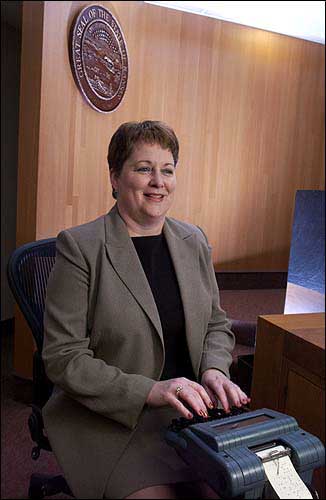
Debbie Oakleaf, president of the Kansas Court Reporters Assn., works at her post in the Douglas County District Court. Oakleaf can write at speeds of 225 words a minute.
A: The first three months I spent learning theory. I found out about the different keys and different combinations of word groupings. Once you learned that, you worked on building your speed. To become certified in Kansas, you have to pass a test at 225 words a minute with 95 percent accuracy.
Q: How many words a minute do you write on your steno machine now?
A: It varies because of the way people speak. I would say on average I’m writing at speeds of 225 words a minute, and there will be bursts where someone might be speaking at 245 or 250 words a minute. People seem to talk faster now than they used to talk, which means I have to write faster.
Q: Does your mind ever wander?
A: Not too much. You just have to really focus. It’s my responsibility to get an accurate record. The district court is the highest trial court in the state. If a case goes to the Kansas Court of Appeals or the Kansas Supreme Court, the justices don’t hear testimony. They rely on the court transcript. The job can be more difficult if I have a cold and I’m having trouble hearing. I usually ask people to try and speak a little slower. Sometimes I do have to stop someone if they’re speaking too fast or the people are talking at the same time. The attorneys also are very good about going over information, like giving me the spelling of different names or technical information. They realize if the court reporter isn’t getting it, then the jury probably isn’t getting it either. But I’ve been accused of going into this zone when I’m working, trying to tune everything else out so that I can hear.
Q: Has technology helped in your job?
| Age: 47.Occupation: Court reporter for the Douglas County District Court.Years worked in Lawrence: 4.Resides: Baldwin.Family: Three adult daughters.Hobbies: Scrapbooking, bell choir at church.Positions of honor: President of the Kansas Court Reporters Assn. |
A: Sure. When I first started as a court reporter, it was back in the onion skin and carbon paper days. The stenograph machines now have a computer in them, which my first machine didn’t have. We can also do real time, where we hook up our stenograph machines to a laptop and you can actually read what’s being said in court as I’m writing. Court reporters are also responsible for most of the closed captioning you see on your TV now, too. So we are constantly trying to keep up with the new technology. Some people ask why we don’t use tape recorders. That just isn’t as reliable as having a live person in the courtroom who can intervene if issues arise that might compromise the quality of the record.
Q: What else do you do as a court reporter?
A: I have to keep track of the exhibits from each case, which could be anything from a document to drugs to guns. So, if there’s a recess or a break for the evening, then I lock them up in my evidence locker.
Q: What do you like about your job?
A: There’s something different every day, and I’ve met a lot of people from all walks of life. One of the positives can also be a drawback. You find out interesting information, but that can be a problem, too. Some of the things you hear in cases you’d rather not know.
Q: What’s the most interesting case you’ve been a court reporter for?
A: I was the court reporter on a capital murder case. You don’t see those cases often, so that was probably the most high-profile case I’ve worked on. Because we have more judges than court reporters in this district, we all rotate through the domestic court division. I would say those cases, though, are just sad. They get into the personal lives of people. I usually leave work counting my blessings.
City Government

Rising Rates: A three-part investigative series examines why Lawrence water and sewer bills have been soaring
Some leaders are now stating a new reason for why Lawrence’s utility rates are soaring: The city didn’t grow enough

Lawrence City Commission could start the process of finding a construction manager for new fire station

Lawrence is charging water, sewer customers a special tax not required by state or city law

Lawrence housing market strains residents as development fails to keep up, city’s affordable housing study finds