Medical experts are asking about massage
Studies show benefits go beyond therapy
You lie on the crisp white sheet of the massage table in semidarkness. The scent of almond oil fills the air. Then come the hands, gently kneading the necklace of knots that rings your back, your neck, your shoulders. You close your eyes, breathe deeply and let yourself relax. Beyond the pleasures of the moment, though, are there medical benefits to massage?
Hospitals and medical clinics around the United States are beginning to integrate massage into patient care. Massage is currently the most common nontraditional therapy offered in U.S. hospitals, according to an American Hospital Assn. survey in 2003. The most common uses for massage in hospitals: helping patients cope with pain and stress, and as a therapeutic service for cancer and maternity patients.
And at the University of California-Los Angeles Center for East-West Medicine, a team of four therapists use massage to alleviate pain and symptoms for patients suffering from illnesses such as fibromyalgia, migraines and back pain.
The National Institutes of Health is funding several studies to examine the medical benefits of massage. Previous studies by various organizations have found that massage can help reduce chronic pain, diminish anxiety and depression, and enhance immune function.
A new survey by the American Massage Therapy Assn., a professional organization, shows that nearly half of Americans have used massage therapy as a way to manage and relieve pain. The survey also found that health care providers are more likely than before to discuss the possible benefits of massage and to recommend it to their patients. And some health insurers have begun paying for the therapy, according to the survey.
Still, many doctors remain skeptical of the research suggesting a medical benefit to massage, saying more rigorous studies are needed.
But doctors, nurses and patients who have seen massage in action say that even if the benefits can’t be demonstrated by large clinical studies, the anecdotal evidence is powerful.
Dr. Ka-Kit Hui, director of UCLA’s East-West Center in Santa Monica, Calif., said: “Massage is a very important therapeutic approach which is underutilized and underappreciated. A lot of people think massage is good for aches and pains. But what we have found is that massage activates the body’s own healing system.”
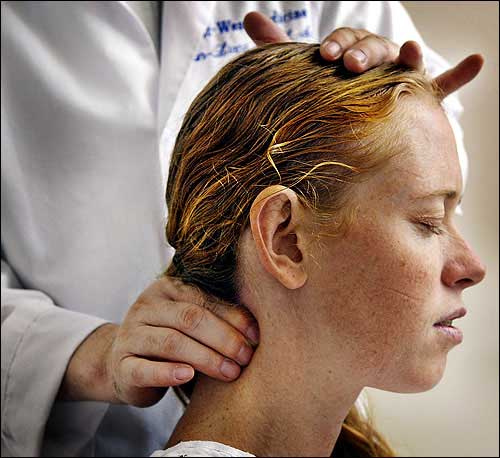
Brandi Hugo, who has suffered from a chronic inflammation, credits her improvement primarily to massage therapy. Dr. Jun Liang Yu conducts massage therapy on Hugo to help speed recovery and relieve pain at the University of California-Los Angeles Center for East-West Medicine in Santa Monica, Calif.
Patients at the center see a team made up of a Western-trained doctor, an acupuncturist and a massage therapist.
Brandi Hugo, 30, who suffers from interstitial cystitis — a chronic inflammation of the bladder — is a patient at the East-West Center who attributes her improvement primarily to massage. After years of ineffective treatment with antibiotics, she was treated at UCLA with acupuncture, a few muscle relaxants and massage. She has been off antibiotics for two years.
Hui does not believe massage is a panacea. Nor does he believe it can replace surgery or medications. But he does believe it is “an important frontline approach for a lot of chronic problems, or prevention of chronic problems.”
Health
Nonprofit plans a full slate of events for Sexual Assault Awareness Month, including trivia, art auction, vigil for survivors

Public invited to free event focusing on birth outcomes in Douglas County
IT’S NOT JUST VACCINES: Parents are refusing other routine preventive care for newborns

Ion robotic bronchoscopy transforms lung cancer detection
Just how important is a water filter?