

Cap Fed dividend drives stock
Topeka-based bank marks five years on Nasdaq
It was the story of a Kansas company going to Wall Street, and for a while it looked like it was going to have an ugly ending.
Five years ago, Topeka-based Capitol Federal Savings Bank made its debut on the Nasdaq. Its opening day price on April 1, 1999, was $10 per share. And then the stock did something that initial public offerings seldom did in the 1990s — it dropped.
By the end of the first day, its price had dropped to $9.75 per share. One week later the stock hit a low of $8.51. For about 15 months, the stock traded below its offering price of $10.
The state’s largest residential lender and a bedrock of the Kansas financial community for more than 100 years, was finding that surviving on Wall Street wasn’t easy.
“At that time, we were not having a lot of fun,” said John B. Dicus, the company’s president and chief executive. “The biggest thing that negatively affected us was that it was the beginning of the dot-com boom. The Internet stocks were all the rage, and we weren’t an Internet stock.”
Capitol Federal’s image is different than the dot-com dynamos. Rapid growth, the key ingredient in a dot-com company, isn’t part of Capitol Federal’s plans. The bank has been in business 111 years but has never expanded beyond Kansas. It also hasn’t expanded its business model much. The bank is almost exclusively a residential lender, with 94 percent of its loans for single-family homes.
Then the dot-com bubble burst. Its pop, it seemed, served as a starter’s pistol for a rise in Capitol Federal’s stock price. The company is now trading in the $35 price range.
“The first 15 months were rough, but after that it has been a pretty nice ride for Capitol Federal and the shareholders who stuck with us,” Dicus said. “There are a lot of value stock buyers out there right now looking for a good, solid company that pays a nice dividend. That’s what we are.”
Dividend darling
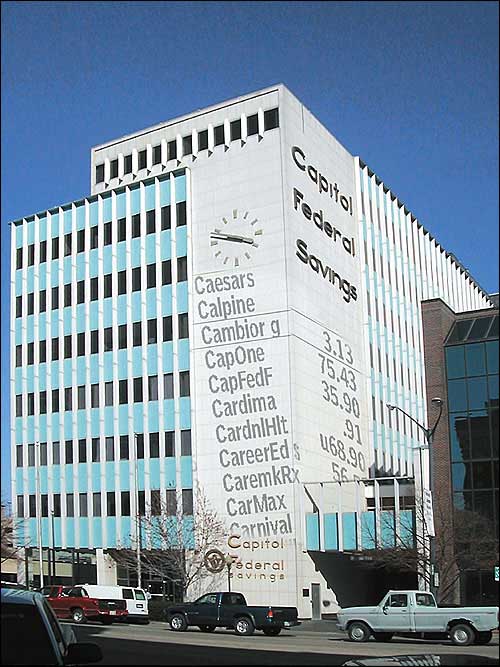
Capitol Federal Savings Bank is celebrating its fifth year as a publicly-traded company. The Topeka-based bank, whose downtown headquarters is pictured above, has benefited from an aggressive dividend that it pays to shareholders.
Most analysts agree that there’s a simple reason why Capitol Federal’s price has rebounded so well. The company is a big-time player in the dividend game.
For 2003, the company paid its shareholders an annual dividend of $2 per share. When President Bush’s tax plan decreased the amount of taxes shareholders must pay on dividend earnings, the stock became an eye-catcher for people looking to take advantage of the new law.
Capitol Federal began increasing its dividend in November 2003. Before the increase in the dividend, the stock was trading at $21 per share. Since then it has reached a high of $38 per share.
“I would like to say that the rise is because people are fond of our good management, but in all honesty, it is the dividend,” Dicus said. “We were able to position ourselves to take advantage of the market’s demand for dividends.”
Earnings struggles
But the bank’s overall business has struggled during the past year. For fiscal year 2003, which ended Sept. 30, the company posted earnings per share of 74 cents. That’s down 40 percent from 2002 earnings of $1.25 per share. Dicus blames the earnings shortfall on the low-interest rate environment. As the largest residential lender in the state, Capitol Federal had many existing customers refinance their loans. Although that produces some fee income for the bank, it reduces interest income.
“When you have loans on the books at 7 percent and people start refinancing them at 5.5 percent, all of a sudden that starts to adversely affect your net income,” Dicus said.
Dividend questions
The company’s stock price has performed well. Analysts say that’s because the dividend is still strong. Most analysts who cover the company also agree that the company’s earnings will rebound.
“When rates go back up that should definitely help the company’s bottomline,” said Ron Peterson, an analyst with Moors & Cabot, a Boston-based brokerage firm that follows the banking sector.
Not everyone agrees though. Dave Anderson, chief investment officer for Overland Park-based Gold Trust Co., said he was uncertain a rise in interest rates would help the company’s profits. And if profits don’t increase, Anderson said the company would have to cut its dividend, which almost certainly would hurt the price of the stock.
Anderson said he believed the company’s earnings justify a dividend in the 50 cent per share range — not its current $2 range.
“I think Capitol Federal is a good organization, but I think they have some reality checks to deal with,” Anderson said.
Dicus said the company’s dividend was on solid ground because Capitol Federal had built up significant cash reserves to pay shareholders even if the company’s earnings weren’t enough to cover the dividend expense.
Peterson also is advising clients that the dividend will continue.
“I think the dividends are safe,” Peterson said. “The cash at the company is there to pay for at least eight more quarters. Plus, they still have earnings coming in. It’s not like the company is losing money.”
Unique strategy
Anderson thinks the company needs to take a more aggressive growth strategy and change its policy in terms of servicing its own mortgage loans.
The bank generally doesn’t sell its mortgages to other companies, and Anderson says that makes the company more vulnerable to interest rate swings.
“They are a very stable company and there’s something comforting about them, but historically they don’t make the aggressive moves to grow,” Anderson said.
Dicus said the company was looking for new business opportunities but didn’t predict large-scale changes. He said the bank had made a decision to keep most of its loans rather than sell them to third-party financial companies. He believes that gives the bank a competitive edge in the market.
As for expansion, Dicus said the company would consider expanding outside Kansas, particularly into the Kansas City, Mo., area. But Dicus said if the company were to buy another bank, it would have to be a deal that would add to earnings immediately, otherwise the bank’s dividend policy could be at risk. Dicus also didn’t rule out opening more branches in Lawrence, which has three.
Dicus also said he expected the company to largely remain a residential lender, spurning opportunities to get into the riskier but sometimes more profitable commercial lending market.
“It is always an option for us to get into that (commercial lending,)” Dicus said. “But single-family lending is what we know how to do. One thing about this company is that we’ve always believed in sticking to what we know how to do, and then do it better than the next guy.”