

China’s Long March really much shorter
Shanghai, China ? They slogged across rugged terrain for a year, fleeing Nationalist forces and forming the cornerstone of Chinese communist legend — the “Long March” that turned Mao Zedong’s guerrillas into folk heroes of the masses they would soon command.
Now, seven decades after the grueling trek, two Britons who retraced the march’s route on foot are committing political heresy. Their conclusion: The journey was more than a third shorter than the Communist Party says — some 2,500 miles.
Ed Jocelyn and Andy McEwan said their findings showed the journey — during which Mao cemented his rule over the party that took control of China in 1949 — was 3,700 miles long.
“It was still a remarkable achievement in endurance and courage,” Jocelyn told The Associated Press on Wednesday. “The fact that it’s shorter than originally believed doesn’t diminish that in any way.”
Jocelyn, 35, and McEwan, 37, completed their journey Monday after 384 days; the original march reportedly took 370 days. The two, who have worked as editors for English publications in Beijing, are neither geographers nor historians; they based their estimate on timed walks, maps and distance markers.
History books often say the 1934-35 Long March covered 6,200 miles; some accounts say it was as long as 8,000 miles.
Fleeing the forces of Nationalist leader Chiang Kai-shek, Mao and his Red Army followers trudged through some of China’s poorest, most remote areas. Conditions were harsh. Of the roughly 80,000 men — and 35 women — who began, only between 8,000 and 9,000 survived.
“The Long March is the first of its kind,” Mao wrote in late 1935. “It is a manifesto, a propaganda force, a seeding machine.”
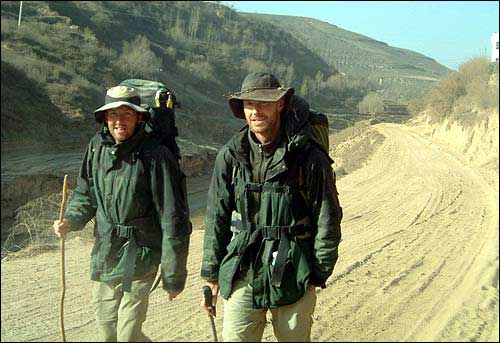
Andy McEwan, left, and Ed Jocelyn walk on the final day of their 384-day march into Wuqi, northern China. The two British men, who retraced the route of the 1930s Long
Calculating the march route’s length has long been difficult. Under continual attack from Chiang’s ground and air forces, the communist Red Army often broke up into different columns, dispersed over wide areas, backtracked, crossed the same rivers repeatedly or just got lost.
For Jocelyn and McEwan, maps of the route and references to points traveled sometimes proved wrong. Villagers along the way often corrected them.
Without any known accurate measurements, Mao and the communists may have chosen 10,000 kilometers (6,200 miles) because it was a round number that boldly defined the scale of the event, Jocelyn said. Chinese governments have a history of using numbers in that manner.
McEwan and Jocelyn can expect more resistance. Gao Zhiyin, a spokesman for the Yan’an Foreign Affairs Department, wants to argue the matter face to face.
“Can they change history?” Gao said. “The whole world acknowledges these facts.”