KU students savor taste of Indian food
Dishes contain lots of spice
For the moment, Sirisha Kodeboyina and her roommates are eating exceptionally well.
The mother of one of the Kansas University graduate students Kodeboyina shares an apartment with has come from India to spend about six weeks visiting her daughter, and she happens to be a wonderful cook.
So these days, the apartment is perfumed with the tantalizing aromas of dish after dish of homemade comfort food made by an Indian mom: chicken marinated in ginger-garlic paste, red chili powder and lime juice; aloo bonda, meltingly luscious fried potato dumplings with chilies, ginger and mint; and pav bhaji, toasted, buttered buns served with a mild, curried sauce of mashed vegetables.
Oh, and the desserts: gulub jamun, a classic Indian sweet (fried dough balls soaked in sugar syrup and chilled); and sunnunda (dense, rich and intensely delicious balls made from lentil flour, sugar and ghee, a kind of clarified butter).
“She really makes good Indian food,” Kodeboyina said of the dishes emerging from her apartment’s small kitchen, courtesy of Jagannayaki Kilambi, the mother of Sri Anjana, who’s earning her master’s degree in biomechanical engineering at KU.
“This is like eating all the food we have been missing.”
Kodeboyina, working toward her doctorate in biochemistry, has lived in Lawrence for two years. She likes it here, but, like many KU students who come from India, she misses the familiar tastes of home.
“I didn’t know a lot about cooking in India. So a couple of friends and I started to cook. It’s really difficult to totally survive without Indian food,” she said.
“I have to have rice and curry at least once a day. A lot of Indian students (at KU) are roommates, and they take turns cooking.”
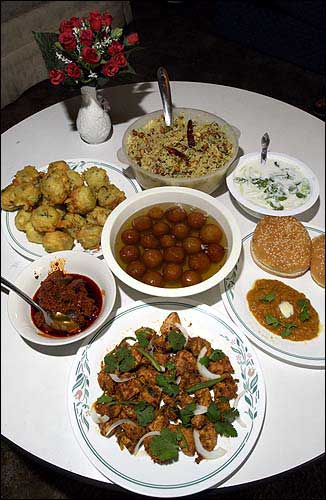
Authentic indian food is usually spicier and hotter than dishes served by Indian restaurants in the United States. Traditional Indian dishes include, clockwise from bottom, chili chicken, mango pickle, aloo bonda, yellow rice, raita, pav bhaji and gulub jamun, center.
Venumadhav Mangipudi, who recently earned his master’s degree in computer science from KU, has his own strategy for maintaining a steady supply of Indian dishes.
“I’m not a very good cook, but I have a lot of friends who cook,” said Mangipudi, who is from Hyderabad, a big city in the Indian state of Andhra Pradesh.
“I miss everything my mom used to cook back there. She usually makes dal (a lentil dish) and a curry every day, a chutney (a spicy, pickled dish) and yogurt. That’s a typical vegetarian meal.”
Club promotes Indian culture
With recent movies such as “Monsoon Wedding” (2002) and the current release “Bend It Like Beckham,” about a Sikh teenage girl’s struggle to play soccer against the wishes of her parents, more Americans are being exposed to Indian culture.
The results of this can be seen at KU.
“I’ve been associated with the KU Cultural India Club for about a year. The more I talk to Americans about Indian culture, the more they are interested in it,” said Siddharta Gavirneni, a student from Hyderabad who’s working on his master’s in computer science.
| The Internet is a good source of information about traditional Indian cooking and recipes.Two helpful Web sites are: www.bawarchi.com and www.daawat.com.To learn more about the Kansas University Cultural India Club, click on www.ku.edu/~kuindia/Menu.htm. |
“The shows and festivals that we have at KU, about 400 to 500 people come, and 50 percent of them are non-Indians.”
The club, which is run by a committee of 10 students, has between 100 and 150 members, according to Gavirneni. He is the club’s public relations officer.
The club sponsors several large gatherings each year at KU to mark major Hindu festivals such as Dushera, Diwali and Holi, as well as a party each Aug. 15, Indian Independence Day.
These gatherings on campus feature traditional Indian food, music and dancing.
In between the cultural club’s festivals, KU’s Indian students have to fend for themselves to find the kind of meals they’re used to.
“Whatever I eat here doesn’t taste the same as my mom cooks. That’s who I learned my cooking from. I cook twice a week, usually northern Indian dishes like chicken curry or pav bhaji,” Gavirneni said.
KU’s Indian students like to get together on weekends and take turns cooking for each other.
“We have potlucks and watch Indian movies,” Kodeboyina said.
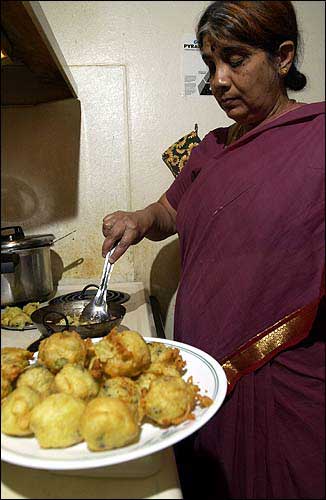
Jagannayaki Kilambi, mother of Sri Anjana, a Kansas University graduate student, makes aloo bonda in her daughter's apartment. Aloo bonda is like fried potato dumplings. Kilambi made the dish Thursday during her six-week visit in Lawrence.
Going to Indian restaurants just isn’t enough to satisfy the cravings of students like Kodeboyina, Gavirneni and Mangipudi.
“Restaurants here are different in the spice levels they use. The food is a little bit bland compared to what we eat at home. We’re used to eating more spicy food,” Kodeboyina said.
Indian restaurants in the United States typically serve northern Indian dishes, which are milder in flavor and served with roti, a flatbread.
“Americans don’t get to eat a lot of authentic Indian food. The desserts are difficult to make. I guess that’s why they don’t have them here,” she said.
Watch out for mango pickle
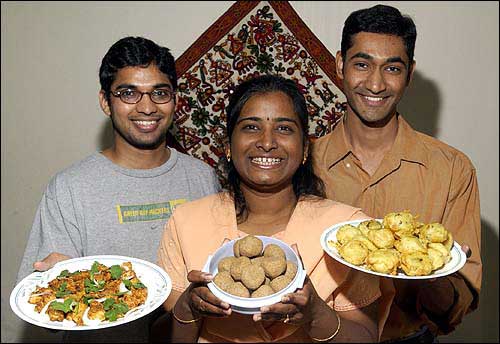
From left, Venumadhav Mangipudi, Sirisha Kodeboyina and Siddharta Gavirneni hold their favorite Indian dishes. Those dishes are, from left, chili chicken, sunnunda and aloo bonda.
Indian students coming to the United States will often bring favorite delicacies and condiments with them.
One such hard-to-find item is mango pickle, a side dish made up of highly spiced mango chunks with mustard and fenugreek seeds, chili and turmeric powders and aniseed.
KU’s Indian students will warn you: It’s dangerously hot. Like wasabi, mango pickle is best sampled in tiny bites. Otherwise, you’ll feel like you’ve swallowed rocket fuel.
A good antidote to the scorching heat of mango pickle is a mouthful of raita, a cool dipping sauce or condiment made of onions, coconut powder, cilantro and yogurt.
Few Americans seem to know how healthful Indian food really is, according to Mangipudi.
“One misconception is that it’s a high-calorie food, because a lot of it is fried. But it’s very nourishing and good. There are lots of vegetables, greens and lentils,” he said.
Americans can enhance their appreciation of Indian food by learning to cook it themselves.
“It’s not that hard. People think it’s really difficult, but it’s not. I do a lot of cooking — it feels like being closer to home,” Kodeboyina said.
Food

This quiche just might make you love leeks
Molcajete, while not required, adds magic to chicken thighs with roasted tomatillos