Fire up the grill
Top chefs, cookbook authors talk about American tradition
Chicago ? Get out your apron, dig out Dad’s favorite barbecue recipe and fire up the grill. Grilling season is here.
Whether you cook with charcoal, gas or a bit of both, guests will crowd around your picnic table if you follow a few simple grilling tips, not to mention recipes, from some top chefs and authors.
To many, Dad’s barbecued ribs, whether dry or wet, spicy or mild, are every bit as American as Mom’s apple pie. Indeed, Abraham Lincoln’s parents celebrated their wedding with a barbecue, and George Washington loved to go to barbecues and even wrote about them in his diary, according to Steven Raichlen, author of “How to Grill,” “The Barbecue! Bible” and his newest, “BBQ USA” (Workman, 2003, $19.95 paperback)
“Barbecue is very deeply imbedded in our national psyche and has been since even before we were a nation,” says Raichlen, speaking by phone from his home in Martha’s Vineyard, Mass.
From ribs to lobster, corn-on-the-cob to bread pudding, grilling can be an innovative yet easy way to cook.
Food Network chef and cookbook author Gale Gand, for example, enjoys grilling fruit on a propane grill on her screened-in porch outside Chicago. Grilling, she said in a phone interview from New York, “really intensifies the sweetness without adding extra sugar. The hotter the grill, the more caramelization you’ll get” when cooking fruit, Gand says.
Gand, co-owner of Tru restaurant in Chicago, takes part in neighborhood grilling parties and believes grilling holds “the same emotional tie as a hearth or fireplace.” People seem to gather around a grill “as if some kind of magic or alchemy is going on,” she says.
“You hear that crackling sound of the flames, and you know something great is about to happen,” adds Gand.
Tips on cleaning
Advice from Gand: Cooks should be sure to clean the grill once a year and keep an extra tank of propane handy so they won’t run out of fuel while cooking dinner.
Raichlen has about 30 grills altogether, between his two homes, one in Massachusetts and one in Florida.
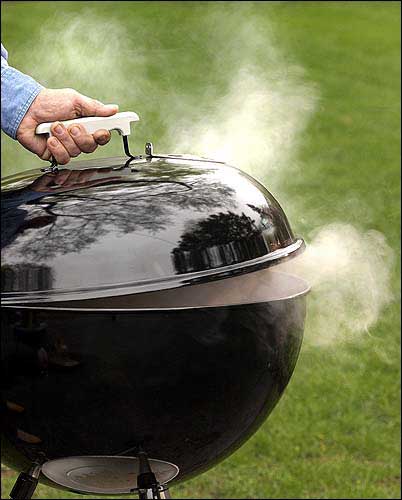
In his household, “Everything from the appetizer to dessert tends to get cooked on the grill,” he said. “We allow for the occasional green salad or steamed fiddlehead ferns, however.”
Raichlen advises home chefs to keep their grills hot, clean and well-oiled. “Food is less likely to stick to a hot grill grate, and you’ll get better grill marks,” he says.
To clean a grill, Raichlen recommends using a stiff wire brush or crumpled aluminum foil. He suggests oiling the grate before turning on the grill.
“To do that, you take a paper towel, fold it into a little pad, then dip it into a bowl of vegetable oil and rub it across the bars of the grate.”
Hankering for hickory
Rick Bayless, chef-owner of Chicago’s highly rated Frontera Grill and Topolobampo restaurants, cookbook author and host of the PBS-TV series “Mexico: One Plate at a Time,” calls himself “an inveterate barbecuer.”
Bayless puts his charcoal and gas grills to good use every February when he invites friends over for a huge barbecue just to remind them “summer is going to come.”
Bayless, whose parents ran Hickory House, a barbecue restaurant in Oklahoma City, says he grew up on the flavors of grilled and smoked meat.
“I don’t like charcoal. I like to burn logs,” he says. Bayless says it’s fun to play around with other woods, “But, man, when I get a hankering for that Oklahoma stuff, it’s always hickory.”
| Here’s a summary of grilling advice from the pros:¢ Keep grills hot, clean and well-oiled.¢ Set up three grill zones: hot, medium and cool with the burner off.¢ Use tongs, not a barbecue fork, to turn meat so as to avoid poking holes in the meat and letting out some juices.¢ Baste steak with a little olive oil or rub butter on it when it comes off the grill. “That little bit of fat seems to bring out the flavor.”¢ Let a steak or chop rest a couple of minutes before you cut into it so that the meat relaxes and the juices come back in.¢ Clean your grill well at the end of the season so that it’s ready to go the first time you get another chance to cook outdoors.¢ Keep an extra tank of propane on hand.¢ Consider using flavored or smoked woods on the charcoal grill.¢ Oil your food rather than your grill grate unless the grate is cast iron.¢ Allow the food to cook a while before flipping it. |
One of his favorite grilled foods is pizza, particularly one topped with melted goat cheese and bacon. And, of course, he likes to slow-cook pork ribs in the middle of his grill, with the coals banked on either side.
Common mistakes
Bayless thinks a common grilling mistake is that people get their fire too hot, causing food to cook too quickly on the outside before it’s done on the inside. In fact, Raichlen suggests setting up three grill zones: hot, medium and cool. Then if something is cooking too fast, you can quickly move it to the cool zone.
Bayless also suggests brushing or spraying oil on the food rather than on the grill unless the grate is cast iron.
Cookbook author Rick Tramonto, Gand’s partner at Tru, also loves to grill, in fact “almost every night in the summer.”
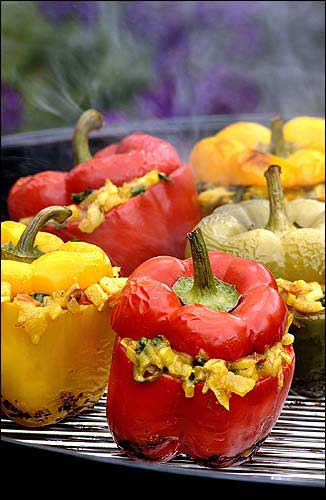
Stuffed peppers make unique grilling fare but care must be taken with temperature.
Tramonto believes the most common grilling mistake people make is turning the food too soon. “People don’t let stuff cook; they can’t just start flipping. They don’t let it develop a crust. They don’t let it develop a good sear which seals in all the juices and all the flavor,” he says.
Tramonto, who owns one gas and one charcoal grill, says he enjoys grilling because of the great flavor and “the whole ambiance of being outside and cooking outside.”
He’s adventuresome, too. He says he loves grilling frog legs, he cooks outdoors even when it snows, and hopes others will grill more, too. “It brings family together; it brings friends together; it’s a great social setting.”
He’s particularly fond of his Tramonto Potato Wedges. He says one potato should serve two people. For each potato, this informal recipe calls for a half cup of olive oil, two cloves of minced garlic, salt, pepper and cayenne pepper to taste, and one teaspoon of Dijon mustard.
Wrap each potato in aluminum foil and bake it in a 400 degree oven for 45 minutes to an hour. Let it cool about an hour. Make a marinade of the olive oil, garlic, salt, pepper and cayenne pepper. Quarter the potato into wedges, then cut each wedge in half before dressing the potato with the mixture. Allow the potato to marinate about 10 minutes, then grill on both sides for about 3 minutes each side.
Food
Instant Pot Jewish brisket adds sweet and savory flavor to Passover and many holidays
The seafood industry is betting on fish that looks more like meat

This minty pea soup with ham is a creamy, chive-packed upgrade for puréed soups

Rural winery in Leavenworth County that won $22,000 state grant for tourism hopes to grow to be bigger part of community