Outbreak closes city pools
Water-borne parasite infects 11 victims
Four public swimming pools were ordered closed Friday after an outbreak of illness caused by cryptosporidium, a parasite spread by human and animal waste.
Lawrence-Douglas County Health Department Director Kay Kent said 11 people had been diagnosed with illness caused by the bacteria since early July. The victims had been swimming at the four pools.
“Even if swimming pools were not the original source” of the infection, she said, “we’re recommending the hyperchlorination of the pools where we have had positive cases.”
Kent closed the city’s Lawrence Aquatic Center, 727 Ky., and the pool at Alvamar Golf and Country Club, 4120 Clinton Parkway.
She also requested the closing of pools at Kansas University’s Robinson Center and Haskell Indian Nations University. Those are state and federal facilities, respectively, not subject to the health department’s jurisdiction.
Officials said Lawrence’s water supply was not in danger.
Cryptosporidium is a microscopic parasite that causes diarrhea, loose or watery stool, stomach cramps, upset stomach and a slight fever. It can be fatal to patients with weakened immune systems, such as the young, elderly or people with HIV. More than two-thirds of those who contract cryptosporidiosis are children.
The parasite is easily passed in swimming pools, because it is able to survive outside the body for long periods of time and is resistant to chlorine disinfection.
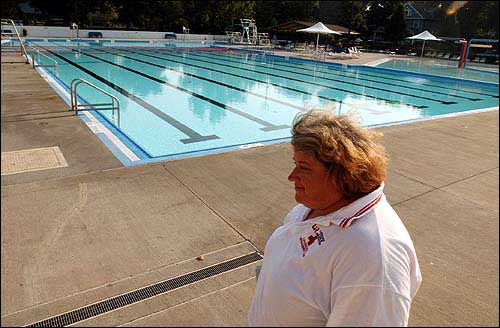
Lori Madaus, Lawrence's aquatic manager, walks poolside after closing the Lawrence Aquatic Center, 727 Ky., because of 11 confirmed cases of cryptosporidium, a parasite spread by human and animal waste. Four pools in Lawrence closed Friday because of the illness.
In Lawrence, the outbreak was serious enough for officials to shut down swimming pools during one of the hottest weeks of the summer.
The city’s outdoor pool closed at 5 p.m. Friday instead of the usual 9 p.m. City Manager Mike Wildgen said Carl Knox Natatorium, 1901 La., was being shut down and also would be treated. The Indoor Aquatic Center, 4706 Overland Drive, was already closed for maintenance.
“Our hope is that the pools can open Sunday, but we won’t know if that can be achieved until the treatment is confirmed,” he said.
Lynn Bretz, a KU spokeswoman, said a diving pool at Robinson already was closed for maintenance. The university is complying with the health department’s request and closing the other pool at the center, a lap pool.
An official at Alvamar declined to be interviewed. Attempts to contact Haskell officials were unsuccessful.
Agencies requested
Kent said there were no outbreaks of cryptosporidium in Douglas County in 2002. This year’s first case appeared in early July; by July 23, officials knew there was more than one person who had contracted the parasite.

 6News video: Parasite discovered in city pools
Ten of the 11 people diagnosed with illness had recently been swimming at one of the four pools, Kent said. But the origins of the outbreak remain unknown.
The Kansas Department of Health and Environment and the federal Centers for Disease Control have been asked to assist the investigation into how the parasite spread.
Anyone who has had diarrhea should avoid swimming for two weeks, Kent said, to avoid passing the parasite to others.
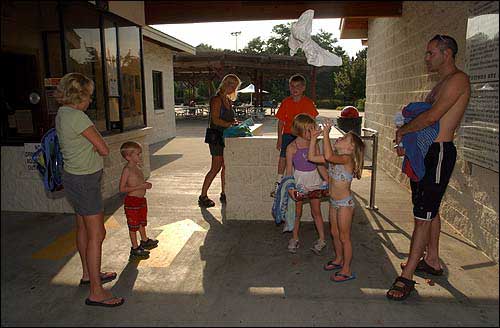
At the Lawrence Aquatic Center, swimmers stand at the pool's entrance and debate their next plan of action after finding the pool closed because of an illness caused by the cryptosporidium parasite.
“I would say it’s an outbreak,” Kent said. “I wouldn’t want to say it’s bad.”
Disappointment
Lori Madaus, the city’s aquatics manager, said 50 people were asked to leave the outdoor pool at 5 p.m. Friday.
Soon after, people were being turned away at the gate. One young girl was seen crying at the disappointment.
Thelma Helyar brought her granddaughter Savita, 6, only to find the entrance gated.
“I’ve been promising her all day. It’s a big disappointment,” Helyar said. “But I certainly wouldn’t want her to get it.”
Madaus said she sympathized with the would-be swimmers.
“It’s very discouraging for us and the staff,” she said. “But it’s something we’ve got to do — we’re going to be proactive and take care of it.”
There is no way to test for the parasite in pool water, she said. But technicians will take hourly samples from the pool as chlorine levels are boosted to twice their normal levels, then brought down so the public can swim again.
The city’s outdoor pool is scheduled to close for the season after Sept. 1, which is Labor Day.
“It will probably be an inconvenience for” swimmers, Kent said. “But in the long run it’s for the protection of their health.”
The biggest outbreak of the infection, in 1993, killed 100 people and sickened 400,000 when cryptosporidium contaminated the water supply in Milwaukee.
City Government

Rising Rates: A three-part investigative series examines why Lawrence water and sewer bills have been soaring
Some leaders are now stating a new reason for why Lawrence’s utility rates are soaring: The city didn’t grow enough

Lawrence City Commission could start the process of finding a construction manager for new fire station

Lawrence is charging water, sewer customers a special tax not required by state or city law

Lawrence housing market strains residents as development fails to keep up, city’s affordable housing study finds