

Longest U.S. desegregation case due for settlement this week
Baton Rouge, La. ? President Eisenhower was launching his re-election bid in 1956 when black schoolchildren here embarked on what has become the nation’s oldest school desegregation lawsuit.
Now, nearly a half century later, a judge who keeps the original, yellowed papers in a vault is set to bring the case to a close with a long-awaited settlement.
But the decades of legal turns have done little to achieve the lawsuit’s goal of integration or made things much better for what are now the plaintiffs’ grandchildren.
Middle-class whites have largely abandoned this city’s beleaguered, 45,000-student public school system, which is now nearly 75 percent black. Money has been tight. No new schools were built between 1974 and 2002. At one school north of downtown, water leaks through stained ceiling panels, and flakes of peeling paint must be swept from the children’s bathrooms.
The settlement, up for a final hearing Thursday before U.S. District Judge James Brady, is itself a mixture of formulas to parcel out the few remaining whites.
Proponents frankly admit its main virtue is to end the long-running suit.
“I don’t think it’s going to mean a whole lot for any kind of integration. I don’t think that’s possible now,” said Carl Bankston, a Tulane University expert on desegregation in Louisiana schools.
It’s an ironic twist on the simple plea of 1956 that black children in the then-separate system be allowed to “enroll, enter, attend classes and receive instruction in the public schools on a nonsegregated and nondiscriminatory basis.” It was signed by, among others, Thurgood Marshall, later a Supreme Court justice but then with the National Association for the Advancement of Colored People.
That plea was shunted aside, here as elsewhere in the South. The judge who presided over the lawsuit for the first two decades was once a vocal opponent of integration, and Baton Rouge schools continued to operate largely as they had before.
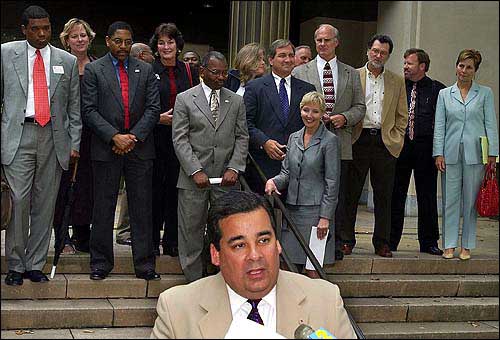
Clayton Wilcox, the East Baton Rouge Parish school superintendent, announces an agreement June 18 in Baton Rouge, La., that would settle the remaining issues in the city's 47-year-old desegregation case. Standing behind him on the steps of the federal courthouse are participants in the mediation that led to the agreement. The settlement is expected to be finalized Thursday in federal court.
When a new justice, U.S. District Judge John Parker, took over 25 years after the suit’s filing, he was appalled that so much time had elapsed with so little progress — and ordered busing. That was 1981, a decade after most places had already gone through busing’s contortions.
The cure was late and drastic, and white students, 60 percent of the system in 1980, immediately began draining out. The numbers of whites in city schools dropped from 42,000 then to only about 12,000 today.
In 1996, officials still desperately trying to solve the Baton Rouge desegregation case substituted magnet schools for busing.
But whites didn’t come back and private school enrollment boomed. By 2000, of all the whites in school in Baton Rouge, 74 percent of them were outside the public system.
So why did school desegregation take longer to resolve in this city than elsewhere?
One key factor was the first judge who presided over the desegregation case, U.S. District Judge E. Gordon West. In the same year the Times lauded the city’s stand on race, West called the Supreme Court’s landmark Brown v. Board of Education decision that integrated public schools “one of the truly regrettable decisions of all times.”
In 1975, he declared the case over and Baton Rouge’s schools desegregated. A higher court overruled him, however, and eventually busing and the closing of some schools was decreed.
The case dragged on, evolving into a political grudge match.
“Too much politics, too many people who didn’t want to give up ground,” said Samuel Moncrief, who was a small child when his name was put on the suit in 1956. “I wished it would have been settled a long time ago.”