

Afghans blame U.S. for mysterious ‘tiger’ attacks
Resentment toward troops bolsters legends
Qoochi, Afghanistan ? To hunt the ferocious ‘tiger cat’ on the Shomali plains north of Kabul, the capital, you must move through a maze of walled dirt alleys and dip into the icy fear that chills entire villages.
Along the way, you must interrogate bombastic heroes who claim to have wrestled and killed these beasts single-handed, and sift conflicting descriptions of something like a big dog, or a fox or a cat.
And just when you are convinced that the whole story is a crazy legend, you will meet children scarred by cat attacks and mourn with a man who lost his grown son to illness after a cat bite.
Whatever it is that is terrifying the villagers on this verdant plain studded with fruit trees and land mines, people here agree on whose fault it is: the U.S. military’s.
There are theories the cats might have crossed the mountains from China, or perhaps are domestic cats gone so feral in the country’s long wars that they acquired a taste for human flesh. But few people give those much credence.
These beasts, the popular view goes, did not just arrive. They were brought here. In the blinkered certainty of village logic, the arrival of two recent unwelcome groups of newcomers, U.S. soldiers and “pisho palang”, can only be related.
“Before this new army came here, we didn’t have these cats,” said Mohammad Yakob, 45, from Saidkhail village, near Charikar, north of Kabul
Even in anti-Taliban areas, the jubilation over America’s role in toppling the hard-core religious regime has long faded and resentment against foreigners is growing. Many Afghans see the American forces as interlopers, even occupiers, and gossip about their bad deeds and ill intent is rife.
In some parts of the country, angry farmers blame Americans for their poor opium poppy crops this season, claiming that U.S. planes sprayed them with herbicides — an assertion denied by U.S. officials. In Charikar, they accuse American servicemen of selling pornographic magazines in the market square. Near the U.S. base at Bagram airport, north of Kabul, rumors about the pisho palang convey the scale of the public relations problem that the American military has in Afghanistan.
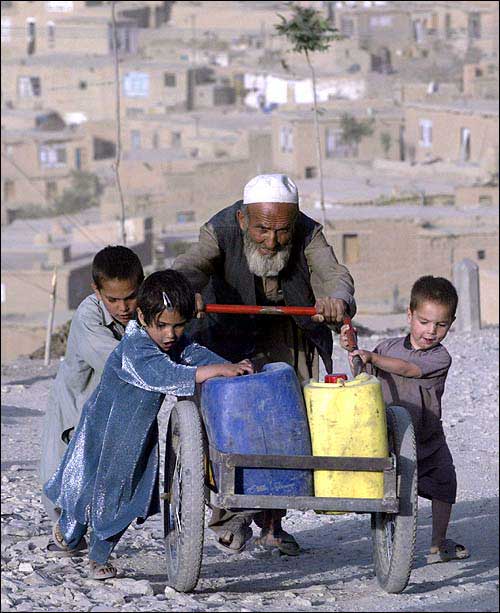
Three young Afghani children help an elderly man push a cart with water up TV Tower Hill in Kabul, Afghanistan. While Afghans have grown accustomed to U.S. troops in the country since the fall of the Taliban, they resent some aspects of the troops' behavior and have blamed them for a host of problems, from failing opium crops to the legends of deadly tiger cats exploring the countryside.
In an e-mail response to the questions about the rumors, Col. Roger Davis, of the base media office, rejected the villagers’ assertions that American forces had released the tiger cats, but did not say whether the Americans thought it important to correct the misconceptions.
“No, we don’t use cats, killer cats, al-Qaida cats, mountain cats, tiger cats, pussy cats or any other cats to execute combat operations,” he wrote.
Raining cats
At times, the alleged American motives for releasing the pisho palang and supposed delivery methods strain common sense.
“We heard that foreigners are releasing them at night from planes to eat people. We heard that usually the tiger cats attack the throat and drink all the blood,” said Mohammad Saber, also from Saidkhail.
Air delivery? But wouldn’t the fall kill the cats?
“They fly really low,” said Koko Gul, 20, of nearby Monara village, holding his hands a foot from the ground, “and they just drop the cats onto the ground.”