

Historic cookbooks provide glimpse into past
Dallas ? Carefully turning the yellowed pages of old cookbooks, written by settlers a century or more ago, conjures up a time when lard was a common ingredient, puddings were all the rage and directions for measurements might read “a teacup full.”
The value of recipes in old cookbooks isn’t always culinary; they often lack accurate measurements and fail to give cooking directions. Just ask Cammie Vitale Shuman, a former cooking teacher, cookbook editor and part-time caterer, who attempted a muffin recipe from one of the books.
“They came out as hard as lead,” she recalls. “The older the cookbook, the less likely you are to have satisfaction from the recipes in them.”
The books have historical value for Vitale Shuman, curator of Southern Methodist University’s collection of about 275 cookbooks from the 1870s to 1935.
“We want to have cookbooks here that help us unravel the cultural history of Western people,” she says about the cookbooks, which yield tremendous information about the fiber of local communities.
“They were done by charitable and church organizations, and we assume that many of them were done to finance the programs that those church and civic and charitable organizations had in their local community,” she says.
After the Civil War, there was a growth in the range of women’s civic and community organizations, as seen in the sponsorship of cookbooks, says Crista DeLuzio, assistant history professor at SMU.
“Women are drawing on their traditional functions, but using that to claim a larger space in the public sphere,” says DeLuzio, who plans to use the growing collection in her classes.
The cookbook collection is part of SMU’s DeGolyer Library of rare books, specializing in Western Americana. It was started less than two years ago. Most of the books, which range in value from several hundred dollars to less than $10, were found by scanning eBay and other Internet vendors. The library is, of course, always looking for donations.
Many of the books contain interesting aside, including advertisements that provide insight into the lifestyles of another time.
In an 1876 cookbook from Des Moines, a man identified only as Dr. Aborn held himself out to Iowa readers as an “oculist, aurist, catarrh, throat & lung physician … and specialist for chronic diseases generally.” The ad helpfully pointed out that Des Moines was “accessible by railroad to the five or six adjoining states.”
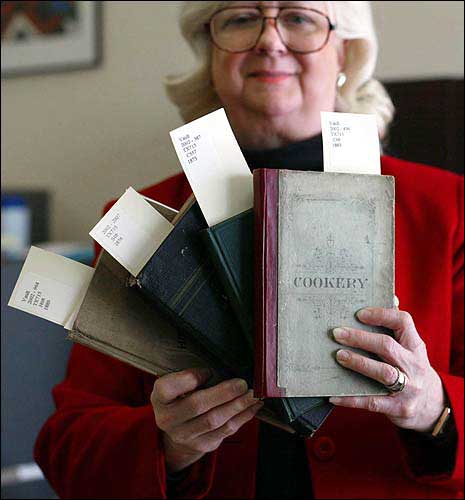
Cammie Vitale Shuman, curator of Southern Methodist University's collection of cookbooks from the 1870s to 1935, holds some of the university's historic cookbooks in Dallas. Vitale Shuman said the cookbooks yield tremendous information about the local civic and church groups that assembled them.
Recipes in the old books feature delicacies such as pork cake. “The Texas Cook Book,” believed to be the first cookbook in the state, offers a cough syrup formula featuring 20 grains of opium. The library has two facsimiles of that 1883 book from the Ladies’ Assn. of the First Presbyterian Church in Houston and would like an original.
The home remedies show that women were also expected to cure ills.
“Up until the 1920s or so if you went to a hospital, you went there to die,” says Susan Mitchell Sommers, history professor at Saint Vincent College in Latrobe, Penn. “Medical doctors were few and far between.”
Sommers said drug use was common in the 19th century and many people grew items such as opium poppies in their gardens for remedies.
Most of the older cookbooks didn’t find it necessary to give cooking instructions. “Choice Receipts,” published in 1873 to help pay for the building of a girl’s school in Walla Walla in what is now Washington state, gives the following recipe for pound cake: one pound of sugar, three-quarters of a pound of butter, 10 eggs, one pound of flour and some grated nutmeg.
“They assumed that the cooks knew their way around the kitchen,” Vitale Shuman says. “There’s nothing really that passes for directions in these things.”
Most recipes were handed down through families or friends, and precise instructions for the heat weren’t included in the early cookbooks because they were working with wood or coal burning stoves, in which heat was difficult to control. Ingredients were often limited to locally available items.