

Settlement reached in massacre of 11 Israelis at 1972 Olympics
Munich, Germany ? Thirty years after the massacre of 11 Israelis by Palestinian gunmen at the Olympic Games, Germany announced Friday that relatives had accepted $2.98 million in compensation far less than the $29 million they demanded and without an apology.
Speaking to reporters at a ceremony marking the anniversary of the Sept. 5, 1972, massacre, Interior Minister Otto Schily rejected suggestions German police made mistakes that contributed to the carnage.
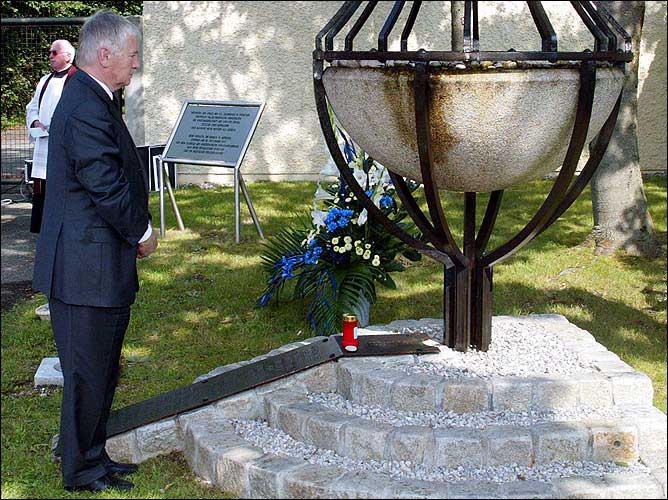
Germany's Interior Minister Otto Schily observes a minute of silence at the memorial site for the victims of the terrorist attack at the 1972 Olympic Games in Munich. The observance was Friday at the military air base in Fuerstenfeldbruck, south of Munich. Eleven athletes from Israel and one German police officer were killed in the terrorist attack.
“Even in Israel, hostage-takings and attacks are not prevented,” Schily said. He said the compensation was a humanitarian gesture from the German government, the state of Bavaria and city of Munich.
The Jewish holiday of Rosh Hashanah meant the families of the slain Israeli team members didn’t attend the ceremony at the military air base near Munich, where the drama came to a bloody end.
Schily and other officials joined in prayer for the victims and urged the world to combat hatred and fanaticism, revealed again in the Sept. 11 attacks in the United States.
About 100 guests gathered at a memorial erected in 1999 at the Fuerstenfeldbruck air base, placing pebbles from Israel on the rim of its granite bowl beneath 12 flames of weathered steel symbolizing the Olympic flame, the 12 tribes of Israel and the 12 victims, who included one German police officer.
A connecting thread
A minute’s silence followed near the squat control tower where German police shot four of the eight terrorists, sparking a firefight in which nine hostages, five of their captors and the police officer died.
“A thread connects the terrible events of 1972 with today,” said Israel’s ambassador to Germany, Shimon Stein. “The sad thing is that the terrorists have stuck to their gruesome methods over the years.”
The attack on Israeli athletes set back Germany’s efforts to rehabilitate its image 27 years after the end of World War II and nearly half a century after Adolf Hitler turned the 1936 Olympics into a showcase for Nazi Germany.
It also wrecked the ideal of the Olympics as an oasis of international friendship at a time of high tension in the Middle East.
Surprise attack
The drama started before dawn, when eight members of a Palestinian terrorist group called Black September clambered over the unguarded fence of the Olympic village, sparking a drama that millions watched on television.
Wearing track suits and carrying weapons concealed in athletic bags, they burst into the building where the Israeli team was staying, shooting dead wrestling coach Moshe Weinberg and weightlifter Yossi Romano.
Some Israeli athletes escaped through a back door but nine were seized. The terrorists demanded the release of more than 200 Palestinians held by Israel and two German left-wing extremists in German jails.
After a day of tense negotiations, the terrorists and their hostages were allowed to leave aboard two helicopters for the Fuerstenfeldbruck airfield 16 miles away. The terrorists were promised a plane and safe passage to Cairo, Egypt.
Sharpshooters at the airfield opened fire as the terrorists and hostages prepared to board a Lufthansa jet.
The guerrillas tossed grenades at the hostages, and one of the helicopters was blown up by a terrorist grenade. When the fighting died down, the captives were dead along with five of their captors.