

Indigenous peoples re-tell ocean-blue point of view
Berkeley, Calif. ? If you believe the textbook version of Christopher Columbus, he was an explorer of mythic proportions, the man who proved the Earth was round, the man who discovered the new world.
But there is another version to the tale, one that depicts the Italian sailor as a greedy conqueror who pillaged the earth and enslaved the people he found there.
As the nation prepares to mark the 510th anniversary of Columbus’ landfall today, hundreds of people gathered in Berkeley for the weekend to celebrate the city’s 11th annual Indigenous Peoples Day.
“A lot of our Indian people, we did not celebrate Columbus Day or Thanksgiving,” said Tom Philips, a Kiowa who lives in Manteca, Calif.
“We did not give thanks, because we lost our land. We lost everything that belonged to us.”
Indigenous Peoples Day dates back to 1977, when the idea first surfaced at an international conference of American Indians.
In 1990, with the 500th anniversary of Columbus’ explorations just two years away, representatives from 120 American Indian nations resolved to transform the day into a show of solidarity for indigenous peoples.
The holiday is now recognized in Berkeley, Sebastapol and Santa Cruz. San Francisco replaced Columbus Day with Italian-American Day.
“He really was not just an explorer,” said John Curl, a Berkeley resident and member of the Indigenous Peoples Day committee. “He was a general in the army. It was his plan to use the island of Haiti as a jumping-off point to conquer America.”
The complex and controversial history of Columbus and America’s native peoples was not on the minds of most who gathered Saturday for a powwow and Indian Market at Berkeley’s Martin Luther King Jr. Park.
With the smell of sage and the rhythmic beat of drums hanging in the afternoon air, Rhoda Anderson and her 10-year-old granddaughter, Vaneza, prepared for the powwow grand entry.
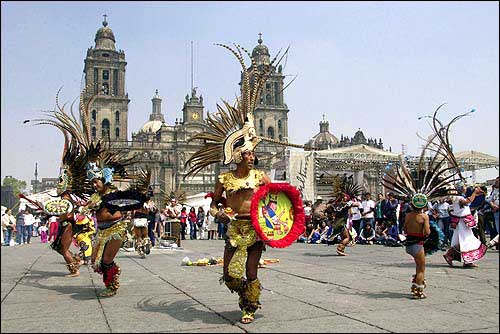
Dancers perform at the plaza of the Constitution in Mexico City on the 510th anniversary of America's discovery. Saturday's celebration was one of many where the traditional focus of Columbus Day has evolved into an event to commemorate the life of indigenous peoples.
“To me it’s a gathering of nations, a gathering of people to celebrate who we are,” said Anderson, a Chico resident. “There’s a lot of spiritual meaning behind this. It’s a healing place.”
Families meandered through the Indian Market on the outer edges of the powwow circle, picking up turquoise and silver bracelets, thick Indian blankets and whimsical dream catchers.
They ate frybread smothered in beans and cheese, listened to the mournful cry of the singers and watched as a parade of vividly clad dancers made their way into the circle.
“This is our way,” said Isaiah Branzuela, a singer and drummer who brought his family to the powwow from Los Gatos. “The drum is like the heartbeat of the earth. Without the drum, you have no music. Without the music, you have no dancing.”
It is that kind of deep understanding of Indian tradition that means the most to Philips, who said he is witnessing the beginning of an American Indian renaissance.
“This is like a revival,” Philips said. “It’s very important for us to pass this on to other generations.”