

World-class ukulele collection assembled in Rhode Island home
Cranston, R.I. ? It’s a long way from this blue-collar town to the warm sands of Waikiki.
Yet in a modest home on a quiet street, Sue Abbotson and her husband, Dave Wasser, have assembled a shrine to that most Hawaiian of instruments: the ukulele.
Abbotson and Wasser are part of a consortium of ukulele nuts who have assembled one of the world’s largest collections, including rare and historic “ukes” dating back to the dawn of the instrument.
They hope one day to find this stockpile a permanent home somewhere in a Ukulele Hall of Fame Museum, along with books, recordings, photographs and bits of Hawaiiana.
For now, Wasser and Abbotson’s house serves as the museum’s temporary home. The place is cluttered with the diminutive instruments, which line every wall, upstairs and down. Others are stacked in their cases in the dining room.
“It started as a joke,” says Abbotson. “I guess you could say now it’s become an obsession.”
The collection includes ukuleles made from cigar boxes and coconut shells. There are ukes painted with tropical landscapes, ukes made by high-end guitar makers like National and Martin, and “banjo ukes,” constructed and played like a banjo. There are even a few made by Manuel Nunes, the first master ukulele maker.
“They’ve got a wonderful collection of hard-to-find stuff,” says Jim Beloff, a former Billboard Magazine editor who has written a book on the ukulele. “You can tell that they’re just so deeply passionate about the instrument.”
Though its mellow tone conjures images of hula dancers and swaying palms, the ukulele actually has its roots on the Portuguese island of Madeira. A shipload of Madeiran settlers arrived in Hawaii in 1879, bringing along the braghuina, an instrument like a small guitar.
“The Hawaiians saw them playing it and they liked it,” Abbotson says.
The islanders made their own version using koa wood, and gave it a new name, which means “jumping flea.”
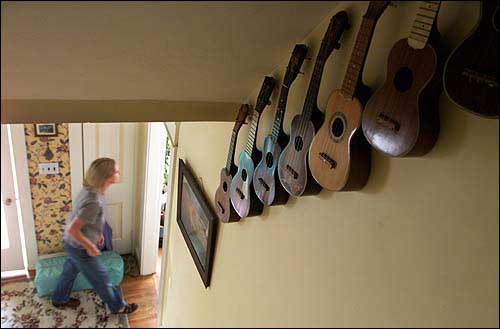
Sue Abbotson walks past the ukulele-lined stairwell in her Cranston, R.I., home. Abbotson and her husband, Dave Wasser, have assembled a shrine to the most Hawaiian of instruments, the ukulele.
Instrument’s comeback
The ukulele was featured in a Hawaiian exhibit at the 1915 Pan-Pacific Exposition in San Francisco and its popularity exploded on the mainland over the next several decades.
Roy Smeck, a legendary ambassador of the ukulele, hosted a popular radio program in the 1920s, and TV host Arthur Godfrey ushered in the instrument’s second golden age in the 1950s.
But the ukulele eventually faded into obscurity, except as a curiosity for tourists in Hawaii.
In recent years, however, it’s made a comeback. The billionaire financier Warren Buffett is said to play one before board meetings (to date he hasn’t responded to fund-raising overtures from museum organizers). Pearl Jam frontman Eddie Vedder is also a self-professed fan.
Though modern-day players have taken the instrument to new levels of technical mastery, Beloff claims he can teach anyone to play the ukulele in 60 seconds.
“It’s so easy,” Abbotson says. “It’s unthreatening. It’s small. And you only need a couple of chords to be able to play.”
Celebration of ukulele
Wasser, an avid guitarist, discovered the ukulele when a friend brought one on a 1990 road trip to Mardi Gras. Six months later, when he met his future wife while both were in graduate school at the University of Connecticut, he introduced himself: “Hi, I’m Dave. I play the ukulele.”
“Wherever he took me, all his friends played the ukulele,” says Abbotson, who had no choice but to join in.
They soon formed a band comprised entirely of ukulele players, touring the East Coast in the mid-1990s. Wasser and Abbotson got to know other aficionados, including Paul Syphers of Duxbury, Mass.
“He’s the guy who had the vision and the dream of the Ukulele Hall of Fame Museum,” Abbotson says.
In 1996, the group held its first annual “Ukulele Expo,” a celebration of the instrument and its history. Tiny Tim, the ’60s ukulele legend with the falsetto voice, made one of his last public appearances at the first Expo, where he suffered a heart attack onstage. He died two months later.
The following year, the museum acquired nonprofit status and the group began raising money to find it a permanent home.
Membership which requires a minimum donation of $24 has grown to 220 people. This year’s Expo was held last weekend in Montclair, N.J.
Abbotson writes a newsletter for members, and maintains the Web site and online museum shop. Currently, the organization makes just enough to stay afloat.
The opening of a permanent museum seems “a long way off,” Abbotson says. “But the dream is still very much alive.”