Eminem getting more respect
New York ? Until recently, it seemed only kids and music critics could love Eminem.
Politicians condemned his obscenity-laced and violent lyrics. Gay and women’s groups blasted him as a homophobe and misogynist. The Grammy-winning Detroit rapper had millions in album sales, but little love from mainstream America.
Well, he’s still not America’s sweetheart. But some of the vitriol directed at Eminem has diminished replaced not just by grudging respect, but by downright enthusiasm from some unlikely quarters.
“The guy is funny, smart and sometimes shocking,” author Stephen King gushed on his Web site. “Those are all things I look for in rock and roll.”
Randy Newman called Eminem a “kindred spirit.”
Writer Paul Slansky, a self-described middle-aged white guy, penned a New York Observer column titled, “Guess Who Thinks Eminem’s a Genius? Middle-Aged Me.” (He recently sounded the same theme in an essay on NPR.)
Whether the 30-year-old rapper has softened or America has just grown more accepting, “he has started to interest serious, grownup audiences that would have dismissed him as a teenage hip-hop phenomenon,” said New York Times critic Janet Maslin, who spent time with Eminem on the set of his upcoming movie, “8 Mile,” for Premiere magazine.
“He’s moved out of the youth ghetto.”
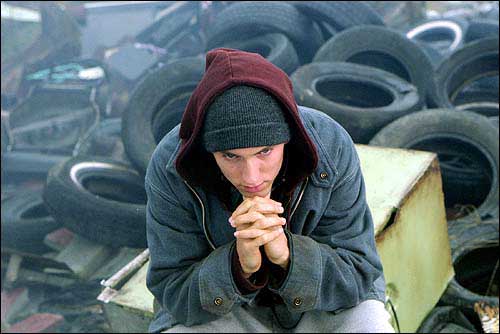
Eminem, portraying Jimmy Smith Jr. in this undated photo from Universal Studios, lives in hopes of getting
Interest in Eminem, whose real name is Marshall Mathers, should grow even more with the release next Friday of “8 Mile,” loosely based on his own troubled youth. The movie, directed by “L.A. Confidential’s” Curtis Hanson, and Eminem’s performance in it have received early critical acclaim.
“I think he’s just going to earn a lot of respect from people,” said Sia Michel, editor in chief at Spin magazine, which has Eminem on its December cover. “They’re going to see that he’s clearly a talented guy.”
Not that people doubted Eminem’s talent. His first disc, 1999’s “The Slim Shady LP,” was praised by critics for its twisted, demented but humorous wit, and earned him the first two of his five Grammys. He was the first white rapper since the Beastie Boys to enjoy street credibility and admiration from both blacks and whites.
But there was anger over his lyrics, which included violent fantasies about his estranged mother and his wife and anti-gay slurs. The late Billboard editor Timothy White dedicated one of his influential music columns to excoriating Eminem.
The rapper’s personal battles didn’t help. He was arrested twice in 2000 for weapons violations (he received probation). He went through an ugly divorce and custody battle over his young daughter, and was sued by his mother for defamation.
When “The Marshall Mathers LP,” which sold 8 million copies in the United States alone, was nominated for album of the year in 2001, there were howls of protest even more so when openly gay star Elton John agreed to perform with him at the Grammys ceremony.
Scott Seomin, entertainment director of the Gay and Lesbian Alliance Against Defamation, said that controversy helped Eminem’s career: “All of that attention has brought him more into the mainstream.”
Not everyone is raving, however. Star, a popular New York DJ on the hip-hop-R&B station Hot 97, speculated that many of Eminem’s new fans have never listened to the same kind of clever, angst-driven rhymes from black rappers such as DMX or Jay-Z.
“He’s not the best. That’s an insult to black people who have created this art form. It’s an insult to Spanish people … He’s just the Elvis Presley of hip-hop, and that’s it.”
Arts and Entertainment
Theatre Lawrence’s upcoming season to feature ‘On Golden Pond,’ ‘Pirates!’ and more

Watkins Museum to host traveling exhibition featuring photographs, narratives of the Underground Railroad
Local vendors can apply now for KU’s new monthly on-campus market, Jayhawk Fridays

UPCOMING EVENTS: Easter egg hunts, fee-waived pet adoptions and more

Join ‘the musicians and the artists and the collectors of crap’ at the East Lawrence Yart Sale this weekend