

Adoption creates confusion for rookie Fujita
RIVER FALLS, WIS. ? If Scott Fujita ever meets the woman who gave him up at birth, he knows just what he’ll tell her.
“I’m going to say thank you,” Fujita said. “I could have been an abortion statistic. It took a lot of courage for an 18-year-old girl to carry through with a pregnancy. My biological father was well, he just wasn’t around.”
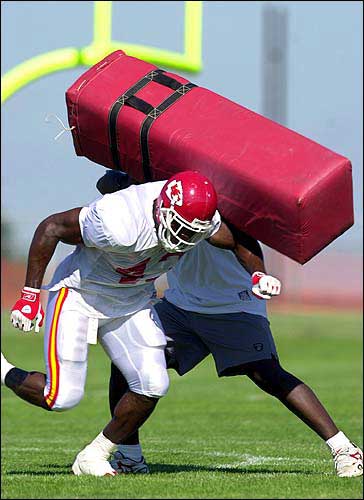
Kansas City fullback Omar Easy rushes past a tackling dummy wielded by running back coach James Saxon. Easy was participating in a passing drill Monday in River Falls, Wis.
Shortly after that teenage mother gave birth to a little boy in 1979, her baby caught his second huge break.
He was adopted by Rod and Helen Fujita, a Japanese-American couple who set him on a path that’s led him through college as an honored scholar-athlete and has now landed him in the NFL as a rookie linebacker for the Kansas City Chiefs.
“I’ve been blessed,” Fujita said. “I know I’ve been very, very lucky.”
An honor student at Cal-Berkley, he had already earned a master’s degree with straight-A’s when the Chiefs took him last spring in the fifth round of the draft.
“We like him a lot,” said coach Dick Vermeil. “He can move and he’s extremely bright. He can get to where he needs to get.”
He’s also got a good sense of humor. Growing up as a tall, sandy-haired Caucasian kid with a Japanese surname, a guy would need one.
“I can’t tell you how many times I’ve actually had to pull out my ID and prove who I am,” Fujita said. “I even had to do it a couple of times in high school when a substitute teacher would call the roll and not believe my name was Fujita. I never got mad. I just thought it was a joke.”
His adopted dad, a high school teacher in Ventura County, Calif., is 5-foot-6. An older adopted brother is 5-10.
“And me being 6-5 and 250 pounds, it was a real head-turner when I’d be out with my family,” Fujita said. “There have been a whole lot of funny experiences. And my name has been absolutely butchered every which way.
It’s pronounced, “Few-JEET-uh.”
“But I’ve been called fajita-pita, fujimora, you name it,” Fujita said with a laugh. “My adopted dad is Japanese and my adopted mother is Caucasian. I always swore up and down that I was Japanese because I felt like I was.”
He was also taught to be a proud American by an adopted father, who was born in one of the infamous internment camps set up in the hysteria following Pearl Harbor.
“My grandfather was my hero in life,” Fujita said. “He left a pregnant wife in a relocation camp and fought with the 442nd battalion for the United States in Italy. That’s some serious American pride. They were Americans through and through, and that’s been reflected in everybody in my family.”
Nagao Fujita, who died 15 years ago, was an officer with the 442nd. After the war, he came home and taught his son to speak English.
“They say it was the most highly decorated battalion in World War II,” Fujita said. “He was a great man. He spoke five languages and was the first bilingual attorney in Southern California. Even now people will come up to me and say, ‘Your grandfather helped me out of a bad situation 40 years ago.’ He makes me very proud.”
Even though he’s only a rookie, Fujita has thought ahead to a future when his playing days are over.
“In college I covered business, political science and education,” Fujita said. “And I’ve thought a lot about going to law school someday. I’ve tried to keep my options open. I should be all right.”
Fujita and wife Jaclyn are thinking about starting a family in a couple of years. So he may then try to contact his biological mother, “for a health history and things like that.”
“I only know a little about her,” Fujita said. “I know she was a good student and a good person. If I ever do meet her, I’ll say, ‘Hey, you were an 18-year-old kid. I appreciate your bravery.”‘
She would be in her 40s now. What kind of life has she had? Fujita can only guess. But if she ever finds out what kind of person her baby grew up to be, she’s certain to feel very proud. And very, very grateful to Rod and Helen Fujita.