Medium puts stock in ‘Mr. Magazine’
Journalism professor's expertise respected throughout industry
Oxford, Miss. ? Mention Samir Husni’s name to just about any editor or publisher in the magazine industry and you’ll likely hear something like, “oh, Mr. Magazine.”
It’s an apt nickname, judging by the overflowing stacks of periodicals on virtually every topic that are crammed into his office at the University of Mississippi’s journalism department.
“The only solution is more boxes,” the 49-year-old professor and magazine industry consultant says of his ever-expanding collection.
Husni owns about 20,000 first editions — and has given up counting the other magazines he has stashed away. Glossy magazines have taken over his den, his garage, his van. His mother still asks from time to time what she should do with all the magazines he began collecting as a boy in Lebanon.
“I really believe that magazines are the best reflector of our society,” he says. “I’m not really interested in ink and paper. It’s more the nature of the product itself.”
There are more than 6,000 magazines in publication and Husni says he normally spends at least $3,000 a month to purchase them, though many publishers send him complimentary copies. Every day, Husni scours newsstands for his most valuable commodity — the first edition.
In 2001, Husni tracked 702 new magazines in his annual guide, “Samir Husni’s Guide to New Consumer Magazines.”
Of those new starts, Husni says many never make it to the shelves and about 60 percent fail in their first year. Only one in 10 will publish for an entire decade.
“We’re seeing more new start-ups but we are also seeing a faster death rate,” Husni says.
From his perch, Husni has a unique view of the latest trends. Today’s readers, he says, want a “livable fantasy” — a post-Sept. 11 homey feeling — with tips on living more affordably. That, and anything of interest to teens.
Husni says today’s most successful magazines are adapting to the fast-paced “factoid age,” in which publishers give time-strapped readers more information in smaller bursts. Magazines are beginning to rely increasingly on so-called charticles — charts in articles.
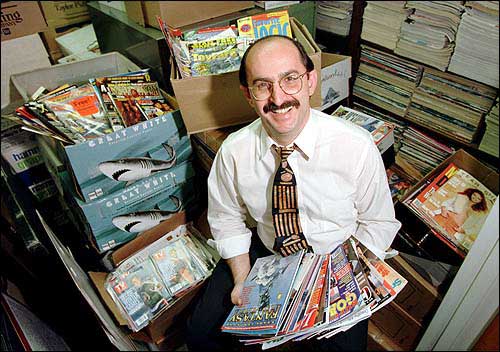
Samir Husni, known as Mr.
“First, you have to write for the eye,” Husni says. “You can’t just be descriptive. You really have to be inventive.”
Husni says many new magazines reflect a resurgence in “the simple life, the budget life.”
“Look at this new magazine Budget Living … their motto is to live rich, spend smart. It’s a real simple magazine,” he says.
That magazine’s publisher, Donald E. Welsh, says Husni’s criticism is as valuable as his praise.
“I’ve certainly made mistakes, and he’s told me, and he’s usually right,” says Welsh of his 35-year magazine career.
“The thing so extraordinary about Samir Husni is he really is an encyclopedia of the magazine industry,” Welsh says. “It’s amazing how many startups, so many regional magazines no one’s heard of, that he includes in his book.”
Cable Neuhaus, editor of Folio, a magazine about the industry, says Husni’s research is not earthshaking, but “his influence is that it gets out there in the … popular press and people read things they normally wouldn’t read about the industry.”
While those in the industry may disagree over Husni’s importance, they seem to agree his predictions are rarely wrong.
Although critics were touting Rosie O’Donnell’s now-defunct magazine, Rosie, last year, he said it would fail. And when Maxim was expected to flop in 1997, Husni lauded it.
“I just think that people feel like he’s got a grasp of what people want,” says Mike Hammer, executive editor of the now-2.4 million circulation men’s magazine.
“I’m known for my frankness of opinion,” Husni says. “Some people really love me for that, but people hate me for that.”
Arts and Entertainment

Events: Ballet, cinema, walking tours and lots of Easter egg hunts

Theatre Lawrence’s upcoming season to feature ‘On Golden Pond,’ ‘Pirates!’ and more

Watkins Museum to host traveling exhibition featuring photographs, narratives of the Underground Railroad

Local vendors can apply now for KU’s new monthly on-campus market, Jayhawk Fridays

UPCOMING EVENTS: Easter egg hunts, fee-waived pet adoptions and more