

Recreation may dry up with reservoirs
Reservoirs in northeast Kansas are at or near their lowest levels since they were built more than 30 years ago, leading officials to worry about the effects on water recreation this winter and next spring.
“It started causing some problems late last summer when in some places mud flats and stumps were uncovered by water,” said Jim Franz of the U.S. Army Corps of Engineers at Clinton Lake southwest of Lawrence.
In addition, water from some lakes is being used to maintain flows in the Kansas and Missouri rivers.
Clinton Lake is about a foot from the record low elevation it hit in August 1989, Franz said. Perry Lake northwest of Lawrence was at its lowest elevation since the lake began filling in 1969, lake operations manager Frank Funk said.
If water levels don’t return to normal by spring, boaters will have fewer areas to use on the lakes.
Already, hunters are seeing the effects in the number of waterfowl feeding at the lakes.
“Certain areas could become unsafe” for boaters in the spring, Funk said, adding that buoys already had been dropped in some troubled locations at Perry Lake.
Marinas at Perry have been extending their docks as the water recedes, Funk said.
“The problem could be getting in and out,” Funk said of boats docked at the marinas.
“We’re hoping and praying that we get some moisture this winter,” said Bob Best, owner of Lake Perry Yacht and Marina.
That hasn’t been a problem yet at Clinton Lake marina, general manager Lee Kennedy said. The docks haven’t been extended.
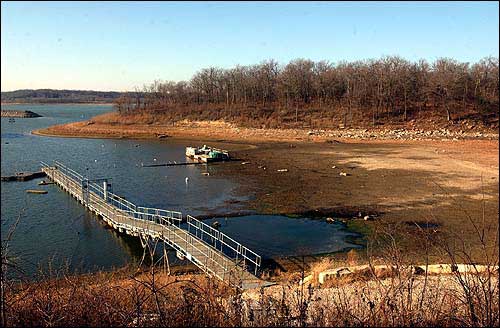
Docks sit in the mud, and ramps leading to the docks rest on rocks at Perry Lake. The reservoir is at its lowest elevation since the lake began filling in 1969, lake operations manager Frank Funk said.
The water level at the Clinton Marina is at 21 feet, which Kennedy said was about five feet below normal. It would take a drop of about eight feet before Kennedy said he would start to worry.
Receding water already has affected duck hunting at Clinton Lake, Franz said.
“We don’t have any water in weeds where the waterfowl would be,” he said.
Lawrence city officials are keeping an eye on Clinton Lake levels as well. The city draws some of its water out of the lake, and as the lake level decreases organic material in the water becomes harder to eliminate, said Chris Stewart, assistant director of water operations.
The increased organic material can cause taste and odor problems that sometimes show up in the water, Stewart said.
“It isn’t causing a problem now, but if the drought continues into the summer we’ll have to make some changes in our operations,” Stewart said. “I can’t say what those changes might be right now, but it’s something we’re thinking about.”
Other Kansas lakes also are suffering. Milford Lake is at the lowest recorded level since it began filling in 1967, according to the U.S. Geological Survey, which operates water-level recording equipment at the lake and gauges upstream on the Republican River.
During the past year the Corps of Engineers used Milford, Tuttle and Perry lakes to draw water for the Missouri River via the Kansas River so commercial navigation could be maintained, said Earl Lewis, manager of the hydrology and evaluation with the Kansas Water Office in Topeka.

 Kansas Water Office
In July three feet of water from each lake was taken into the river and in November 2.5 feet was taken again from Tuttle, Lewis said.
The navigation season ended on Nov. 27 and will not restart until March.
There is no commercial navigation on the Kansas River, but several water suppliers take water from the river, Lewis said. State and federal water officials watch the level to keep it from dropping below the intake pipes used by the suppliers, Lewis said.
The concern with the Kansas River is maintaining a flow that will not drastically decrease the river bed, Lewis said. Drought conditions reduce the amount of sediment that is carried by the water because it doesn’t flow as fast. Sediment that is moved off the river bed is less easily replaced, he said.
The reservoir system was built to maintain river flows and water supplies through the type of severe drought that struck the Midwest in the 1950s, Lewis said. The shrinking lake levels are where the drought’s effect is the most visible, he said.
“There is still a lot of water (in the lakes) even though it looks bad,” Lewis said.
Northeast Kansas is currently in a moderate drought, said Scott Dergan, meteorologist with the National Weather Service in Topeka. He said he didn’t know if there would be enough rain or snow during the winter and spring to replenish the lakes.
A weather event known as El Niño is expected to affect the area, making for a warmer and wetter winter than usual, Dergan said.
The last time El Niño affected winter weather here in 1997-1998, Northeast Kansas received about a half an inch above normal moisture, Dergan said.
“It’s too early to tell how it will affect spring,” he said.