Couples struggle with romantic roles in ‘Possession’
While some will assume filmmaker Neil LaBute is shying away from the cynical reputation perfected in his acutely disturbing “Your Friends & Neighbors” and “In the Company of Men,” his most recent effort still embraces comparable themes.
LaBute’s customary subject of how men and women seem destined to rip each other apart is fully displayed in “Possession” in two different time zones, no less. And his sense of cold detachment feels at home in the Victorian era, where even the most erotic maneuvers are hampered by restraint.
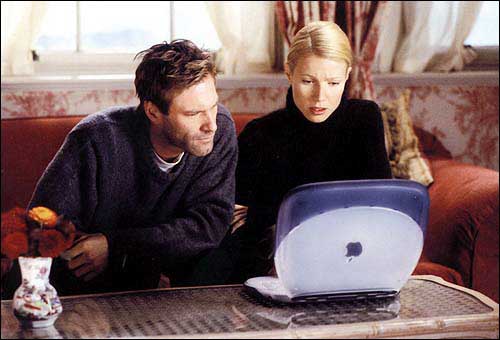
Aaron Eckhart and Gwyneth Paltrow play literary experts in the romantic detective story Possession.
Adapted from the celebrated novel by A.S. Byatt, “Possession” concerns the attempt of sleuthing modern-day scholars to uncover a steamy connection between two iconic poets of the 1800s.
Aaron Eckhart who has appeared in all of LaBute’s features stars as Roland Michell, an American academic working in London to research the life of Randolph Henry Ash (Jeremy Northam). Roland uncovers evidence to suggest that the (fictional) poet laureate to Queen Victoria may have had an affair with Christabel LaMotte (Jennifer Ehle), who was herself a revered poet, proto-feminist and reputed lesbian.
Roland seeks the expertise of Maud Bailey (Gwyneth Paltrow), a literary expert on LaMotte and her blood relative thrice removed. Convinced that Ash may not have been so steadfastly faithful to his wife and that LaMotte might have been pulling an “Anne Heche,” the modern pair starts playing detective. As they dig up the truth, they also begin to “investigate” each other.
For a filmmaker so steeped in latter-day America, LaBute has little trouble orchestrating a period piece composed solely in England. LaBute and production designer Luciana Arrighi (“Sense and Sensibility”) do a fine job implementing the era’s detail. From the English countryside to bustling seaside towns, their centuries-old landscape is always credible.
At times, LaBute (who co-wrote the screenplay) uses John Sayles’ “Lone Star” trick of having both the past and present blend together through unbroken moves of the camera. For instance, in “Possessed” a shot of the contemporary researchers pans over to reveal a bygone steam engine coursing through the hills. This not only prevents the transitions from being jarring, but it also supplies tangible visuals of how the relationships of both couples often echo each other.
Although the inanimate objects look authentic, those inhabiting the frame are not always so lucky.
The romance between Paltrow and Eckhart never comes across as genuine, probably because their pairing seems so inescapably formulaic. When hasn’t a repressed Brit met a candid American and not ended up in bed together by the second act?
These actors deliver sufficient performances (particularly Eckhart, who has a way with the offhand remark), but they each radiate MOVIE STAR. Their conversations just sound like time-passers until she can let her hair down and he can take his shirt off.
| Rating: (PG-13)
Adult Themes1 hour, 42 minutesSouthwind Twelve, 3433 Iowa |
Literary researchers all over the world must be amused at how little their own physical attributes measure up to cinematic idealism.
Does that mean the movie should be populated with ugly people? No. But at least the leads could be depicted as dorky or annoying or something that would detract from the Venus and Adonis-like countenances of these “bookworms.”
Yet what is most surprising is the lack of passion contained in the pairing of Northam and Ehle. These are two quality character actors who seem born to take part in period roles. (Northam was recently seen as the ivory-tickling matinee idol in “Gosford Park” and Ehle was the Hungarian lover in “Sunshine.”) But when partnered they only generate a contrived chemistry. Their falling in love seems based more on a preordained plot device than actual attraction.
The movie’s strongest scenes occur in the epilogue, when what turns out to be a stream of predictable revelations veers off in a new direction. The final shot is quite devastating it exemplifies a barrage of miscommunication coming full cycle. This provides Northam with his best onscreen moment, as his face registers how the whole arc of the story has gained new resonance.
It’s a case of too little too late, however. The emotional passion evoked in the wrap-up isn’t spread liberally enough throughout the rest of the picture. If it had been, LaBute would be culpable for crafting a grand romantic drama rather than a mildly charming diversion.
Arts and Entertainment

Events: Ballet, cinema, walking tours and lots of Easter egg hunts

Theatre Lawrence’s upcoming season to feature ‘On Golden Pond,’ ‘Pirates!’ and more

Watkins Museum to host traveling exhibition featuring photographs, narratives of the Underground Railroad

Local vendors can apply now for KU’s new monthly on-campus market, Jayhawk Fridays

UPCOMING EVENTS: Easter egg hunts, fee-waived pet adoptions and more