

Pure greed may have doomed Enron
Hiding debt wasn't only reason for partnerships
Houston ? The primary motive for creating Enron’s complex web of partnerships was thought to be to hide the company’s debt, keep salaries high and make its stock ever more valuable.
But new revelations by investigators and insider Michael Kopper indicate that whole deals may have been structured more to let executives skim money than to dress up Enron’s books.
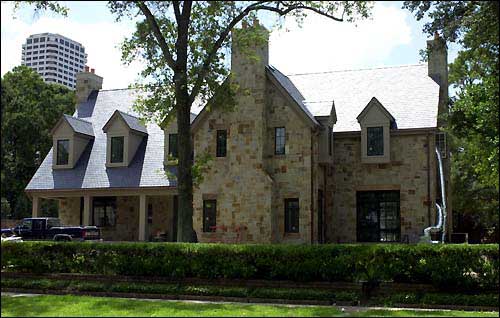
In River Oaks, Houston's wealthiest neighborhood, workmen continue Thursday to finish former Enron executive Andrew Fastow's new five-bedroom stone house worth more than million. In the background is the exclusive high-rise where former Enron chairman Kenneth Lay lives in a .1 million penthouse.
“Some people still had a little bit of hope that maybe they were just skirting the law and weren’t as arrogant and greedy as they really were,” said Rod Jordan, 64, one of thousands laid off last year when Enron crashed. “That hope is gone now.”
Kopper, the first former Enron executive to plead guilty to crimes related to the company’s failure, admitted to creating partnerships designed to enrich himself, his former boss Andrew Fastow and others at Enron at the expense of the company and its shareholders.
He admitted to money laundering and conspiracy to commit wire fraud in three partnership schemes designed to look like legitimate business deals. He said friends, selected Enron workers and members of Fastow’s family stepped up as investors and, using loans from Fastow or Kopper, put up money to make the partnerships appear independent of Enron.
The partnerships then did deals with Enron that generated millions of dollars. Kopper kept some profits and generated massive fees for handling the deals. He also said he funneled money back to Fastow and his family as well as the investors.
Kopper worked for Enron from 1994 to July last year, when he quit to run one of Fastow’s partnerships. Enron pushed Fastow out in October last year after acknowledging he raked in more than $30 million from partnerships.
“There was an arrangement between myself and the Enron CFO whereby I did take some of the proceeds which I received from managing and running that partnership and passed them on to he and his family,” Kopper said of a structure called Chewco created in 1997.
Kopper, a 37-year-old former banker with degrees from Duke University and the London School of Economics, lived well on the millions he pocketed from those dealings in addition to $3.63 million in salary, bonuses, restricted stock and other payments in the year before Enron’s collapse.
The native Long Islander and his domestic partner, William Dodson, live in a $1.4 million marble and stucco four-bedroom house. The pair have four BMWs registered in their names.
Kopper’s house is barely a block away from the high-rise where Lay lives in a $7.1 million penthouse. A few blocks away in River Oaks, Houston’s wealthiest neighborhood, workers continued Thursday to finish Fastow’s new five-bedroom stone house worth more than $2 million.