

Wiccans, pagans draw on natural world for faith
Staying attuned to seasonal cycles inspires religion
Kacey Carlson wants to set the record straight.
Wiccans don’t worship Satan.
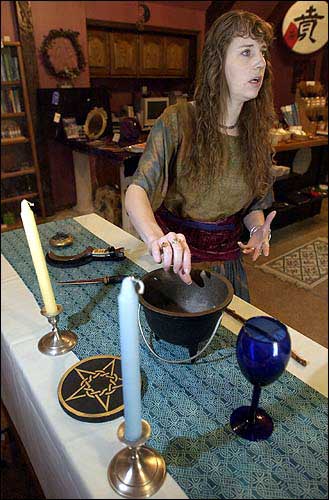
Kacey Carlson explains the significance of the ritual objects a Wiccan would normally place on an altar. The objects include candles, a pentacle, a chalice, a cauldron and two ceremonial blades, called an athame and a bolline.
They don’t sacrifice animals and babies in bizarre rituals.
And they don’t practice “black magic,” whatever that is.
“I’ve never met a Satanist. I don’t think there are any over 14. If Satanism exists at all, it is a really good adolescent rebellion against Christianity,” said Carlson, 36, co-owner of The Good Earth Mother Alchemy Shop, 803 Vt.
Carlson knows a few things about the Wiccan religion. After all, she’s a high priestess of the faith and leads a coven of about 30 believers, called witches, in the Lawrence area.
She swears there’s nothing dark and creepy going on among those who practice Wicca.
Rather, Carlson says, it’s all about revering nature, staying attuned to the Earth’s seasonal cycles and using folk magic or “magick” to channel the energy of the divine for strength and healing.
The problem is that Wiccans, and pagans in general, have gotten a bad rap for centuries. That’s led to popular misconceptions about their religion, as well as blatant falsehoods.
“It started when Christianity decided it was the only right religion. Propaganda was spread about pagan belief systems and how bad they are,” Carlson said.
“The devil, for instance, is a Christian concept. We don’t even acknowledge that there is a bad guy (in the universe).”
Nor do Wiccans believe in sin, or heaven and hell.
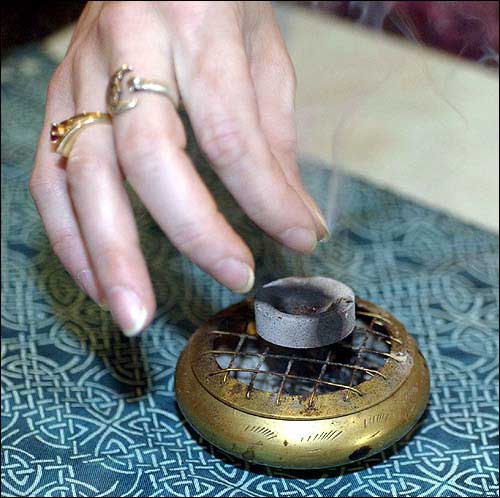
A censer used for burning incense, charcoal and spices is common on a Wiccan altar. The natural elements of fire and air are represented by the lighting of the censer.
The portrayal of witchcraft on television and in movies these days doesn’t help matters any, according to Carlson.
TV shows like “Sabrina, the Teenage Witch” on the WB network trivialize sacred aspects of Wiccan belief, while shock fests like the 1999 movie “The Blair Witch Project” portray witchcraft as demonic and horrifying.
“It’s got nothing to do with our religion,” Carlson said of “Blair Witch Project,” which grossed $140.5 million in domestic theaters. “We don’t need any more bad publicity.”
Gods and goddesses
Carlson isn’t the only Wiccan or pagan in these parts.
KC Pagan Pride Day 2002, a community festival celebrating its fifth year, will be Aug. 24 in Lenexa’s Shawnee Mission Park, and event organizers expect about 250 people from the region to attend.
Pagans of every stripe will be there: Wiccans, Druids, Asatru (believers in Nordic paganism) and those who subscribe to forms of American Indian spirituality.
While the particular beliefs of people in these faith groups may vary, festival participants could best be described as followers of Earth-based religions that perceive many faces of the divine in the natural world.
They’re pantheists, following a doctrine that God and the laws and forces of nature are one.
Pagans typically believe in a single, universal source of energy, but also worship gods and goddesses as representing different aspects of this transcendent force.
Everybody is invited to attend KC Pagan Pride Day, regardless of his or her beliefs.
“The people that come (to the festival) have always been friendly, and I believe Christians would be made to feel welcome. It’s about educating people. Yes, it has a very pagan slant, but the main focus is community,” said the Rev. Duane Marshall, event coordinator.
Marshall is a legal minister recognized by the state of Kansas, ordained through the Church of the Mystic Moon, a coven in Kansas City, Kan.
Marshall, 31, has been a Wiccan for about six years. But he was raised in the Assembly of God faith.
He says his adopted religion is often misunderstood.
“We don’t worship the devil, I’m not out to get your children it’s the standard deal,” he said.
“Me and my dad have had discussions. He’s told me, ‘I don’t know what this pagan thing is, but I don’t approve.’ I believe it’s out of fear. A lot of it comes from die-hard (Christian) fundamentalism.”
Nothing evil about Oct. 31
Carlson, a Wiccan since 1987, wishes more people understood that her religion is peaceful and individualistic.
She notes the Wiccan creed: “An it harm none, do as thou wilt.”
Wiccans also believe that everything a person does returns to him or her threefold. So they’re very careful when it comes to what they wish for.
Nor do they proselytize, trying to recruit potential Wiccans.
“We believe you’re either born this way or not. People (who are Wiccans) express this idea that they’ve come home,” Carlson said.
And Carlson wants people to understand that there’s nothing sinister or evil about Halloween, known to witches as Samhain (pronounced “sowen”).
“That’s our New Year. It’s not scary. What we celebrate is that the time at that point is when the veil between the (physical and spiritual) worlds is thinnest. It’s an ancestor feast,” Carlson said.