Where do we draw the line?
Politics need not be our only guide
Redistricting has been called a political blood sport, and in Kansas it’s wounding the state.
The once-a-decade process of using new federal population statistics to redraw boundaries for legislative and congressional districts sounds about as dry as a summer breeze.
But the new district maps pack a gale-force political punch. Where the lines are drawn help determine who will go to the Legislature or Congress for the next 10 years, or even longer. It may even determine which party controls Congress.
“This is the process by which lawmakers choose their constituents before their constituents choose them,” said Robert Richie, executive director of the Center for Voting and Democracy, a Maryland-based nonprofit organization that promotes voter turnout and fair political representation.
The Kansas Legislature, which is in charge of redistricting, has focused almost solely on one factor in redrawing congressional lines: politics sometimes raw and ugly, which has also affected work on other crucial issues, such as the worst budget crisis in decades.
And when politics becomes the major consideration in redistricting, the city of Lawrence, which is represented by the state’s only Democrat in Congress, gets pushed around big time in the Republican-dominated Legislature.
The partisan squabbles have only been surpassed by the intra-party fighting between conservative and moderate Republicans.
But it doesn’t have to be that way.
A two-hour session with the state’s redistricting software shows dividing Kansas into four districts of equal population can be done in an infinite number of ways, using an infinite number of factors.
And experts can lay down those lines without regard to politics. That is what is happening in nearby Iowa.
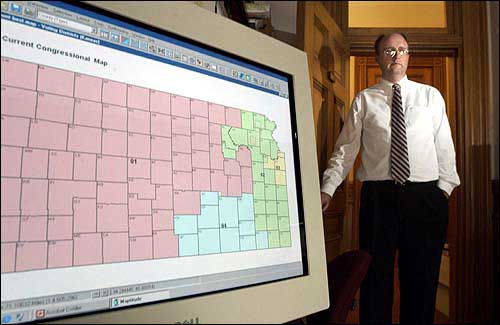
Rob Mealy is the Senate Republican redistricting assistant and map maker.
Crunch time
Legislators will return May 1 to the Capitol for an overtime session that will include approving a new congressional map.
Currently, most of Lawrence is in the 3rd Congressional District, along with Johnson and Wyandotte counties, which comprise the Kansas City area. And that is where Lawrence officials say they want to stay, citing the city’s economic ties with the Kansas City area and education links through Kansas University campuses in Johnson and Wyandotte counties.
The district is represented by U.S. Rep. Dennis Moore, a centrist Democrat who has managed to get elected in a Republican district mainly because he has picked up moderate Republican votes against conservative Republican challengers. Lawrence is seen as a place suited to Moore’s politics.
But because of rapid growth in Lawrence and Johnson County, the 3rd needs to lose about 60,000 people so that the other districts will remain even.
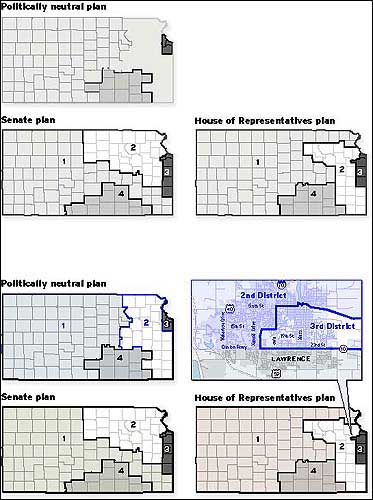
Under a map passed by the state House, Lawrence would be split down Iowa street, with the east side remaining in the 3rd District and the west side becoming part of the neighboring 2nd District, represented by conservative Republican Jim Ryun.
The Senate chose to put all of Lawrence and Douglas County in the 2nd District, split the 12-county southeast Kansas area between four districts, and push the 2nd farther west into Republican rich counties.
It’s a map Ryun wanted and 21 Republicans in the 40-member Senate delivered.
Burdett Loomis, a Kansas University political science professor, said the map with its “tongue licking the southeast corner of the state” is absurd. “They ought to be ashamed of themselves for drawing a map like that,” he said.
It was drawn under pressure from national Republican officials to give Ryun and U.S. Rep. Todd Tiahrt, R-Wichita, safer districts for winning re-election, Loomis said.
“For the White House, Ryun is an automatic vote. He is a no-maintenance guy, so it’s worth a couple of phone calls,” Loomis said.
Ryun spokesman Chad Hayward said Ryun preferred the plan because it keeps Fort Riley and Fort Leavenworth in the district, which Ryun has said is important since he is a member of the House Armed Services Committee.
Both proposals have created a storm of controversy in Lawrence and southeast Kansas, with opponents crying that political considerations were behind the maps.
The Iowa way
In Iowa, redistricting is the process of dividing the state equally among its five congressional districts, keeping the districts as compact as possible and not cutting through county lines.
In Iowa it is illegal for state officials to take into account political factors such as where incumbents live and the political party composition of the population.


And in Iowa, the maps are drawn by a nonpartisan group of bureaucrats who work for the Legislative Service Bureau, which is the research and bill-drafting agency for the Iowa Legislature.
The redistricting plans for Congress, the state House and state Senate are put together, and lawmakers can either accept or reject the package, but if they reject it, they must say what they want changed. One of the few valid reasons for wanting a change is to improve the deviation in the population of the districts.
Politics is out of it until they vote on the plan. And even if they vote down a plan, “the reasons they give can’t be political in nature,” said Gary Rudicil, a senior computer systems analyst who works on the redistricting process in Iowa.
If the Legislature rejects the package three times, then it must write its own plan. But since 1980 when Iowa started this process, it has never reached that point.
Under the Iowa plan, incumbent congressmen have moved to different districts to run for office after having been placed in the same district with another incumbent.
Using software that Kansas mapmakers use, it is possible to draw districts without any regard to how many registered voters exist in a certain district, though maps that are considered by the Kansas Legislature almost always include this information.
Should Kansas change?
Richie, with the voter organization, said he hopes more states move toward the Iowa model, which is unique in the country. The political wrangling in Kansas is not uncommon in other states, he said. In his home state of Maryland, where Democrats control the process, he said Democrats are trying to draw district lines to cause the defeat of a middle-of-the road Republican.
“Nationally, there’s a lot of incumbent protection going on. Politicians are ganging up against the voters and shutting them out of the process,” he said.
Even Loomis, who appreciates the rough-and-tumble of politics, said what is happening in the Kansas Legislature this year may show that reform is needed.
“Part of me thinks, hey, this is a political process. But the results this year were not very good. It’s certainly worth looking at some kind of less politicized process,” Loomis said.
Senate President Dave Kerr, R-Hutchinson, who has been at the center of redistricting battles, said he is ready to explore alternatives, though he said he doesn’t agree entirely with the Iowa process.
“We need to find a different and better mechanism for achieving reapportionment 10 years from now because I would not want future legislatures to go through the same thing that we have gone through this year. It’s very difficult to keep people together when they are voting against one another’s interest,” he said.
Tim Holverson, an Iowa-native Lawrence Chamber of Commerce official who has been bird-dogging redistricting for more than a year, said Kansas officials should consider a change.
“For some reason, Kansas has chosen to politicize redistricting. It’s best suited for serving the political interests of elected officials or those who aspire to higher office,” Holverson said.
He said the process is a disservice to the state because it tangles up legislators for months in a political battle that leaves bad feelings on other issues.
“There are so many bigger issues that they should be worrying about rather than someone else’s political future. Let someone else do it and be done with it,” he said.
City Government

Rising Rates: A three-part investigative series examines why Lawrence water and sewer bills have been soaring
Some leaders are now stating a new reason for why Lawrence’s utility rates are soaring: The city didn’t grow enough

Lawrence City Commission could start the process of finding a construction manager for new fire station

Lawrence is charging water, sewer customers a special tax not required by state or city law

Lawrence housing market strains residents as development fails to keep up, city’s affordable housing study finds