

Exhibit at Massachusetts museum rolls out history of the bicycle
SPRINGFIELD, MASS. ? If it weren’t part of a bicycle exhibit, the draisine might be mistaken for a piece of useless furniture instead of the precursor to modern two-wheelers.
Its steering post looks like a fancy table leg. Its frame is a plank of wood suspended over two wooden wheels. No pedals needed: This contraption, marketed to upwardly mobile Germans, was kick-propelled.
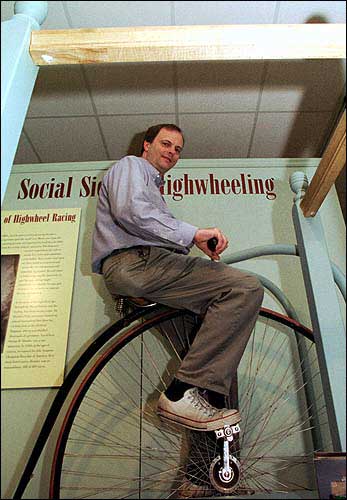
Richard Sanderson, curator of physical science at the Museum of Science in Springfield, Mass., gets aboard a highwheeler bicycle in an interactive area of the museum's exhibit on bicycling history. The wheel is about 54 inches high.
No wonder it was a commercial flop in the 1800s.
“It looked silly, it wore out the heels on your shoes and you’d lose your balance all the time,” said David Herlihy, a bicycle historian whose research led to the creation of “The Bicycle Takes Off: From Boneshaker to Boom,” which runs at the Springfield Science Museum through June.
“But it made a huge first step in the quest for a mechanical horse,” he said.
Models of the ill-fated draisine, along with its more popular offspring like the boneshaker and highwheeler, show the evolution of the bicycle from 1817 to 1900.
“For years, there was a desire to have a human-powered vehicle,” said Richard Sanderson, a curator at the science museum. “The early bicycles were the early results of that.”
But it took five decades from the 1819 blowout of the draisine, named for its inventor Karl von Drais, to the design of the wooden boneshaker before bicycle production really caught on.
Pedaling power
With two small carriage wheels and pedals attached directly to the front axle, the rickety and aptly named boneshaker first hit the streets of Paris in 1863. Its creator, Pierre Lallement, soon immigrated to Ansonia, Conn., where he received the world’s first bicycle patent.
Before long, Lallement was cranking out sturdier bikes made of iron.
At the same time, two French brothers began manufacturing machines that closely resembled Lallement’s design. By 1868, their bicycles were being exported to England, which soon emerged as the world’s leader in bicycle production.
As the bicycle industry faltered in France and America, the British pulled ahead. In 1870, Britain transformed the clunky boneshaker into more stylized vehicles with rubber tires and a new wheel configuration.
The new design gave way to the highwheelers: awkward-looking bicycles with 4-foot-tall front wheels and tiny rear wheels. The pedals were still connected to the front wheel, and the better gear ratio created by the larger wheel meant riders could go farther with less effort.
The popularity of the highwheeler in England made its way to America, where bicycle tracks and racing clubs began popping up around the country. By 1883, Springfield was host to some of America’s biggest and best-attended bicycle races and exhibits.
A machine for the masses
“The Bicycle Takes Off” gives a nod to the western Massachusetts city, showing off a case full of medals won by George Hendee, a Springfield-born highwheeler racer who started the Indian Motocycle Manufacturing Co. in 1901.
As popular as they were in the United States, the highwheelers were still machines for the wealthy.
Mark Twain’s 52-inch model, which is part of the exhibit, cost the writer $142.50 in 1886. That was about three months’ wages for the typical American worker at the time.
With more people wanting to take up the sport, but either not wealthy enough or too scared to brave the highwheeler, England again led the trend in a new bicycle design.
In 1884, the chain-driven Rover was made in England. The look was criticized for being too similar to the boneshaker. However, its safer design and increased speed set the style for today’s bicycle.
By the early 1890s, the bikes were outfitted with pneumatic tires, offering a softer ride.
Between 1893 and 1898, the bicycle industry was one of the largest in the United States. In 1897 alone, about 300 firms across the country produced more than 2 million bikes.
“That’s when the bicycle really became an everyday part of life,” Herlihy said. “The price plummeted, and you’ve got the result people were looking for all along: a self-propelled vehicle that was easy to use and affordable.”